Connect with us

News

Nuclear startup Deep Fission says it’s going public, again, and I have questions

info

Published

on

Image 2.jpg

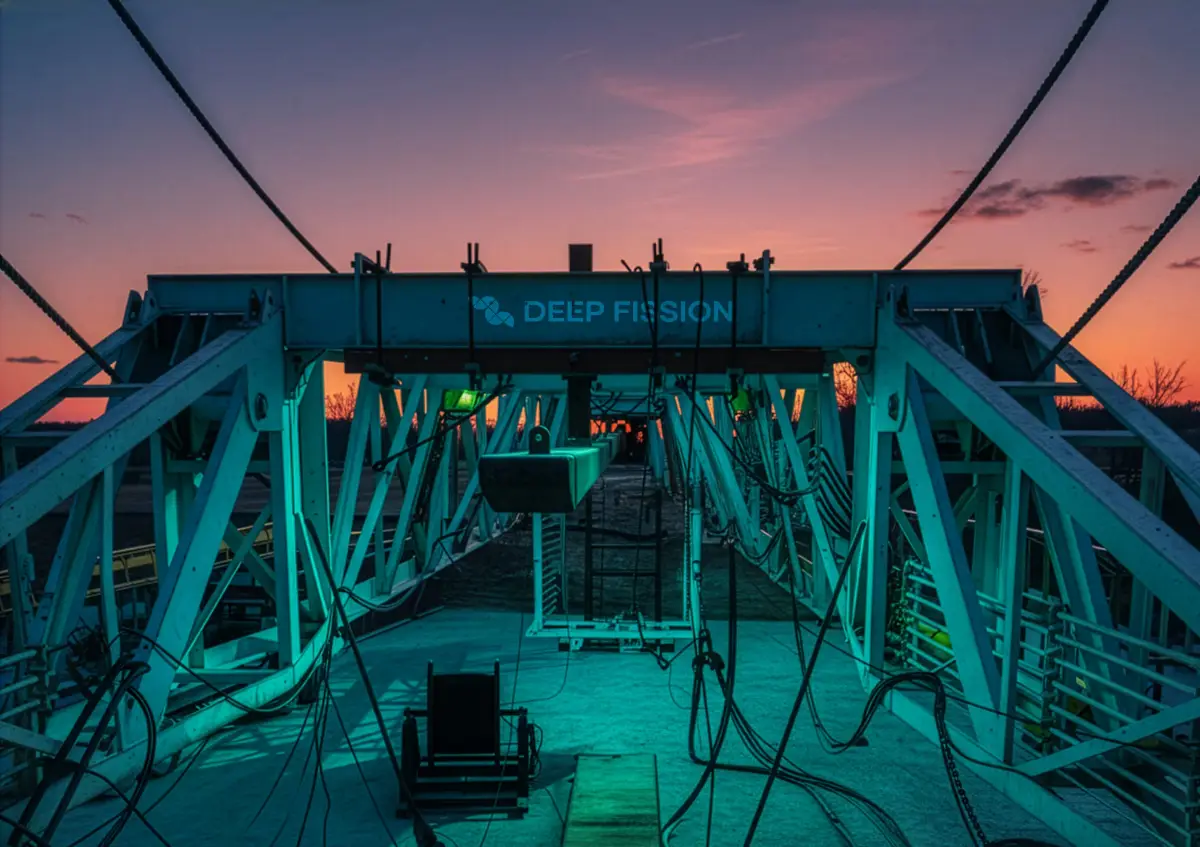
One news headline this week had a whiff of déjà vu about it. Nuclear startup Deep Fission announced that it was going public, hoping to garner investor support to build subterranean reactors to power AI data centers.

Wait, didn’t I already write that story? I could have sworn that I did. 

Oh right, I did. Last September, Deep Fission said that it had gone public via a reverse merger with Surfside Acquisition, a Delaware shell company, a transaction in which a private company acquires an existing publicly listed entity to gain a stock market listing — raising $30 million in a concurrent private placement at $3 a share. Now it’s seeking $157 million in a Nasdaq IPO at $24 to $26 a share. You can see my confusion.

Turns out the previous public listing was public in name only. The reverse merger with Surfside was completed, making Deep Fission a reporting company with SEC obligations, but its stock never actually traded. The company had said it intended to list on the OTCQB, a marketplace for developing companies that don’t meet the listing requirements of major exchanges like the NYSE or Nasdaq. But searches for Deep Fission on OTCQB don’t return any results, and the company, in its S-1, denied that its stock had ever been publicly traded.

In response to questions from TechCrunch, Deep Fission declined to comment, citing the quiet period before its IPO.

Deep Fission’s new public offering on Nasdaq is following the more traditional IPO route, with an offering that would value the company at up to $1.66 billion. It’s a sizable figure for a company that one year ago was struggling to raise a $15 million funding round.

Stranger still, the picture painted in the S-1 filed on May 20 is arguably bleaker than the one outlined in the December filing with the SEC. Its timeline for turning on its first reactor has slipped. Further, back in December, it had hoped to achieve criticality — the point at which a nuclear chain reaction becomes self-sustaining — by July 2026. Now, it won’t provide an estimate. 

Deep Fission does point out that it is drilling a test well. It has also lost a lot of money. 

One thing that hasn’t changed: The new S-1 statement contains the same “going concern” warning present in December. If Deep Fission doesn’t complete the IPO, it could run out of money in the next 12 months.

In fact, the startup’s financial position has worsened in recent months. As of March, its deficit had grown to $88.1 million from $56.2 million. In the last month and a half, the company’s cash and cash equivalents declined by $6.4 million, or about 7%.

On the technical front, Deep Fission says it is now prioritizing drilling, perhaps a tacit admission that making holes in the ground isn’t as easy as it sounds. 

The company says it started drilling the first of three test wells in March. The well will be used to collect data “up to 6,000 feet deep.” At eight inches in diameter, it’s quite a bit smaller than will be needed at commercial scale. 

The challenges in moving from a test well to commercial scale are likely to be significant. Deep Fission says it will need boreholes 30 to 50 inches in diameter and a mile deep, though it hasn’t settled on a specific dimension yet. Even at the low end, its boreholes will be larger than what’s typically used in the oil and gas industry. And until Deep Fission knows how large of a hole it can drill, it’ll have a hard time finalizing its reactor design.

So what has changed since December that would spur a bigger offering at a nine-figure valuation? The company did receive an $80 million equity investment, including $20 million from data center developer Blue Owl, which also signed a non-binding MOU for future power plants. Still, that wasn’t enough to stave off the going concern warning. It’s possible that Deep Fission is sitting on some positive information that it omitted from the S-1, though that’s hard to believe given what’s riding on the IPO.

It’s more likely that the company and its backers are seeking to capitalize on investor excitement over fission power. Just last month, nuclear fission startup X-energy went public in an upsized IPO. But unlike Deep Fission, X-energy is generating revenue and is significantly farther along in the Nuclear Regulatory Commission’s licensing process — a contrast that serves as a useful reminder that in a sector where enthusiasm can run well ahead of technical and regulatory reality, valuation and progress aren’t the same thing.

It isn’t exactly clear what factors are driving Deep Fission toward its IPO, but technological or commercial progress doesn’t seem to be among them.

When you purchase through links in our articles, we may earn a small commission. This doesn’t affect our editorial independence.

Continue Reading
Click to comment

Leave a Reply

Your email address will not be published. Required fields are marked *

Business

UK launches £15 million initiative to boost investment, deepen reforms in Nigeria

info

Published

on

By

British High Commission in Lagos.jpg

MTN ADVERT

The UK has launched a £15 million initiative, aimed at attracting private investment, supporting economic reforms and speeding up Nigeria’s long-term economic transformation.

The initiative was announced during a recent visit by the UK Minister for Africa and International Development, Jenny Chapman, according to a statement issued by the British High Commission on Friday.

The programme, announced during Ms Chapman’s meeting with Taiwo Oyedele, the minister of finance and coordinating minister of the economy, will run for three years. It plans to deepen ongoing reforms, strengthen the private sector and unlock new sources of capital for economic growth.

“The UK-Nigeria Growth Programme helps bring this partnership to life by supporting capital market development, technology investment, small businesses and technical assistance,” Mr Oyedele said.

“We look forward to seeing these opportunities deliver lasting benefits and drive progress for both countries.”

PT WHATSAPP CHANNEL

The new programme comes as Nigeria and the UK look to expand economic cooperation beyond traditional development assistance towards investment-led growth.

Alongside the initiative, the UK announced expanded synergy in Nigeria’s digital economy through the SPRIRET initiative under its Digital Access Programme.

The initiative will enhance governance reforms across five states and help reduce regulatory barriers constraining investment in broadband infrastructure, digital services, and emerging technologies.

The British High Commission said the intervention is expected to encourage greater private-sector participation and improve the business environment for technology-driven investments.

Trade, finance partnerships

During the visit, Ms Chapman met Minister of Industry, Trade and Investment Jumoke Oduwole to review the progress so far recorded under the Enhanced Trade and Investment Partnership between both countries.

Discussions centred on scaling up Nigeria’s exports through the UK’s Developing Countries Trading Scheme, strengthening cooperation in the fintech sector, and expanding capital market linkages.

READ ALSO: Democracy Day: Tinubu says economic reforms are boosting healthcare funding

The engagement reflects growing efforts by the two countries to deepen trade and investment ties as Nigeria seeks to diversify its economy and attract foreign capital.

According to the statement, British International Investment, the UK’s development finance institution, has invested roughly $800 million in sectors including agriculture, manufacturing and renewable energy in Nigeria.

The UK government is also supporting the rehabilitation and expansion of Lagos ports through financing valued at about $1 billion.

The country remains an important destination for Nigerian businesses seeking international expansion, with seven Nigerian banks now operating there.


Continue Reading

News

SpaceX shares soar 30% midday, vaulting it to top six most valuable U.S. companies

info

Published

on

By

Spacexipo nasdaq.jpg

SpaceX lifted off on its first day as a public company, immediately jumping to $150 a share after it began trading on the Nasdaq, around 11% higher than the $135 figure at which it officially priced its IPO on Thursday. The stock price reached as high as $176 in midday trading, pushing the company’s market capitalization to nearly $2.3 trillion, making SpaceX the sixth most valuable public company in the U.S.

The stock pop isn’t a surprise. The company’s IPO was oversubscribed by 4x, according to Bloomberg, meaning many institutional investors didn’t receive allocations and are likely buying shares on the open market.

The demand for SpaceX is also a function of its small float, with only about 4% of shares available for public trading, while early investors and employees hold the rest. SpaceX also successfully lobbied a number of indexes (like the Nasdaq 100) to change their inclusion rules. The company will now join those indexes in a matter of days, not months, increasing demand for SpaceX stock before other large institutions and funds start automatically buying it.

Robinhood said it has seen “record-breaking” traffic on its trading platform Friday in the hours after SpaceX’s historic public markets debut.

The debut is also one of the largest windfalls in the history of venture capital. The returns to Founders Fund, which invested $600 million in the company and owns a 3% stake, are estimated at more than $50 billion at the IPO price of $135, according to Bloomberg. Meanwhile, Andreessen Horowitz’s stake is worth more than $10 billion, and Sequoia’s is valued at over $20 billion.

Debuting at $150 made founder Elon Musk the world’s first trillionaire. The New York Times has reported that around 4,400 current and former SpaceX employees will become millionaires, while around 400 will become centimillionaires.

The original version of this article was published at 11 am ET. The article has been updated with a new share price and other information.

When you purchase through links in our articles, we may earn a small commission. This doesn’t affect our editorial independence.

Continue Reading

Trending