Connect with us

News

NDC: Peter Obi present when motion for party supremacy was passed – Dickson

info

Published

on

Seriake Dickson 1.jpg

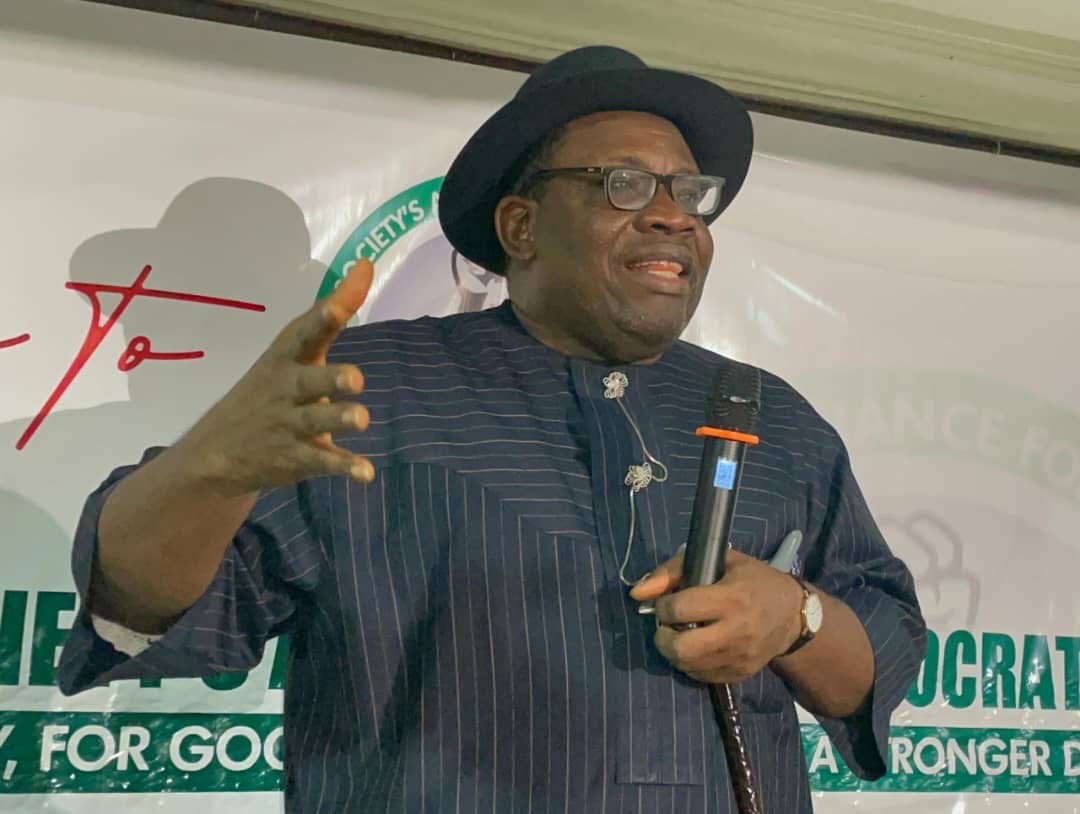
National Leader of the Nigeria Democratic Congress, NDC, Seriake Dickson, has revealed that the poo party’s presidential candidate, Peter Obi, was president when the motion for party supremacy was passed.

Speaking at the NDC stakeholder’s meeting on Thursday, Dickson said appointments and nominations will be done with consensus of the party and stakeholders.

Dickson was speaking on the party’s directive mandating affiliated groups like the Obidient Movement to operate under NDC supervision

According to him, they do not want somebody to win and run a one man show.

“His Excellency, Peter Obi was there when this motion on party supremacy was moved by Senator Ovie Omo-Agege and seconded by Senator Victor Umeh, and it was put to vote and passed.

“Every elected officer of this party must implement the programmes and policies not according to his or her whims and caprices, but programmes and policies of this party that will be analyzed, discussed, debated, and agreed.

“So, whether in the National Assembly or everywhere, we want to build an institution in this country. We may not get it one year or two years, but that’s our vision. So we say government policies and programmes must align with the parties, and a team is fine tuning certain things, which we will present to the public.

“Now, the second element is that appointments and nominations will be done with consensus of the party and stakeholders at all levels,” Dickson said.

Continue Reading
Click to comment

Leave a Reply

Your email address will not be published. Required fields are marked *

Health

Kano implements 90% of health blueprint in three years – Commissioner

info

Published

on

By

Dr Abubakar Yusuf Health 1 e1781203477394.jpg

MTN ADVERT

The Kano State Government says it has implemented about 90 per cent of its healthcare blueprint within three years of Governor Abba Yusuf’s administration.

The Commissioner for Health, Abubakar Labaran, disclosed this on Thursday while briefing journalists in Kano on the achievements recorded in the health sector.

Mr Labaran said the state had fully implemented the Abuja Declaration on Health, demonstrating its commitment to improving healthcare delivery.

He said the administration sanitised admissions into health training institutions through the introduction of a digital process, eliminating fraud that previously cost the state more than N1 billion.

“The government had also revived the training and retraining of healthcare personnel, restoring professionalism and credibility in the sector,” he said.

PT WHATSAPP CHANNEL

Mr Labaran said several health-related courses had secured accreditation from regulatory bodies, and opportunities had been created for medical doctors to advance to consultant status.

He said the measures had strengthened healthcare institutions and improved service delivery.

The commissioner said maternal mortality was being tackled through free healthcare for pregnant women, including free caesarean sections in more than 30 government hospitals.

He said more than N60 million was spent monthly to sustain the programme and ensure access to quality maternal care.

“Ambulances had been provided to all 44 local government areas to support emergency services, particularly for pregnant women in labour”.

He added that 484 mini ambulances had been procured for distribution to all wards to address transportation challenges during emergencies.

Mr Labaran said 320 primary healthcare centres had been rehabilitated, and the government was working to ensure every ward had a functional centre.

Additionally, he said health personnel had been recruited through collaboration between the state and federal governments and deployed to the facilities.

READ ALSO: Agency disbursed N400m to health facilities in Borno in Q1, Q2 – Official

He said the government was also strengthening secondary healthcare services across the 44 LGAs.

“Drug availability in hospitals had improved significantly from 30 per cent at the start of the administration through investment and prompt payment to suppliers,” he said.

The establishment of the Kano State Centre for Disease Control was another major milestone, he said, noting that it had enhanced the state’s capacity to prevent, detect and respond to public health emergencies.

Mr Labaran reaffirmed the government’s commitment to sustaining investments to ensure accessible, affordable and quality healthcare for all residents.

(NAN)


Continue Reading

News

TETFund Awards N7.5bn Research Grants To 174 Researchers

info

Published

on

By

IMG 20260611 WA0052.jpg


Warning: Undefined array key “sfsi_plus_threads_display” in /home/u310331633/domains/nannews.ng/public_html/wp-content/plugins/ultimate-social-media-plus/libs/sfsi_widget.php on line 2021

Warning: Undefined array key “sfsi_plus_threads_display” in /home/u310331633/domains/nannews.ng/public_html/wp-content/plugins/ultimate-social-media-plus/libs/sfsi_widget.php on line 2021

By Funmilayo Adeyemi

The Tertiary Education Trust Fund (TETFund) has awarded N7.5 billion research grants to 174 research teams across Nigerian tertiary institutions under the 2025 National Research Fund (NRF) Grant Cycle.

The Executive Secretary, Mr Sonny Echono, announced this at a news conference on Thursday in Abuja, while releasing the outcome of the 2025 NRF grant selection process.

Echono said the grants were awarded following a rigorous and competitive process.

He explained that the process involved the submission and evaluation of concept notes, full proposals, oral defence and final selection by the TETFund NRF Screening and Monitoring Committee.

According to him, the value of individual grants ranges from N13.7 million to N49.98 million.

He said the funded projects covered key national priority areas, including health and social welfare, agriculture and food security, sustainable use of natural resources, science and engineering, power and energy and blue economy.

Other areas, he said, were innovation and technology in national defence, clean and affordable energy, education and human capital, gender equity and social inclusion, as well as conflict, defence and security.

The executive secretary said the Federal University of Technology, Minna, emerged as the highest-performing institution with 18 successful grants.

He added that the Federal University of Technology, Owerri, secured 11 grants, while Ahmadu Bello University, Zaria, won 10.

Other institutions included the University of Ilorin with eight grants; Bayero University, Kano and Nnamdi Azikiwe University, Awka, with seven grants each; while University of Jos got six.

The University of Ibadan, University of Lagos and Usman Danfodiyo University, Sokoto, secured five grants each.

Echono said some newly established federal universities also recorded successes in the grant cycle.

He identified the institutions as the Federal University of Applied Sciences, Kachia; Federal University of Environment and Technology, Koroma/Saakpenwa, Ogoni; and the Federal University of Technology and Environmental Sciences, Iyin-Ekiti.

He also listed state-owned institutions that won grants as Enugu State University of Science and Technology, Ekiti State University, Kwara State University, Adamawa State University, Rivers State University and Sokoto State University, among others.

According to him, several polytechnics also secured grants, including the Federal Polytechnic, Ilaro; Federal Polytechnic, Bida; and Federal Polytechnic, Nekede.

“Others are Federal Polytechnic, Moguno; Federal Polytechnic, Ile-Oluji; Federal Polytechnic, Bauchi; Ramat Polytechnic, Maiduguri; Yaba College of Technology; Kaduna Polytechnic; and Umaru Ali Shinkafi Polytechnic, Sokoto,” he said.

He added that beneficiary colleges of education included the College of Education, Katsina; Osun State College of Education, Ilesa; and Isa Kaita College of Education, Dutsin-Ma.

Echono congratulated the successful institutions and research teams, describing the awards as the “culmination of a transparent and highly competitive selection process”.

He said preparations would soon begin for the 2026 NRF Grant Cycle and encouraged researchers and scholars in tertiary institutions to take advantage of the opportunity by submitting concept notes for consideration.

Echono said the Federal Government had intensified support for research and development over the past four years as part of efforts to drive economic transformation and national development.

He said the government was leveraging the intellectual capacity of tertiary institutions to develop solutions that would improve resource utilisation, boost innovation, create jobs and address national challenges.

According to him, countries such as Singapore, South Korea, Brazil, India and China achieved rapid development by investing heavily in research and innovation.

“We believe that if we harness the intellectual talents in our tertiary institutions and deploy them efficiently, we will create new products and services, grow the economy and improve the living standards of our people.”

The executive secretary said the grant programme was also designed to prepare Nigerian researchers to compete successfully for international research grants.

According to him, Nigeria has moved from eighth to fourth position in Africa, in terms of research grant competitiveness over the past two years.

He said Nigerian scholars in the diaspora remained the highest-performing African researchers globally, expressing confidence that researchers within the country could attain similar levels of excellence with adequate support.

To accelerate commercialisation, Echono said the fund would host another NRF in November, where researchers would showcase innovations to investors, financial institutions, industries and start-up organisations.

He added that TETFund had created a national database of researchers and research outputs to facilitate access by potential investors and industry partners.

On accountability, Echono said the fund had not recorded significant cases of misuse of research grants due to its stringent monitoring mechanisms.

He explained that grants were disbursed in phases based on approved work plans and verified milestones, while project supervisors and monitors tracked implementation.

“Researchers do not receive the entire grant at once. Funds are released in tranches based on performance and progress reports,” he said.

The executive secretary, however, acknowledged that some projects experienced delays due to security challenges, personnel changes and other operational constraints.

He also highlighted several innovations already emerging from TETFund-supported research, including improved food preservation technologies, cleaner and more efficient gari processing systems and high-yield crop varieties.

“Other innovations are water purification technologies, renewable energy solutions, electric vehicles and locally designed automotive components,” he said.

Echono further disclosed that Nigerian researchers have developed prototypes for hearing aids, wind-powered cooling systems, compressed natural gas conversion technologies and fully indigenous vehicle designs.

He said some of the innovations were already in the market, while others were undergoing certification and scaling for commercial production.

He expressed optimism that stronger collaboration between academia and industry would accelerate the adoption of research outputs and contribute to Nigeria’s industrialisation drive. (NAN)(www.nannews.ng)


Edited by Philip Yatai


Continue Reading

Trending