News
Masara Kim Accuses Barkin Ladi PYC Leaders of Defending Government Over Victims




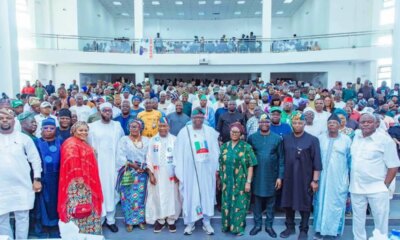
The presidential candidate of the Allied Peoples Movement, APM, Seyi Makinde has said states will generate and distribute their own electricity under his administration.
Makinde said this on Wednesday while unveiling his Reset Nigeria Manifesto at the Congress Hall, Transcorp Hotels and Suites, Abuja.
According to him, the current system where everything is controlled from the centre is not working. He said if Nigeria wants to develop, states must be allowed to produce power and give it to their people.
"States will generate, distribute their own electricity," Makinde declared.
The Oyo State governor further stated that his Reset Nigeria Agenda will reset the economy by fixing the power problem, stressing that no economy can grow when businesses are closing by 8pm because there is no light and insecurity.
Makinde said his plan is to reduce the cost of doing business and cost of living, and fixing electricity is number one.
He said he will run a transitional government of national unity that will restructure the country so that states can control their resources.
States will generate, distribute electricity if I’m elected President – Makinde
News
Crypto News: Bitcoin Price Faces Renewed Pressure While Binance Resumes Crypto Withdrawals After $6.3 Billion Hack


Bitcoin’s renewed pressure and Binance’s gradual reopening have left the crypto market weighing two signs of recovery: whether prices can stabilise and whether customers can move their assets normally again. BTC slipped below $77,000 on 3 November, while Binance expanded its withdrawal rollout following the $6.3 billion security incident.
The latest crypto news therefore extends beyond the price chart. Restoring access to funds addresses an immediate operational problem, but the market still has to assess the remaining asset replacement, the scope of reopened networks and the evidence behind reserve claims. Those developments can influence confidence without producing an immediate Bitcoin rebound.
Bitcoin news tracks BTC price below $77,000 after brief recovery above $78,000
Bitcoin fell to about $76,566 in an early market report on Tuesday, 3 November, renewing pressure after a brief recovery above $78,000 the day before. The movement remains a recent reference point for Wednesday’s market and shows how quickly the attempted rebound lost ground.
The BTC price movement also explains why operational progress at Binance and market weakness can coexist. Reopened withdrawals let customers move assets, yet their next move could be to hold those coins elsewhere, convert them or leave them untouched. A withdrawal is not, by itself, evidence of a sale.
For Bitcoin news, the immediate question is whether renewed access is followed by steadier market conditions. A short move back above $77,000 would recover one reference point. Sustaining it would provide stronger evidence of stabilisation than a brief price spike, particularly after the failed move above $78,000.
Binance resumes crypto withdrawals for Bitcoin, Ethereum, XRP and Solana
Binance began another phase of crypto withdrawals at 04:00 UTC on 3 November. It followed the initial reopening on 1 November, which began with Bitcoin. The additional rollout covered selected assets on several networks, including Ethereum, BNB Smart Chain and Solana.
The distinction between an asset and its network matters. Access to a token through one network does not establish availability through every supported route. Binance said it would reopen each network-and-asset combination progressively after checks, with deposits remaining available. Its notice also warned of possible delays during the rollout.
That makes Binance recovery a sequence of operational milestones. Key measures include which routes have reopened, whether withdrawals are complete and how much of the affected asset pool has been restored. Read a broad reopening announcement alongside its detailed coverage, rather than treating it as confirmation that every service has returned simultaneously.
Binance recovery reaches 95% as proof of reserves verifies 10 crypto assets
In its 2 November update, Binance said it had covered approximately 95% of the impacted amount using its own resources. It attributed the remaining portion to less liquid tokens that took longer to source. These remain statements from the company about its recovery programme.
The platform also said its 31 October snapshot was verifiable for ten assets, including BTC, ETH, USDT, BNB and XRP. Binance said it would take a further proof of reserves snapshot covering more tokens today, 4 November. The company estimated that producing the resulting cryptographic proof would take another 40 to 50 hours, so the expanded verification is not expected to be available at the time of publication.
Reserve evidence and withdrawal access answer related questions. One concerns the assets represented in a particular snapshot; the other concerns customers’ ability to retrieve balances. Assessing both provides a fuller view of crypto market confidence than relying on either a reserve percentage or a reopening headline alone.
Bitcoin market activity brings crypto betting and BTC wagers into focus
Bitcoin’s latest price movements have created new reference points for readers following the market. Binance’s phased reopening of withdrawals adds another timely development, connecting exchange activity, asset flows and BTC price action within the same news cycle.
This combination also matters for crypto betting on moon.com, where users can wager on cryptocurrency price direction. Shifts in Bitcoin momentum and major Binance updates provide fresh market context for evaluating potential BTC moves across time frames.

For Bitcoin wagers, short-term volatility, resistance levels and recovery attempts can all shape the available market outlook. The return of more withdrawal routes gives crypto audiences an additional indicator to follow as Bitcoin searches for its next sustained direction.
Crypto asset custody gives Nigerian readers a separate reference point
The focus on access and reserves connects directly to digital asset custody. Nigeria’s SEC rules on digital assets include provisions covering custodians, operational controls and responses to system failures. That framework explains why safeguarding assets and maintaining reliable systems are separate responsibilities.
Banking access is another layer. The CBN guidelines for VASP bank accounts, issued in December 2023, address relationships between supervised financial institutions and eligible virtual asset service providers. They concern banking arrangements rather than the status of an individual blockchain withdrawal.
Neither document verifies Binance’s latest recovery claims. They provide Nigerian context for assessing service access, custody and settlement without confusing a global platform update with a local regulatory decision.
Bitcoin and Binance withdrawals face different recovery milestones
The next useful developments are specific: wider withdrawal coverage, evidence about the remaining affected assets and publication of the cryptographic verification generated from the 4 November snapshot. Each would add information about the operational recovery, although none alone establishes where Bitcoin should move next.
Another consideration is where withdrawn Bitcoin goes. Transfers into personal wallets can reflect a change in custody preferences rather than an intention to dispose of the asset. Conversely, moving coins to another platform may increase their availability for conversion without proving that a transaction has occurred. Public wallet movements therefore need context before they can support claims about selling pressure.
The recovery timetable also deserves scrutiny. Replacing the most liquid assets first can restore access for many customers while leaving smaller balances or less common routes unavailable. Progress should consequently be assessed against the remaining obligations, alongside the proportion already covered. This keeps the focus on completed service restoration rather than reassuring percentages alone. Both access and evidence will shape the next assessment.
For the Bitcoin market, the price response remains a separate measure. The reopening process can remove one source of uncertainty while broader demand stays weak. A more convincing improvement would combine dependable access to funds with sustained price stability, rather than a single reassuring announcement followed by another short-lived bounce.
-

 News2 days ago
Plateau APC 2027 Campaign Council inaugurated today in Jos
-
Health4 days ago
Ebola: No new cases in Nigeria as two suspected cases in North-east test negative
-
News3 days ago
Plateau Igbo Community Ends Leadership Crisis, Elects Johnson Nwosu as Eze Igbo IV
-
News3 days ago
NPFL Matchday 11: Shooting Stars Run Riot, Rivers United Held by Rangers as Bendel, Kano Pillars Claim Away Wins