Connect with us

Business

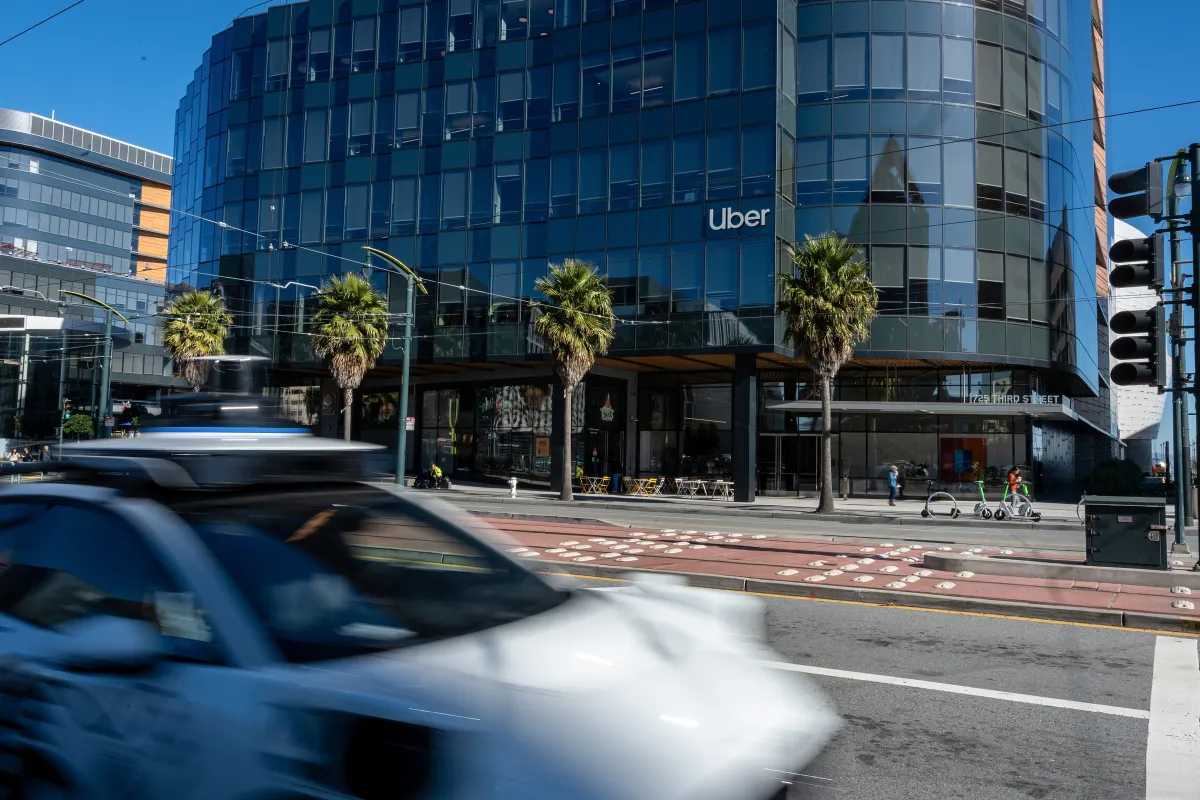
Uber wants to turn its millions of drivers into a sensor grid for self-driving companies

info

Published

on

GettyImages 2259104536.jpg

Uber has a long-term ambition that goes well beyond shuttling passengers: the company eventually wants to outfit its human drivers’ cars with sensors to soak up real-world data for autonomous vehicle (AV) companies — and potentially other companies training AI models on physical-world scenarios.

Praveen Neppalli Naga, Uber’s chief technology officer, revealed the plan in an interview at TechCrunch’s StrictlyVC event in San Francisco on Thursday night, describing it as a natural extension of a nascent program the company announced in late January called AV Labs.

“That is the direction we want to go eventually,” Naga said of equipping human drivers’ vehicles. “But first we need to get the understanding of the sensor kits and how they all work. There are some regulations — we have to make sure every state has [clarity on] what sensors mean, and what sharing it means.”

For now, AV Labs relies on a small, dedicated fleet of sensor-equipped cars that Uber operates itself, separate from its driver network. But the ambition is clearly much larger. Uber has millions of drivers globally, and if even a fraction of those cars could be transformed into rolling data-collection platforms, the scale of what Uber could offer the AV industry would dwarf what any individual AV company could assemble on its own.

The insight driving the program, Naga said, is that the limiting factor for AV development is no longer the underlying technology. “The bottleneck is data,” he said. “[Companies like Waymo] need to go around and collect the data, collect different scenarios. You may be able to say: in San Francisco, ‘At this school intersection, I want some data at this time of day so I can train my models.’ The problem for all these companies is access to that data, because they don’t have the capital to deploy the cars and go collect all this information.”

Becoming the data layer for the entire AV ecosystem is a pretty smart play, particularly considering Uber years ago abandoned its own ambitions to build self-driving cars (a move that co-founder Travis Kalanick has publicly lamented as a big mistake). Indeed, many industry observers have wondered if, without its own self-driving cars, Uber might one day be rendered irrelevant as AVs increasingly spring up around the globe.

The company currently has partnerships with 25 AV companies — including Wayve, which operates in London — and is building what Naga described as an “AV cloud”: a library of labeled sensor data that partner companies can query and use to train their models. Partners, which Uber plans to more aggressively invest in directly, can also use the system to run their trained models in “shadow mode” against real Uber trips, simulating how an AV would have performed without actually putting one on the road.

Techcrunch event

San Francisco, CA
|
October 13-15, 2026

“Our goal is not to make money out of this data,” Naga said. “We want to democratize it.”

Given the obvious commercial value of what Uber is building, that positioning may not last long. The company has already made equity investments in numerous AV players, and its ability to offer proprietary training data at scale could give it significant leverage over a sector that right now depends on Uber’s ride marketplace to reach customers.

When you purchase through links in our articles, we may earn a small commission. This doesn’t affect our editorial independence.

Continue Reading
Click to comment

Leave a Reply

Your email address will not be published. Required fields are marked *

Business

How NDLEA intercepts Chinese grandma with 31.0Kg of drug consignment at Lagos airport

info

Published

on

By

913e4fc6 b1d0 4a7b a200 9a35b8a8d82e.jpeg

BY NKECHI NAECHE-ESEZOBOR—-A 63-year-old Chinese grandma Ting Hung Kiong has been arrested by operatives of the National Drug Law Enforcement Agency (NDLEA) following her attempt to smuggle large consignment of Canadian Loud, a synthetic strain of cannabis into Nigeria.

The female Chinese national who naturalised in Malaysia was arrested on Sunday 17th May 2026 upon her arrival in Nigeria from Thailand via Dubai, UAE, aboard an Emirates Airline flight. She was intercepted by NDLEA operatives attached to the Terminal 2 Arrival Hall of the Murtala Muhammed International Airport (MMIA), Ikeja, Lagos.

Investigation revealed that the suspect travelled from Malaysia to Thailand and subsequently to Nigeria via the UAE with two large travel boxes containing the synthetic cannabis consignment weighing 31.0 kilograms.

During an interview, the 63-year-old suspect who claims she works as a caregiver in Malaysia stated that her daughter sponsored her trip from Malaysia to Thailand and subsequently to Nigeria.

She further disclosed that she spent two weeks in Thailand, before she was handed the illicit consignment at the Thailand airport to deliver in Nigeria.

Meanwhile, another major shipment of illicit drug consignment has been recovered at the import shed of the Lagos airport. Following close monitoring of the consignment by NDLEA operatives since its arrival from India aboard an Emirates Cargo flight, the 29 large cartons containing One Million, Eight Hundred and Twenty-Five Thousand, Seven Hundred and Ten (1,825,710) tablets of Tapentadol 250mg, worth Two Billion, One Hundred and Ninety Million, Eight Hundred and Fifty-Two Thousand Naira (N2,190,852,000) were eventually handed over to the NDLEA by the Customs Service on Friday 22nd May 2026.

In another successful interdiction operation, NDLEA operatives at the Akanu Ibiam International Airport, Enugu on Wednesday 20th May intercepted a suspect Onyeka Valentine Emeka during the inward clearance of passengers on Ethiopian Airlines flight from Sierra Leone via Addis Ababa, Ethiopia. When placed under observation, the suspect excreted a total of 185.36 grams of cocaine.

At the Nnamdi Azikiwe International Airport, Abuja, a 29-year-old building engineer, Babatunde Prosper Afekhide was on Wednesday 21st May arrested by NDLEA operatives while attempting to board an Ethiopian Airlines flight from Abuja via Addis Ababa to Milan Malpensa, Italy.

A search conducted on his luggage led to the recovery of 10,280 pills of Tramaking 225mg; Tramadol 200mg and Tapentadol 250mg. The opioids were concealed using foil paper and hidden inside a carton, in a suitcase, obviously to evade detection.

In yet another operation at a courier company in Lagos, NDLEA operatives intercepted 1,174 pills of MDMA (Ecstasy) concealed in bicycle luggage carrier heading to Netherlands; 66 pills of tramadol 225mg hidden in soap container going to the United States and 18 tablets of tramadol 225mg concealed in body cream container heading to the United Kingdom.

In Edo state, NDLEA operatives acting on intelligence raided Igwe community in Owan East LGA where a total of 59 jumbo bags of skunk weighing 489kg and cannabis seeds weighing 9kg were recovered.

While a suspect Isah Sani, 30, was nabbed with 196,000 pills of exol-5 on Wednesday 20th May along Zaria/Kano road, Kano state, NDLEA officers at Seme border, Badagry area of Lagos recovered 59kg skunk from a warehouse in Mowo, Badagry on Tuesday 19th May.

Another operational success was recorded in Ekiti state where NDLEA operatives on Saturday 23rd May raided a warehouse located at N/56, Ikoyi community, Ikole-Ekiti and recovered 1,116 kilograms of skunk, while 54-year-old suspect Ogundana Adebayo Julius was arrested in connection with the seizure.

With the same zeal, Commands and formations of the Agency across the country continued their War Against Drug Abuse (WADA) sensitization activities in schools, worship centres, work places and communities among others in the past week.

These include: WADA enlightenment lecture to students and staff of Command Day School, Mokola, Ibadan, Oyo state; Girls Secondary School, Amenyi, Anambra; Matazu Model Primary School, Matazu LGA, Katsina; C&S Primary School, Majidun, Ikorodu, Lagos; Alufo High School, Apugo, Enugu; Aramoko District Commercial Secondary School, Aramoko Ekiti; and Government Girls Secondary School, Kurna, Kano state, among others.

While commending the officers and men of MMIA, NAIA, AIIA, Edo, Ekiti, Seme, and Kano Commands as well as those of DOGI for the arrests and seizures, Chairman/Chief Executive Officer of NDLEA, Brig. Gen. Mohamed Buba Marwa (Rtd) noted their drug supply reduction efforts balanced with WADA sensitization activities while he charged them and their compatriots across the country to continue to raise the operational bar.

The post How NDLEA intercepts Chinese grandma with 31.0Kg of drug consignment at Lagos airport appeared first on Business Today NG.

Continue Reading

Business

NCAA directs suspension of services to 11 airlines over unpaid charges

info

Published

on

By

Nigerian Civil Aviation Authority NCAA.jpg

The Nigerian Civil Aviation Authority (NCAA) has directed its departments to suspend services to 11 domestic airlines over unpaid financial obligations owed to the regulator.

The directive was contained in an internal memo dated 22 May, which instructed all NCAA directorates and regional offices to place the affected operators on a “no-pay-no-service” arrangement pending financial clearance from the Directorate of Finance and Accounts.

The memo was signed by the Director of Finance and Accounts, Olufemi Odukoya, and copied to the Director-General of Civil Aviation (DGCA) and other senior officials of the authority.

Airlines affected by the directive include Air Peace, Ibom Air, Arik Air, United Nigeria Airlines, Max Air, Rano Air, NG Eagle, ValueJet, Overland Airways, Umza Air and Caverton Helicopters.

The directive comes amid increasing financial pressure on domestic airlines due to rising aviation fuel costs, foreign exchange challenges, and high operating expenses across the sector.

PT WHATSAPP CHANNEL

Under the directive, affected airlines may be unable to access some regulatory services until their financial obligations are settled.

The move has also raised concerns within the industry over the possible impact on airline operations if the situation persists.

READ ALSO: NCAA grants Pioneer Airlines approval for non-scheduled flight operations

The NCAA relies on statutory charges and service-related payments from airlines to fund inspections, oversight responsibilities and other regulatory activities.

In recent months, several domestic airlines have faced operational disruptions linked to rising costs, aircraft maintenance challenges and limited fleet availability.

PREMIUM TIMES earlier reported that some airlines, such as Rano Air, adjusted schedules and suspended routes amid the sharp rise in Jet A1 aviation fuel prices, which continued to pressure operators.

The latest directive further underscores the financial strain on Nigeria’s aviation sector, as airlines struggle to balance rising operational costs with declining passenger purchasing power.

Continue Reading

Trending