Amjad Masad has been building Replit for a decade, but the last 18 months have been something else entirely. The AI coding assistant company went from $2.8 million in revenue in all of 2024 to tracking toward what Masad describes as a billion-dollar annual run rate.
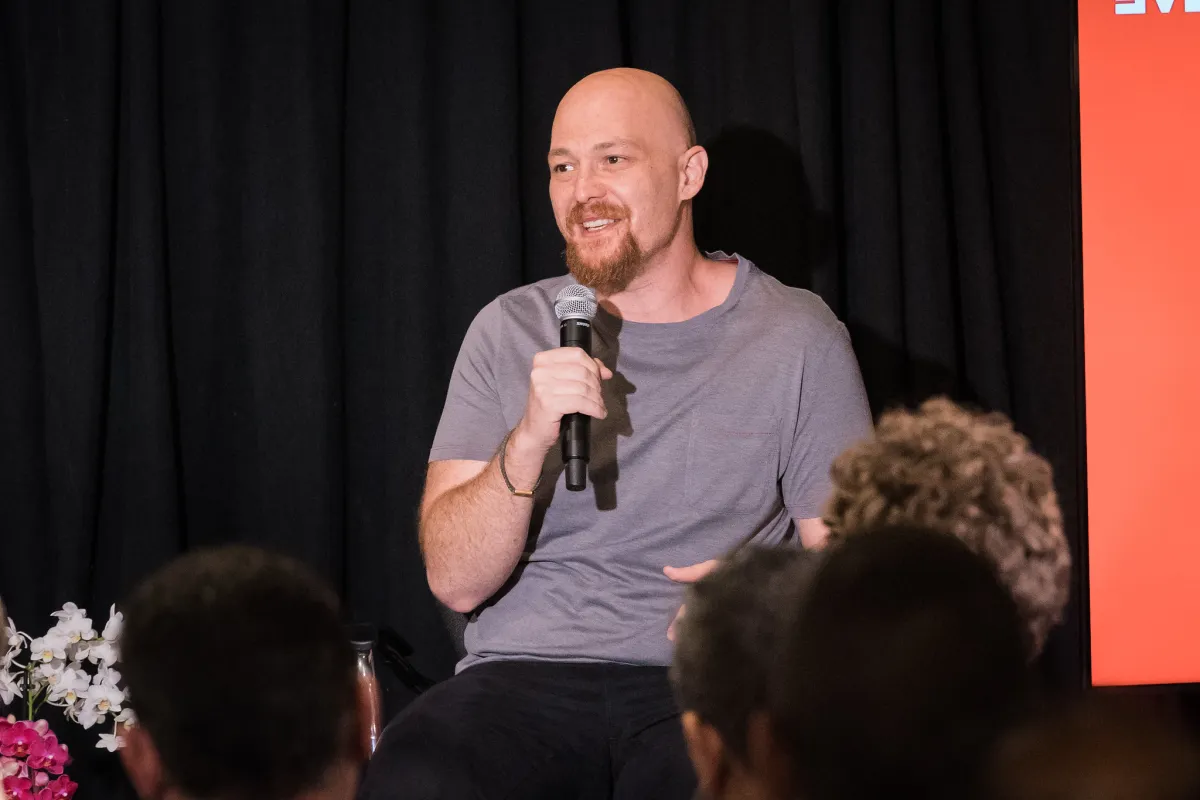
At TechCrunch’s sold-out StrictlyVC event in San Francisco on Thursday night, we covered a lot of ground in a short time, beginning with the question everyone in the industry is asking right now: in a world where rival Cursor is reportedly in talks to be acquired by SpaceX for $60 billion, is Replit also bound to sell? We also got into Replit’s net revenue retention — a measure of how much existing customers expand their spending — which Masad says is reaching as high as 300%, his willingness to take Apple to court over what he called outright lies in its App Store battle with Replit, and the possibility of the company beginning to invest in its own customers.
On the question of independence, Masad was unambiguous. Unlike Cursor, which he said has been operating at negative 23% gross margins, he argued Replit has the economics to make that path viable — even if he stopped short of ruling out a sale entirely.
The following has been edited for length and clarity:
TC: Cursor’s reported SpaceX deal was the talk of the industry last week. What did you make of it?
AM: It’s kind of hard being an independent, smaller AI company that’s building on foundation models, especially if you’re burning a ton of cash. Part of the reporting suggested Cursor has negative 23% margins, and if you’re also wanting to invest in training models, that makes it incredibly hard to stay independent.
For us at Replit, partly because we target a different customer set, we’ve been able to run the business more rationally. We’ve been gross margin positive for over a year. We’re slightly more expensive, but we provide a lot more. Our audience tends to be mostly non-technical users who previously haven’t been able to create any software. We provide an end-to-end platform — from the prompt all the way to a deployed application that can scale. We handle security, databases, database migration. And we’ve been doing this long enough that we’ve built a lot of those primitives into the platform.
Techcrunch event
San Francisco, CA | October 13-15, 2026
Is Replit for sale? I would assume you are talking with potential acquirers all the time; it’s your fiduciary responsibility.
Yeah. We have amazing partners, and they sometimes bring up these topics. But we’re going to try to stay independent. I would love for us to remain an independent company. We’ve been around for 10 years, before it was even accepted that you could make apps just from ideas. We were talking about creating a billion software creators back in 2018 at YC, and people sometimes actually laughed at that dream. Now that dream is possible, and we kicked off this revolution with our agentic coding experience in September 2024. It just feels like we can take it much further.
You work closely with Anthropic, Google, and OpenAI. If you had to rank them — who’s doing it best?
Anthropic is still undefeated on the core agentic loop. They have the best tool calling; the agent can stay coherent much longer. GPT-5 is catching up quickly. Google’s Flash family of models is just amazing on price-performance. If you want something fast and cheap, they’re actually beating open source right now. We use all three, and honestly I wouldn’t discount the newer labs either. Reflection AI is coming out with open-source models we’re hearing great things about. And the Chinese models are impressive — Kimi is as good as an Anthropic-generation model from January, so it’s only about three months behind.
When you’re in a bake-off for an enterprise deal, what wins it for you?
Most of our sales are inbound or organic — very product-led. We’ve acquired customers like Zillow and Meta purely through people adopting the product and then raising their hand to buy an enterprise plan. When it does go top-down and there’s a formal bake-off, we usually win on product. But even in cases where we might be missing a feature, once it hits the C-suite and the IT group, Replit wins on security. A lot of vibe-coding tools will generate a website and connect it to an external database — great products, but it makes security much harder, because the database is open to the public and you need to configure row-level security, which is especially difficult for non-technical builders. Replit being full stack, with the database built into the project and not open to the public — that makes the app inherently more secure.
We also spent 10 years battling crypto scammers and hackers, so our cybersecurity function is as good as a dedicated cybersecurity startup. Every time you deploy an app on Replit, we create an entirely new isolated project on Google Cloud. We inherit Google’s security model.
Can we talk about churn? How long do you hold onto customers if the best prototypes eventually get rebuilt into a company’s existing stack?
Churn is very, very low, and net retention is incredibly high — 300% in some cases. What we actually hear from customers is that when engineers get nervous and try to rebuild an app into their own stack, they often make it worse. Once enterprises get comfortable with the full Replit stack — especially when we set up a single-tenant environment for them — they keep the apps on Replit. Bain & Company, for example, replaced Tableau and Power BI with Replit and Databricks.
There’s a growing concern about AI bloat — non-technical users generate far more code and burn through far more tokens. That’s good for you [given your usage-based fees]. What about your customers?
We don’t have a lot of regrettable spend. Enterprises are very ROI conscious, and they tell us about the returns they’re getting. For the most part they feel the investment is totally worth it — often one, two, three orders of magnitude. If they spend $100,000 a month with Replit, they’re usually generating $2 million, $3 million, $10 million in some kind of return.
Let’s talk about Apple. Another rival, Lovable, just got an app-building app approved by the App Store this week. Replit has been in App Store purgatory, with Apple blocking your updates for months. How much does that hurt you?
It’s not life or death — we could lose the app and it wouldn’t do anything meaningful to our business. But it’s an app people genuinely love. We’ve been on the App Store for four years. Kids in underprivileged communities learn to code on Replit on their Android devices. Executives use it in meetings.
The reason Replit got blocked when others weren’t, we believe, is that Replit makes iOS apps. When we launched that capability in December, there were charts going around showing how many apps were getting into the App Store through us. We think Apple feels threatened by that.
Apple’s stated reason is that you’re downloading new code to the device [after the approval process], which violates their guidelines.
That’s a lie. And we can prove it in court if we have to.
Is that going to happen?
I hope not. I’m a fan of Apple, and I’d love to collaborate and build something great together. We’re happy to send customers to Xcode [Apple’s own development environment]. But you can’t run a marketplace that a billion people have access to and make decisions that are discriminatory or based on whims.
Just wondering if, like Nvidia, OpenAI and others, you’re thinking about investing in your own customers in exchange for equity.
We’ve thought a lot about it, and it is a consideration. I’ve personally invested in a few startups that started on Replit before they made any money. Some of them, like Magic School — a teacher decided to take his time during COVID to learn a little bit of vibe coding and built an AI app for other teachers. He found this problem that in America, we burn out a lot of teachers. He wanted to use AI to reduce the workload. He did that, and he made $20 million in the first year. Other companies that started on Replit, I think, are valued at half a billion dollars. The entrepreneurship happening on Replit right now is genuinely exciting. We integrated with Stripe a few months ago, and the transactions flowing through Replit are growing triple digits month over month. Pretty soon, our customers will be making more revenue than we are.
You can watch our full conversation with Masad below:
The Nigeria Democratic Congress, NDC, in Borno State has dismissed its House of Assembly candidate, Mohammed Bunu, over alleged involvement in campaign activities linked to the African Democratic Congress, ADC, presidential candidate, Atiku Abubakar.
The decision was communicated in a letter dated October 25, 2026, signed by the NDC state Deputy Chairman, Umar Fema.
The letter said the allegations stemmed from campaign materials bearing the ADC logo, the slogan “SABON TAFIYA, SABON SALO,” and the names and photographs of Atiku and Bunu.
According to the letter, the disciplinary process began at the Hausari Ward level before the matter was referred to the Maiduguri Metropolitan Council, MMC, party leadership for investigation.
Fema said the ward executive invited Bunu to respond to the allegations on October 23, but he did not attend.
He was invited again on October 24 to appear before an investigation committee but allegedly failed to attend.
The MMC party chairman, Adamu Ibrahim, subsequently endorsed the recommendation for disciplinary action and forwarded it to the state leadership.
The NDC said it decided to dismiss Bunu after considering the allegations and reports submitted through its disciplinary process.
A video has surfaced online showing some members of the Agaji volunteer group of Jama’atu Izalatil Bid’ah Wa Iqamatus Sunnah, JIBWIS, popularly known as Izala, chanting lyrics that appear to call for armed attacks on citizens in Enugu and Jos.
The footage, which gained attention on social media, particularly X on Sunday, shows a group of uniformed young men wearing brown attire and blue berets, reportedly associated with the Agaji volunteer wing of the Islamic organization.
In the video, one of the men leads a morale song containing references to obtaining an AK-47 rifle to attack people described as “infidels” in Enugu and Jos.
The chant includes the lyrics: “He should be given AK47. He would then go to Enugu, the land of the infidels. On Sunday when they are worshiping and clapping, he would then open fire, so that he can kill the infidels.”
The singer subsequently repeats the call for an AK-47, this time referencing Jos, and chants about killing more people he describes as infidels, before referring to the act as “the training.”
“He asked to be given AK-47 again. So that he can go to Jos and kill more infidels. That is the training.”
The exact date and location where the video was recorded have not been verified.
The footage, which has sparked reactions online, raised concerns over the possibility of attacks on Christians in Nigeria.




 News3 days ago