Business
Tinubu Approves ₦3.3 Trillion to Clear Power Sector Debts

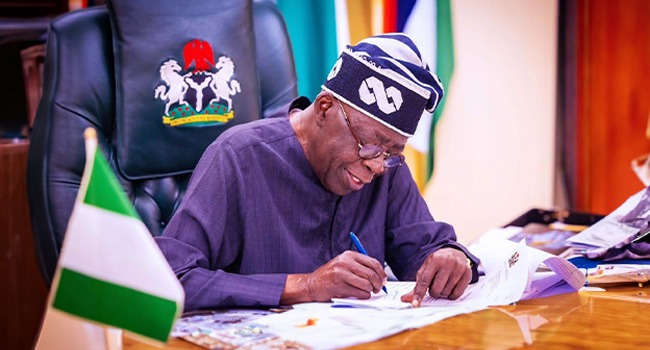

President Bola Tinubu has approved the payment plan to finally settle the outstanding debts under the Presidential Power Sector Financial Reforms Programme.
The debt repayment plan followed the final review of the legacy debts that have beset the power sector for more than a decade.
The long-standing debts accumulated between February 2015 and March 2025. Following verification, ₦3.3 trillion has been agreed as a full and final settlement, ensuring a fair and transparent resolution.
Implementation has begun, with 15 power plants signing settlement agreements totalling ₦2.3 trillion. The Federal Government has already raised ₦501 billion to fund these payments. Out of the amount, N223 billion has been disbursed, with further payments underway.
What this means for Nigerians: With payments reaching the power value chain, generation will be more stable. With power plants supported, electricity reliability will improve.
And as the sector stabilises, more investment, more jobs, and better service will follow.
“This programme is not just about settling legacy debts. It is about restoring confidence across the power sector — ensuring gas suppliers are paid, power plants can keep running, and the system begins to work more reliably,” explained Olu Arowolo-Verheijen, Special Adviser on Energy to President Tinubu.
“It is part of a broader set of reforms already underway — including better metering and service-based tariffs that link what you pay to the quality of electricity you receive.
“The government is also prioritising power supply to businesses, industries, and small enterprises — because reliable electricity is critical to creating jobs, supporting livelihoods, and growing the economy.
“The goal is simple: more reliable power for homes, stronger support for businesses, and a system that works better for all Nigerians,” she added.
President Tinubu has commended all stakeholders who supported efforts to resolve the legacy issues in the power sector. He has also confirmed that the next phase (Series II) will begin this quarter.
The post Tinubu Approves ₦3.3 Trillion to Clear Power Sector Debts appeared first on Business Today NG.

The Bank of Industry (BOI) said it will expand financing for agriculture, local healthcare manufacturing and digital businesses in 2027.
The bank stated this as it seeks to consolidate the gains of its 2025–2027 corporate strategy and strengthen Nigeria’s industrial development.
The bank’s Managing Director and Chief Executive Officer, Olasupo Olusi, disclosed the plan on Thursday at a meeting in Lagos, where he outlined the bank’s priorities for the final year of the strategy.
Mr Olusi said BOI would work with the Federal Ministry of Industry, Trade and Investment on the National Industrial Finance Compact to attract more long-term capital into Nigeria’s industrial sector.
He also said the bank would deploy its new European Investment Bank facilities to agriculture and local healthcare manufacturing to increase domestic production of food and medicines.
The funding includes €85 million secured from the European Investment Bank for agriculture and another €50 million for healthcare manufacturing in 2026, as part of more than €2.2 billion in new funding the bank has secured for Nigerian industry since 2024.


READ ALSO: BOI supports 1.68m jobs as lending rises 26% to ₦644.9 billion
“We will deploy our new European Investment Bank facilities into agriculture and local healthcare manufacturing, so that Nigeria produces more of the food and medicines it consumes,” he said.
The bank also plans to expand its information and communications technology (ICT) and digital economy portfolio through the Investment in Digital and Creative Enterprises (iDICE) programme.
Mr Olusi said the initiatives formed part of the bank’s efforts to consolidate its achievements and meet the targets of its 2025–2027 corporate strategy.
“2027 is the final year of our strategy, and our task is to consolidate and meet every target we set,” the BOI boss, Mr Olusi, said.
BOI said it disbursed N644.9 billion in 2025, reaching 12,501 businesses and supporting 1.68 million jobs.
Discover more from Premium Times Nigeria
Subscribe to get the latest posts sent to your email.

First HoldCo Plc has appointed Gwen Mwaba as a non-executive director of the financial institution, effective 15 October, following an approval by the Central Bank of Nigeria (CBN).
The lender disclosed the appointment in a regulatory filing signed by Abiola Baruwa, the group company secretary, on Thursday.
First HoldCo said the appointment was made in accordance with the Nigerian Exchange Limited (NGX) Rulebook.
According to the lender, Ms Mwaba brings significant expertise in corporate governance and board oversight, credit risk and portfolio management, banking strategy, capital deployment, structured trade and commodity finance, development finance, environmental, social and governance (ESG) issues, and emerging-market risk.
Profile
Ms Mwaba brings nearly three decades of experience in global banking and development finance institutions, with particular expertise in credit risk oversight, portfolio governance, corporate and sovereign lending, structured trade and commodity finance, development finance and emerging markets.
Until recently, she served as managing director of Trade Finance and Correspondent Banking at the African Export-Import Bank (Afreximbank), based in Cairo, Egypt.
In that role, Ms Mwaba had executive leadership responsibility for trade finance and structured credit activities across Africa and the Caribbean.
The newly appointed director also oversaw a $19.5 billion portfolio of sovereign, financial institution and corporate exposures.
She contributed to the bank’s Pre-Credit and Credit Committees, providing senior credit judgement on major lending transactions. She also oversaw portfolio strategy, sector exposures and country risk limits.
Before that, Ms Mwaba served as regional head for Anglophone West Africa at Afreximbank, overseeing regional strategy and credit origination across Nigeria, Ghana, Sierra Leone, Liberia, The Gambia and Cape Verde.
Earlier, she was executive vice president of Structured Trade and Commodity Finance at Standard Bank Plc, London, where she was responsible for complex commodity finance, export credit agency-backed facilities and pre-export financing transactions across Africa.
Her earlier banking career included senior roles at Stanbic Bank Zambia and Standard Bank South Africa, including head of Vehicle and Asset Finance and head of Corporate Banking.
READ ALSO: CBN restates single-digit inflation target as FG woos investors with tax credits
Ms Mwaba’s wider industry experience includes membership of the editorial board of Trade Treasury & Payments.
Until recently, her also served on the Multilateral Institutions Board Advisory Panel of the International Trade and Forfaiting Association (ITFA) and the World Trade Organization-led Expert Group on Trade Finance.
Ms Mwaba holds a Master of Business Administration (MBA) from Heriot-Watt University, United Kingdom, and a Bachelor of Science (Honours) degree in Applied Accounting from Oxford Brookes University, United Kingdom.
She is a Fellow of the Association of Chartered Certified Accountants (FCCA) and holds a professional qualification from the Chartered Institute of Transport.
Discover more from Premium Times Nigeria
Subscribe to get the latest posts sent to your email.
-

 News1 day ago
Obi, Kwankwaso to hold Middle Belt Youth, Village Hall Meeting in Jos
-
News4 days ago
Meta’s Muse hits 10M U.S. downloads in 40 days, a milestone reached by only 11 other apps
-
Business4 days ago
How Your Side Hustle Income Ends Up in Your RSA
-
News3 days ago
Blacksmith hits unicorn valuation after Sequoia leads Series C