News
Plateau State Specialist Hospital gets new CMD



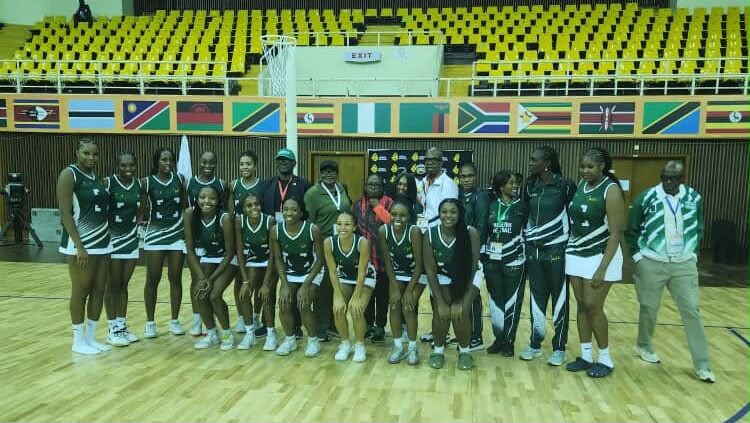
Nigeria’s Green Hawks will turn their attention to Zambia on Tuesday as the country’s first-ever national netball team continues its historic campaign at the Africa Netball Cup and 2027 Netball World Cup African Qualifiers in Nairobi, Kenya.
The encounter presents Nigeria with another opportunity to measure its progress after a demanding welcome to international netball against three established African sides.
Nigeria began the competition with a 61–40 defeat to hosts Kenya before facing world number six Uganda, who recorded a 68–30 victory.
The Green Hawks then suffered an 82–22 loss to Malawi on Monday, leaving the Nigerian side still searching for its first victory of the tournament.
Against Malawi, Nigeria trailed 21–6 after the opening quarter before the gap widened to 40–11 at half-time.
Malawi eventually completed the contest with a 60-goal advantage and, in the process, strengthened their World Cup qualification campaign.
For Nigeria, however, the tournament represents more than immediate results.
The Green Hawks are competing internationally for the first time, with the Nairobi tournament providing the players with their first sustained exposure to some of Africa’s leading netball nations.
Nigeria’s next opponents, Zambia, therefore offer another test of how quickly the newly assembled side can adjust to competition at continental level.
With matches against Kenya, Uganda and Malawi now behind them, Tuesday’s encounter provides the Green Hawks with another opportunity to translate the experience gained from those difficult fixtures into an improved performance.
The Africa Netball Cup and World Cup African Qualifiers continue in Nairobi until September 26.

The Federal High Court in Abuja on Tuesday fixed Nov. 24 for hearing in a suit filed by the Chartered Institute of Forensics and Certified Fraud Investigators of Nigeria (CIFCFIN) against the Institute of Chartered Accountants of Nigeria (ICAN).
CIFCFIN is challenging the power of ICAN to train and issue qualifying certificates to forensic professionals.
The matter, which is before Justice Joyce Abdulmalik, was initially scheduled for mention on Tuesday but the case was adjourned to enable parties appear properly before the court.
The News Agency of Nigeria (NAN) reports that CIFCFIN, through its counsel, Shaibu Aruwa, a Senior Advocate of Nigeria (SAN), sued ICAN as the sole defendant in the suit marked FHC/ABJ/CS/1559/2026.
CIFCFIN argued that ICAN cannot offer a “Certification Programme culminating in the award of Certified Forensic Accountant of Nigeria (CFAN).”
It submitted that this was in line with the combined interpretation of Sections 2(a) – (i),3(1)(a) and 4(a) – (c), 6(2), 12(2), 13, (1) () and (g), 17(1l) (a) and (b) and 22 of the Chartered Institute of Forensics and Certified Fraud Investigators of Nigeria (Establishment) Act No. 45, 2022,


Mohammed Arafat, the Head of Legal and Corporate Services of CIFCFIN, maintained in a supporting affidavit that ICAN’s invitation to applicants for a seven-day professional certification programme culminating in the award of Certified Forensic Accountant of Nigeria (CFAN), is outside its mandate and could confuse the general public.
The plaintiff alleged that ICAN had invited applicants in the fields of knowledge of chartered accountants, compliance managers, bankers, investment analysts, auditors, and anti-corruption agencies staff and other institutions to register for the programme.
CIFCFIN, therefore, prayed the court for an order setting aside and nullifying the award of the qualification or the CFAN certificate, or any other qualification or certificate in the field and practice of forensics in Nigeria by ICAN.
It urged the court to make an order for the defendant to withdraw, retract or cease any publication, gazette notice, or public representation asserting that it has power to certify or license.
CIFCFIN also sought an order of perpetual injunction restraining ICAN, its council, etc, from issuing, advertising or recognising CFAN qualification, designation, licence or certification or any title or award identical or similar to those created under the provisions of its Act.
It further sought a declaration that “by the combined provisions of Sections 2(a) -(i), 3(1)(a) and 4(a)- (c), 6(2), 12(2), 13, (1)(0) and (g), 17(1)(a) and (b) and 22 of the Chartered Institute of Forensics and Certified Fraud Investigators of Nigeria (Establishment) Act No. 45. 2022, the defendant cannot offer ‘Certification Programme’ culminating in the award of CFAN.”
(NAN)
Discover more from Premium Times Nigeria
Subscribe to get the latest posts sent to your email.
-

 Business2 days ago
Lingzhi Global, NACOFTAN Announce 2026 Coffee Festival in Cross River
-
Events2 days ago
Peace Walk: WOPPI Urges Plateau Citizens to Invest in Peace Every Day
-
News2 days ago
INEC declares APM’s Adamu Yakubu winner of Sakwa bye-election in Bauchi
-
 Health2 days ago
Nigerian hospitals collaborate to perform tele-robotic surgery