Views: 4
PRESS RELEASE
COA MEDIA ANNOUNCES PMYA @12 — THE STANDARD
Plateau Man of the Year Awards Enters Its 12th Edition with New Leadership Dialogue
Jos, Plateau State, Nigeria — October 2026
COA Media, organisers of the Plateau Man of the Year Awards (PMYA), announces the 12th edition of the annual awards, scheduled for Sunday, 10 January 2027, at Usiju World Event Centre, Jos, Plateau State.
The 12th edition will introduce the Plateau State Governorship Candidates’ Manifesto & Leadership Dialogue, adding an issue-based public conversation on the future of the state to the PMYA programme.
Established in 2014, PMYA has, for more than a decade, recognised individuals, institutions and organisations whose achievements, leadership, service and contributions have made a measurable difference in Plateau State and beyond.
The 12th edition carries the identity “PMYA @12 — THE STANDARD” and the theme:
“Leadership Beyond Politics: Building a Legacy for Future Generations.”
The edition reflects PMYA’s continued commitment to identifying genuine achievement, meaningful impact and responsible leadership while maintaining a credible record of those whose work contributes to the progress of Plateau State and beyond.
THE STANDARD
For PMYA @12, THE STANDARD represents a deliberate focus on merit, achievement, impact and the enduring value of service.
Since its establishment, PMYA has honoured hundreds of individuals and organisations across diverse sectors, documenting a broad range of contributions to Plateau State and beyond.
At the centre of the awards is the Plateau Man of the Year — Star Category, the highest honour presented by PMYA.
Previous Recipients
- Amb. Yahaya Kwande — 2015
- Sen. Simon Bako Lalong — 2016
- Dame Pauline Tallen, OFR — 2017
- Dr. Chris Kwaja — 2018
- Hon. Beni B. Lar — 2019
- Chief Dauda Wuritka-Gotring — 2020
- Rt. Hon. Ahmed Idris Wase — 2021
- Sir Joseph N. Ari — 2022
- Chief Engr. Meshach Maichibi — 2023
- Barr. Caleb Manasseh Mutfwang — 2024
- Prof. Nentawe Goshwe Yilwatda — 2025
Each recipient represents a distinct chapter in PMYA’s history of recognising leadership, achievement and service.
A BROADER CONVERSATION FOR PLATEAU
As part of PMYA @12, COA Media will host the Plateau State Governorship Candidates’ Manifesto & Leadership Dialogue.
The non-partisan, issue-based platform is designed to give participating governorship candidates an equal opportunity to present their visions, policy priorities and leadership agenda for the future of Plateau State.
The conversation will address critical areas including governance, peace and security, economic development, youth empowerment, education, healthcare, infrastructure, tourism, investment and sustainable development.
The dialogue will operate independently of political parties and campaign organisations, with equal treatment of participating candidates and emphasis on policy ideas, public priorities and issues relevant to the people of Plateau State.
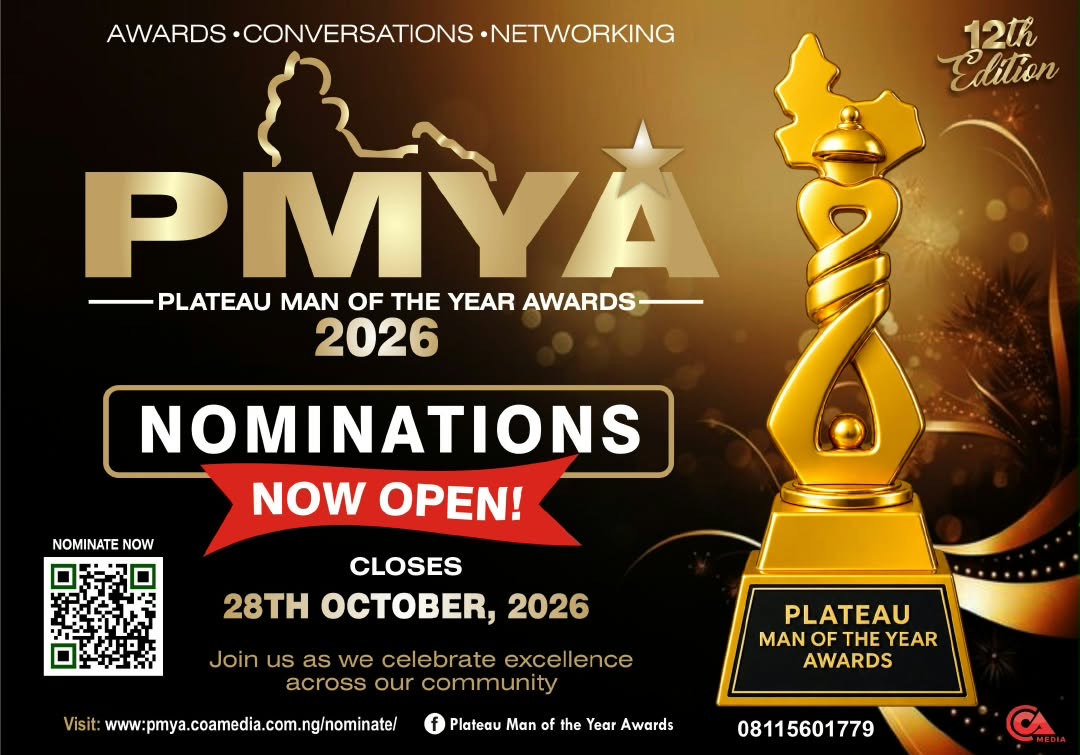
NOMINATIONS OPEN 7 OCTOBER
Nominations for PMYA @12 open on 7 to 28 October 2026.
The awards will feature categories spanning leadership, governance, business, entrepreneurship, humanitarian service, education, healthcare, youth development, agriculture, media, technology, entertainment, culture, professional excellence and community impact, among others.
Members of the public are encouraged to nominate individuals and organisations whose achievements and contributions merit consideration.
Speaking on the 12th edition, Amb. Cletus Akhimien, Executive Director of COA Media and Event Director of PMYA, said:
“PMYA @12 is not simply another edition. It is an opportunity to reaffirm the standard by which achievement, leadership and impact should be recognised. After more than a decade of celebrating people who have contributed to Plateau’s story, we are looking ahead to the kind of leadership and legacy we want future generations to inherit.”
COA Media also invites organisations, institutions and brands interested in supporting PMYA @12 — THE STANDARD to explore strategic partnership and sponsorship opportunities.
EVENT DETAILS
PMYA @12 — THE STANDARD
Theme: Leadership Beyond Politics: Building a Legacy for Future Generations
Date: Sunday, 10 January 2027
Time: 2:00 PM
Venue: Usiju World Event Centre, Jos, Plateau State
NOMINATION & PARTNERSHIP CONTACT
Email: plateauawards@gmail.com
Phone: +234 811 560 1779
Website: pmya.coamedia.com.ng
E-Signed:
Amb. Cletus Akhimien
Executive Director, COA Media
Event Director, Plateau Man of the Year Awards (PMYA)








 News2 days ago