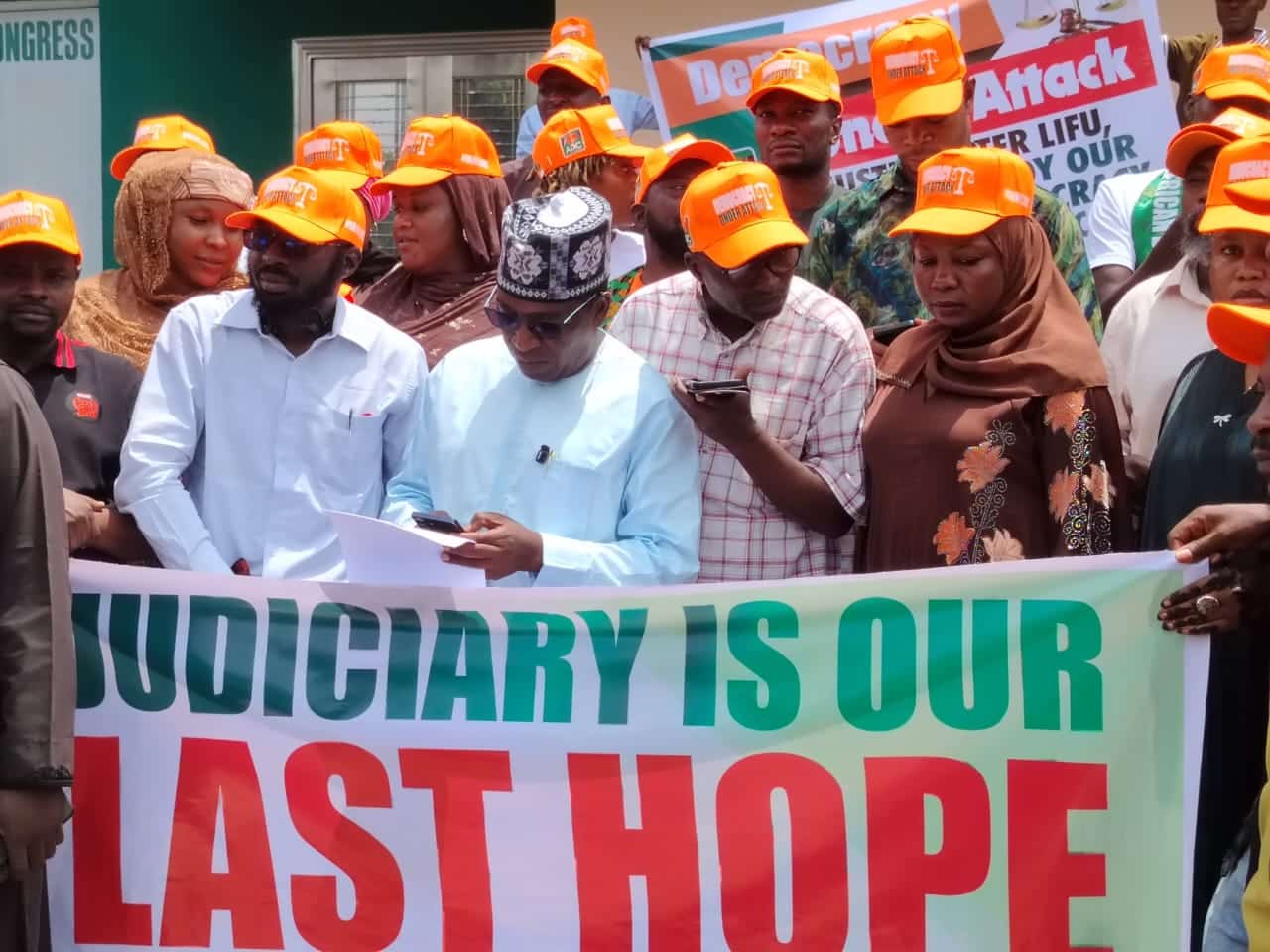
The National Youth Wing of the opposition African Democratic Congress, ADC) has written a formal petition against Justice Peter Odo Lifu, demanding his removal “from any and all adjudicatory matters, reviews, or decision-making roles concerning the ADC.”
The petition, dated June 18, 2026, was addressed to the Executive Secretary, National Judicial Council (NJC), and signed by the ADC’s national youth leader, Comrade Balarabe Rufai.
While reading the content of the petition to media in front of the ADC National Secretariat, Comrade Rufai, who was represented by Comrade Ibrahim Garba Wala, alleged that there were attempts to prevent them from submitting the petition at the NJC.
According to him, all roads leading to the NJC, on Thursday were barricaded by heavily armed security agents; hence, the need to present the petition to the public.
The petition reads, “We demand the immediate, total removal of Hon. Justice Peter Odo Lifu from any and all adjudicatory matters, reviews, or decision-making roles concerning the ADC. Furthermore, given his pattern of flagrant judicial rascality, we explicitly demand that the National Judicial Council recommend his absolute dismissal from the Nigerian judiciary to preserve the fading credibility of the bench.
“Our democratic architecture is under a coordinated assault by compromised custodians of the law. Under suit number FHC/ABJ/CS/2637/2026, Hon. Justice Peter Odo Lifu delivered a highly controversial ruling ordering the Independent National Electoral Commission (INEC) to deregister the ADC and four other political parties. This judgment is not an honest legal error; it is a calculated, politically motivated act designed to shrink the democratic space in Nigeria and artificially consolidate a two-party monopoly.”
While lamenting what he described as “legal distortions and judicial rascality tying Justice Lifu to this systemic compromise,” the ADC Youth leader said, “Justice Lifu brazenly proceeded with this judgment despite a binding Court of Appeal order that explicitly stayed proceedings on this matter, a move that subverts the sacred doctrine of stare decisis and constitutes gross misconduct.”
“The bench looked away as the plaintiffs, the Incorporated Trustees of the National Forum of Former Legislators, clandestinely altered their legal personality midway through the process without a valid court order.
“While the NJC has previously dismissed certain claims due to standard procedural hurdles, the persistence of these identical accusations across multiple petitions—including those by the Chairman of the Boot Party—proves a systemic erosion of public trust.
“We cannot watch the political rights of millions of young Nigerians be auctioned off by compromised benches. The continuous involvement of Justice Lifu in ADC affairs completely destroys public trust and makes a mockery of fair hearings. As the protectors of our nation’s future, we declare that when the bench compromises its integrity, the youth will become the courtroom of public conscience. The ballot box belongs to us, and we will not allow any court to rob us of our political expression.”
“Until the Council acts to protect institutional integrity, enforces discipline, completely recuses this individual from our affairs, and begins the process for his immediate sack from the bench. Respectfully submitted on behalf of the Nigerian youth during a live protest.”
This comes as Lifu, in a judgment, ordered the Independent National Electoral Commission to deregister five opposition parties, including ADC.
However, following widespread condemnation, the appeal court ordered a stay of execution of the judgment.
For more than 30 years, Mutual Benefits Assurance Plc has built its reputation on a simple promise: being there for Nigerians when protection matters most.
From safeguarding families and businesses to protecting assets and supporting long-term financial goals, the company has earned the trust of millions of Nigerians and established itself as a recognised player in Nigeria’s insurance industry.
That legacy of trust now provides the foundation for Mutual Benefits’ next chapter.
Following the successful completion of its recapitalisation,Mutual Benefits is positioning for sustainable growth while strengthening its role as a trusted protection partner to Nigerians.
Commenting on the development, Managing Director/CEO, Femi Asenuga said: “For over three decades, Nigerians have entrusted Mutual Benefits with what matters most to them. This includes their families,
businesses, assets and financial futures.
That trust is both our greatest privilege and our greatest responsibility. Our recapitalisation strengthens the foundation from which we can serve our customers better, innovate more meaningfully and build sustainably for the future.”
For Mutual Benefits, the significance of recapitalisation goes beyond meeting a regulatory requirement. It provides a stronger platform to deepen investment in products, technology, customer experience and service capabilities, while responding to the evolving financial protection needs of Nigerians.
The company’s portfolio spans Non-Life and Life Assurance solutions covering key areas including Motor, Home, Marine, Fire & Special Perils, Travel and Group Life Insurance, among others, as well as a suite of solutions supporting children’s education, retirement, savings and investment.
As customers increasingly expect greater convenience and accessibility, Mutual Benefits is also accelerating its digital transformation, strengthening its online platforms and customer journeys to make insurance easier to access and interact with.
The company is equally placing renewed emphasis on customer experience, with a focus on improving engagement and service delivery across the customer journey.
Asenuga added: “Our ambition is not simply to grow bigger, but to become better for our customers. Every investment we make in technology, people, products and service must ultimately translate into greater convenience, stronger value and greater confidence for the people and businesses we serve.”
As Nigerians navigate changing economic realities and increasing financial responsibilities, Mutual Benefits believes insurance has an increasingly important role to play in helping individuals and businesses build resilience and protect what they have worked hard to create.
The company’s post-recapitalisation strategy, therefore, focuseson sustainable growth, innovation, operational effectiveness and deeper customer engagement, while expanding access to relevant protection and financial solutions.
With three decades of experience behind it and a stronger foundation for the future, Mutual Benefits remains committed to earning and reinforcing the trust of its customers, helping them protect what matters, prepare for uncertainty and pursue their financial aspirations with greater confidence.
“We are proud of the journey Mutual Benefits has taken over the past 30 years, but we are even more focused on what lies ahead. Our stronger foundation gives us the opportunity to serve more Nigerians, create greater value and deepen the trust that has sustained our business. We are committed to being a protection partner our customers can depend on today, tomorrow and for generations to come,” Asenuga concluded.
Nigeria’s telecommunications regulator is set to block SIM-enabled devices that are not registered and authenticated from operating on the country’s mobile networks as part of a new technology-driven crackdown on non-compliant and illegally imported devices.
The Nigerian Communications Commission (NCC) said the measure is being implemented through its Device Management System (DMS), which will electronically determine whether SIM-enabled communications devices comply with the telecoms watchdog’s Type Approval requirements.
The NCC announced the development in a statement signed by Nnenna Ukoha, its Director of Public Affairs, on September 9, 2026, but no time frame was indicated in the announcement made available to Technology Times.
Nigeria’s telecoms market had 195.11 million active mobile subscriptions in July 2026, according to the latest industry statistics from the NCC, underscoring the scale of the network ecosystem affected by the new device-registration regime. Source: NCC.
Nigeria’s telecoms market had 195.11 million active mobile subscriptions in July 2026, according to the latest industry statistics from the NCC, underscoring the scale of the network ecosystem affected by the new device-registration regime. The figure represented a rise from 182.23 million active lines in January, while national teledensity reached about 90% in July. The size of the subscriber base means the NCC’s Device Management System (DMS) will operate across a mobile market approaching 200 million active lines, giving the regulator a broad network-level mechanism for identifying and blocking SIM-enabled devices that do not meet its registration and Type Approval requirements.
Nigeria’s telecoms market nears 200 million active lines
Nigeria’s telecoms market had 195.11 million active mobile subscriptions in July 2026, according to the latest industry statistics from the NCC, underscoring the scale of the network ecosystem affected by the new device-registration regime. The figure represented a rise from 182.23 million active lines in January, while national teledensity reached about 90% in July.
The size of the subscriber base means the NCC’s Device Management System (DMS) will operate across a mobile market approaching 200 million active lines, giving the regulator a broad network-level mechanism for identifying and blocking SIM-enabled devices that do not meet its registration and Type Approval requirements.
Under the new framework, NCC said that all SIM-enabled communications devices brought into Nigeria must be registered before they are sold, while devices that are not duly registered will no longer be permitted to operate on Nigerian telecoms networks.
The move represents a significant expansion of the nation’s telecoms regulator’s enforcement of Type Approval rules, shifting compliance monitoring towards an automated system capable of identifying devices through their International Mobile Equipment Identity (IMEI) numbers.
The commission said the DMS will provide the technology platform for the automated compliance framework and improve its oversight of the communications device ecosystem.
The regulatory intervention is also being implemented with the Nigeria Customs Service (NCS), Original Equipment Manufacturers (OEMs), importers and relevant market associations, putting device compliance at both the border-import stage and network-access stage.
Customs to play role in stopping illegal devices
The NCC said it has commenced the first phase of the automated Type Approval compliance framework and is working with the Nigeria Customs Service and other stakeholders to ensure that devices imported into Nigeria are appropriately registered and authenticated.
The first phase includes onboarding existing devices currently held in stock, while future imports will be subjected to registration and authentication requirements.
This is intended to give the commission a mechanism for identifying non-compliant and illegally imported devices before they enter widespread use on Nigerian networks.
Bashir Adewale Adeniyi, Comptroller-General of Nigeria Customs Service (NCS). Image credit: NCS.
The NCC said it has commenced the first phase of the automated Type Approval compliance framework and is working with the Nigeria Customs Service and other stakeholders to ensure that devices imported into Nigeria are appropriately registered and authenticated.The first phase includes onboarding existing devices currently held in stock, while future imports will be subjected to registration and authentication requirements.
The Customs collaboration gives the new framework a supply-chain dimension, with regulatory checks extending beyond mobile networks to the point at which communications devices enter the country.
The NCC said the system will make it easier to identify illegally imported and non-compliant devices, while improving enforcement of the Type Approval regime.
The commission’s intervention, according to the statement, is based on Section 132(2) of the Nigerian Communications Act 2003, which requires licensed service and facilities providers, equipment manufacturers and suppliers to obtain Type Approval from the NCC before communications equipment can be sold or used in Nigeria.
CEIR to underpin device registration
According to Engr. Edoyemi Ogoh, the NCC’s Director of Technical Standards and Network Integrity, the framework is built around the Central Equipment Identity Register (CEIR), established under the Type Approval Business Rules issued by the commission in August 2024.
The CEIR will maintain a central registry of the IMEI numbers of SIM-enabled communications devices in Nigeria.
Ogoh said the commission began stakeholder engagements and market studies after the 2024 rules were issued, leading to the design and deployment of the current system.
“With the deployment of this system,” Ogoh added, “all SIM-enabled communications devices brought into the country must be registered before they are sold. Devices that are not duly registered will not be permitted to operate on Nigerian networks.”
The use of IMEI numbers gives the NCC a means of identifying individual devices connecting to mobile networks and determining whether they meet the applicable Type Approval requirements.
The commission said this will strengthen its ability to enforce technical standards while providing greater visibility into devices being imported, sold and used in Nigeria.
Stolen phones also targeted
The DMS will not only be used to enforce Type Approval requirements.
The NCC said the system will also help address wider challenges in Nigeria’s device market, including the use of stolen phones.
Devices reported stolen can be blocked from operating across Nigerian mobile networks, potentially reducing the usefulness of stolen devices and making them easier to identify within the communications ecosystem.
Nigeria’s telecommunications regulator is set to block SIM-enabled devices that are not registered and authenticated from operating on the country’s mobile networks as part of a new technology-driven crackdown on non-compliant and illegally imported devices. Image credit: AI.
The platform will maintain device identification information, including IMEI numbers, but the NCC said it will not have access to the content stored on users’ devices or the ability to monitor personal communications through the system.
The commission said the framework is also expected to enhance network performance and consumer confidence in devices sold and used in Nigeria.
For consumers, the implication is that compliance with the NCC’s device requirements will become increasingly important when purchasing SIM-enabled devices, particularly smartphones and other connected communications equipment.
A device that has not been properly registered could ultimately be prevented from accessing Nigerian mobile networks, regardless of whether the device can technically connect to those networks.
NCC says DMS will not monitor users’ communications
The regulator sought to distinguish the device-management framework from systems designed to monitor communications.
Ogoh said the DMS is designed solely to support device identification and Type Approval compliance.
The platform will maintain device identification information, including IMEI numbers, but the NCC said it will not have access to the content stored on users’ devices or the ability to monitor personal communications through the system.
The commission described the initiative as part of its mandate to ensure that communications devices imported, sold and used in Nigeria meet applicable technical and regulatory standards.
The automated framework is expected to make enforcement more efficient by allowing the NCC to electronically determine whether devices comply with Type Approval requirements.
What the new rule means for Nigeria’s device market
The framework effectively creates a compliance chain extending from importation to sale and finally network access.
Importers and manufacturers will need to ensure that applicable devices are appropriately registered and authenticated. Customs authorities and other stakeholders will work with the NCC to improve checks on devices entering the country, while mobile networks will provide the final point at which non-compliant devices can be prevented from operating.
The NCC said the first implementation phase is already underway, with existing stock being onboarded into the system.
The commission did not state in its announcement when enforcement would begin to block all unregistered devices already in circulation, nor did it provide details of a specific grace period for consumers or traders holding devices that have not yet been registered.
It also did not disclose the categories of devices that will be affected beyond SIM-enabled communications devices.
However, the regulator’s announcement makes clear that registration and authentication will become a condition for SIM-enabled devices to operate on Nigerian networks as the DMS framework is rolled out.
The development places greater responsibility on importers, manufacturers, distributors and retailers to ensure that devices entering the Nigerian market comply with the NCC’s Type Approval regime.
For the Nigeria Customs Service, the collaboration with the NCC introduces an additional regulatory layer for communications equipment entering the country, while for the telecoms regulator, the DMS provides a direct mechanism to enforce compliance at the point of network access.
The NCC said the overall objective is to strengthen the integrity of Nigeria’s communications device ecosystem while improving compliance, network performance and consumer confidence.