News
I tried Amazon’s Bee wearable and am both intrigued and slightly creeped out

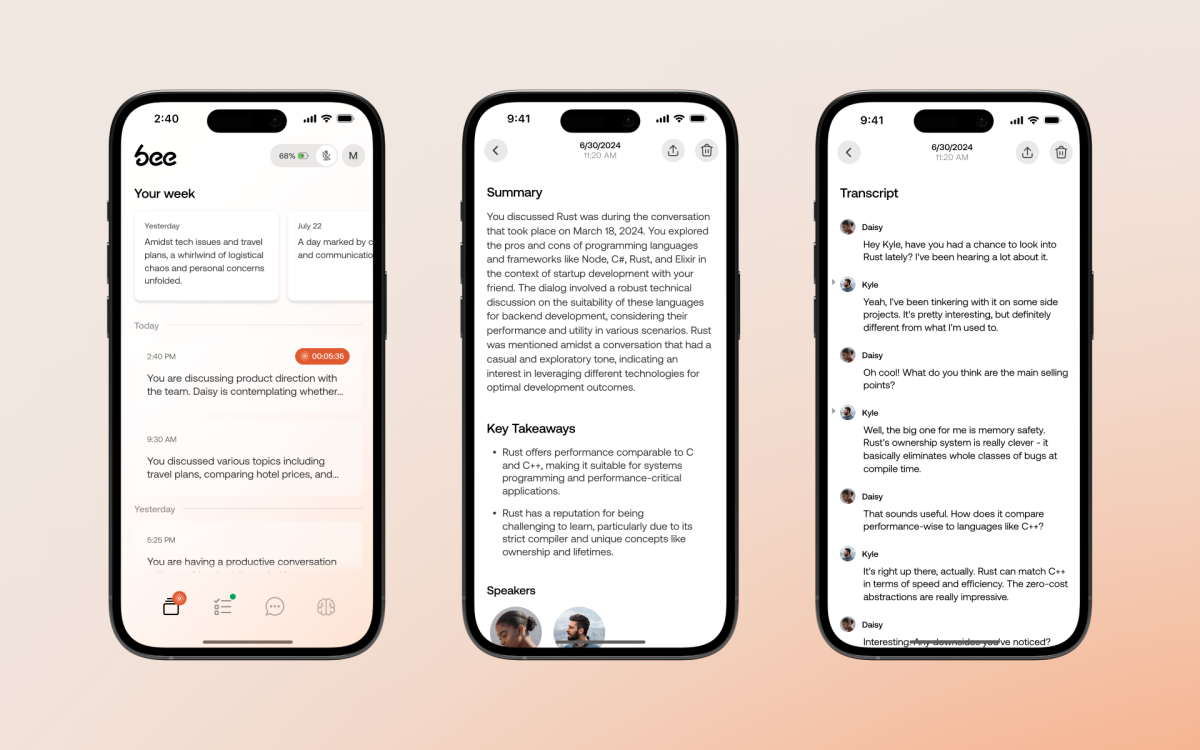
I recently had the opportunity to test out a wearable from Bee, the AI wrist gadget that Amazon acquired last year and has since updated with a number of new features.
Like other AI wearables, Bee is designed as a kind personal assistant: it records, transcribes, and summarizes the user’s conversations throughout the day, providing an ongoing note-taking capability that’s useful if you’re forgetful or just want to be more organized about your life. If you sync it with your calendar, it can also send you alerts and reminders about things you’re supposed to do throughout the day.
TechCrunch has written about Bee before, and the way it works is pretty simple: the user powers it up, puts it on, syncs it with the Bee mobile app, and enters some basic personal information. Bee has a built-in recorder that can be turned on and off by clicking the wearable’s button. When Bee is recording, a green light flashes. When it’s not, that green light goes off. After a conversation has been recorded, the app will create an automated summary that is easy to read, as well as an entire transcription of the conversation.
Your mileage may vary on how exciting (or not) this whole conceit is. The problem for me is that I am something of a privacy enthusiast. In a world where the average person is beset from all sides by constant digital surveillance, I appreciate any opportunity I can get to not be recorded. Therefore, the idea of walking around with an eavesdropping gizmo strapped to my wrist 24/7 was not particularly appealing.
Yet, even I have to admit that — in the right context — Bee could have a lot of potential to help organize your life.
Bee really comes through in the context of professional engagements. If your day is full of meetings and you have trouble keeping it all straight, Bee could be a moderately competent assistant.
During a business-related phone call this week, I activated Bee after getting confirmation that I could record our meeting. Afterward, the app faithfully regurgitated a summary of the conversation, helpfully breaking down each segment of our talk so that I could review it later without having to re-listen to our entire conversation. This was undeniably helpful, although it should be noted that this isn’t something that’s markedly different than those offered by other transcription services, like Otter or Granola and others, which also offer transcriptions and auto-generated summaries.
That said, you could envision a situation in which a professional who has to navigate between various meetings throughout the day would be well-served by this device. You could just keep Bee running throughout the day and, later, review the conversation summaries for anything you’re not clear about.

Bee does a relatively good job at summarizing conversations, but the actual transcripts offered by the wearable can be a bit of a mess. Previous critics have noted that you usually have to manually enter the names of other speakers, as Bee doesn’t always know who is talking. During my conversation, I noticed that it had also omitted certain sections of our chat — nothing huge, but it wasn’t a complete account of everything that had been said.
I also took Bee to my semi-weekly movie night with my friends and left it running throughout the night. Given the fact that we watched Reservoir Dogs, I was mildly afraid that the wearable would mistake all of the vulgar carnage for real-life bloodshed and potentially trigger some sort of internal alarm. However, Bee knew — basically — what was happening. The wearable figured out that we were watching a movie and, in the summary of events afterward, the wearable labeled the conversation “Tarantino Film Scene Analysis.”
While Bee shows early promise as a professional tool, I would not want this thing recording me in my personal life. Weirdly enough, Bee has largely been marketed as a product for personal use. To be comfortable with that, you have to be comfortable with Bee having access to a majority of both your offline and digital life.
Indeed, to work well, Bee needs expansive mobile permissions — including access to your location, photos, phone contacts, calendar, and mobile notifications. You can also share your health data with it — should you, for whatever reason, want it to know about your sleep patterns or your resting heart rate.
The large accumulation of data Bee collects is stored in the cloud, which — again, for the digital privacy enthusiast — presents its own concerns. In a message to tech YouTuber Becca Farsace, Bee apparently unveiled a demo of the device running entirely locally. Were the company able to produce such a device, I would be thoroughly impressed — and might even consider buying one. That said, Amazon hasn’t offered any update on those plans.
As for Bee’s digital privacy protections, the company says that it offers encryption to protect user data — both at rest and in-transit. In its privacy policy, the company states that it has “implemented technical and organizational security measures designed to protect the security of any personal information” that the company processes. Bee also claims that it undergoes “rigorous third-party security audits” and employs continuous security monitoring. That all sounds quite good, although it’s worth noting that Amazon — like many large tech companies — has been subject to the occasional data security issue or two (not exactly surprising for a company that governs as much of the global cloud environment as it does, but still).
In short, Bee is a curious piece of hardware that, given some time and some tweaking, could have some promising professional applications further down the road. As a digital assistant for your personal life, however, it might prove to be a little too invasive for some users.
When you purchase through links in our articles, we may earn a small commission. This doesn’t affect our editorial independence.




The Central Bank of Nigeria (CBN) has granted approval-in-principle to JP Morgan to set up a merchant in the country.
The move eases the path for the US largest bank to expand its services – payments, lending, trade finance and corporate banking – in Nigeria, where it has operated a representative office for years.
JP Morgan Merchant Bank Nigeria Limited plans to run wholesale banking, capital markets and advisory services, Michael Akuka, the CBN’s director of corporate communications and investor relations, said in a statement on Friday.
The approval-in-principle is the first phase of the licensing process, and does not translate into an ultimate banking permit.
JP Morgan needs to clear further regulatory hurdles such as incorporation with the Corporate Affairs Commission and operational approvals before it can commence operations, the regulator stated.
The push comes amidst hordes of banking sector reforms in Africa’s most populous country, aimed at bolstering the financial system, enhancing market confidence and boosting resilience.


According to the statement, the CBN also approved the nomination of Adedapo Olagunju as the managing director of the bank and Latter Kevin George, Nzelu Chinedum Izunwanne and Syed Gabriel Murtaza as non-executive directors.
“Our objective is to build a financial system that is stable, competitive and internationally connected, one that commands confidence and can effectively support investment and economic growth,” said CBN Governor Olayemi Cardoso.
READ ALSO: CBN outlines market infrastructure supporting Nigeria–China financial flows at Beijing investor forum
“We are encouraged by the growing interest of international financial institutions in Nigeria. Our focus remains on sustaining the reforms, strengthening the credibility of our markets and creating an environment in which both domestic and international institutions can participate and thrive,” he added.
On Tuesday, Bloomberg, citing sources with knowledge of the deal, reported that JP Morgan was on course to secure a banking licence in the country after depositing N50 billion ($38 million) with the CBN.
It noted that the bank hopes to receive the licence by year-end or in early 2027, provided it is able to obtain all the requisite approvals
P Morgan’s presence in Nigeria dates back to 1961, when Chase Manhattan Bank, which later evolved into JP Morgan Chase & Co., opened a branch in Lagos, providing a wide range of commercial banking services to local businesses and individuals.
A year earlier, Chase International Investment Corporation, a unit of Chase Manhattan Bank, served as the lead partner in organising Nigerian Textile Mills in Lagos, regarded as the first major private industrial project with an American interest in Nigeria.
Discover more from Premium Times Nigeria
Subscribe to get the latest posts sent to your email.

-

 News1 day ago
Obi, Kwankwaso to hold Middle Belt Youth, Village Hall Meeting in Jos
-
Business4 days ago
How Your Side Hustle Income Ends Up in Your RSA
-
News3 days ago
Blacksmith hits unicorn valuation after Sequoia leads Series C
-
Entertainment2 days ago
FOGMMON PLATEAU CONGRATULATES EJIDIKE UGOCHUKWU (𝙈𝙞𝙣𝙨𝙩𝙧𝙚𝙡 𝙅𝙞𝙙) ON HIS APPOINTMENT AS NATIONAL PRESIDENT