
Opinion
“THE LAW IS AN ASS”: Misconceptions And Beauty Of Its Application For The Common Good – By Professor John W. WADE, mni.

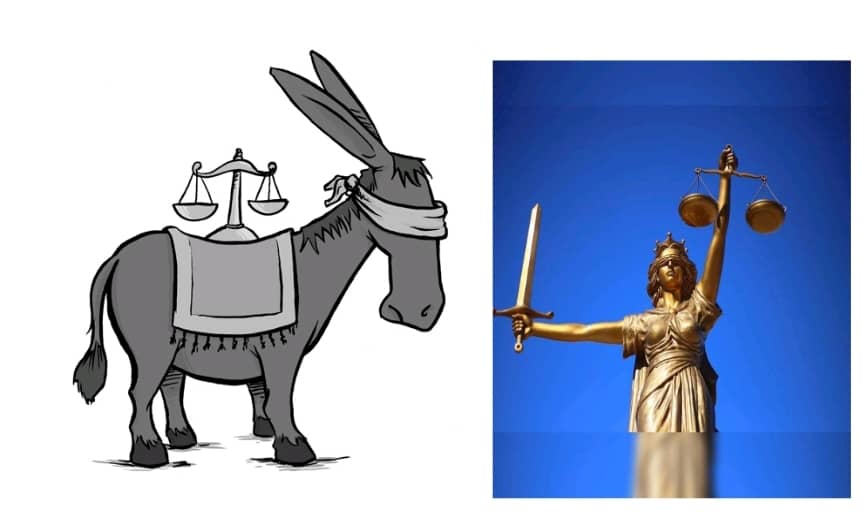
“THE LAW IS AN ASS”: Misconceptions And Beauty Of Its Application For The Common Good – By Professor John W. WADE, mni.
This article is a LONG READ, meant to share values and educate. It therefore requires time and patience in reading between the lines, devoid of sentiments. No mockery or insults on individuals or groups intended, whatsoever. Reader’s Comments are welcomed.
Let me start with what may sound hilarious by introducing the revered pictures of the Ass or Donkey… An Animal with many connotations and Lady Law or Lady of Justice. I Speak on the Ass here for the purpose of direct application to the title of my epistle on “THE LAW IS AN ASS.” Why the depiction of Ass and who is an Ass? The response: When the Law Speaks in the posture of the Ass as elucidated in the picture, it is that of a patient, obedient beast of burden. The mouth closed and Silent; the eyes wrapped around the ears and closed; with scale of justice on its back as symbol of impartiality in weighing facts and evidences to decide on a verdict. This is just as the classical Lady Law Logo, blindfolded and closed and silent mouth (That only opens to speak out to dispense unbiased justice, Stricto Senso); and on one hand is the unsheathed two-edged sword, which symbolizes authority to reward justice and punish injustice and ability to cut through obstacles to get at the truth of facts and reasons. So, “The Law is an Ass” is an interesting phenomenon.

Professor John W. WADE, mni.
A CAVEAT!!!
With humble acclamation let me categorically state that I am not a trained Lawyer nor a Barrister-At-Law that is called to the Bar and licensed to practice. I am therefore approaching this topical issue from a background experience and exposure in my over 30 years of teaching Philosophy and more specifically, Research Perspectives and Philosophy of Science and its broad application to knowledge to my Postgraduate Students. This is the closest that may have its impact on Jurisprudence but not sufficient enough for me to claim being an Authority on the subject matter of Law.
I am prompted to write and make this modest contribution on the topical but popular adage, “The Law is an Ass” following a reading of several posts and misgivings that some people appear to have about fundamental operational basis of the Law and dispensation of justice, as if it is very cheap to obtain in the open market. However efforts to throw more light for people’s understanding came into sharp focus through a post in the social media by a Compatriot, Social Crusader and Barrister-at-Law, Dauda Lamba, Esq, on the issue of Law as a discipline; “The Law as an Ass” and ardent responsibilities of Judges in dispensing justice.
The apt epistle by Barrister Lamba, though very brief, took a Benedictine approach and plea on the imperative to understand the essence of the subject matter of Law as a discipline and the “Law as an Ass.” He further embellished his thoughts with a clarion call for restrain and respect for any judgment as delivered by constituted authorities.
While I sincerely commend his uncommon patriotic zeal and effort, I consider the concerns as long overdue responsibilities on all and sundry. The call to duty for patriotic understanding is even more incumbent on the Government at all levels, Civil Societies Organizations (CSOs), Religious Bodies, Traditional Rulers and veru critically, Political Parties in moments of trials and tribulations as we have been experiencing with the Tsunamis of judgments by different Elections Petitions Tribunal. The judgments are usually to the pleasure and displeasure of either the Petitioner or Complainant or Defendant and their different interest groups.
As stated in my caveat, I am contributing on the topical issue from a Philosophical perspective, which is the closest that may have its impact on Jurisprudence and in furtherance to rendering support and encouragement for understanding and betterment of the society. In this respect, I concluded my thoughts with some advisory expositions on the imperative to understand, appreciate and respect the Law, especially those who often fester on expression of vitriolic sentiments and whimsical cruelty when things don’t go their ways, thinking the world revolves round them.
THE “LAW IS AN ASS:” MEANING AND EVOLUTION.
“THE LAW IS AN ASS” is simply defined in the light of a “rigid application of the letter of the Law seen to be contrary to common sense.” The sentiment is that this expression in the legal system is stupidly rigid, unjust or absurd in application of the law and therefore calls for question. However, it is believed that the “Rigid application of the letter” should be devoid of any personal fiduciary interest to influence the mind of the Jurist or Judge as the case may be.
In this proverbial expression of the colloquial name of “ASS,” it is attributed to the Animal called Donkey that is often perceived as “obstinate, stupid and hard to change in its course of action;” just like the Dodo (an extinct bird species) that is also reputed to be an obstinate and stupid animal but the difference with the Ass being that it would stay-put, starring at its Predator or killer with a gun, instead of running away in the face of death.
In tracing the evolutionary history of the expression of “The Law as an Ass,” it is averred that the expression originated from a play or drama titled, “Revenge for Honour” by George Chapman believed to have been written in 1620, but published in 1654. It was further popularized in the Novel titled, “Oliver Twist” by Charles Dickens in 1838. It remains a popular expression as in Law till date. Invariably, the origin and use of this phrase dates back to over 400 years!
The expression of “The Law as an Ass” can also be said to enjoy its definition from the Philosophy of Positive Law or jus positivum, translated to mean the extant or existing law as it is and as written, “Stricto Senso” or in the “Strict Sense,” without exaggeration or approximation. This finds relevance in Philosophy or Knowledge of Law called Jurisprudence. This, however, does not imply it is closer to the ideal, Natural or Moral Laws and it has some criticisms as we would see later.
I therefore always view the expression of “The Law Is an Ass” from the perspectives of deep Philosophical meaning and its application for the COMMON GOOD; which is critical to the attainment of justice, equity and accountability.
THE “COMMON GOOD” Vs. THE ASS.
The Philosophy and Principle of “Common Good” is basically about working in synergy for the improvement, well-being and progress of people in the society.
This is achievable in the light of considering its fundamental principles, namely, Personhood or dignity of the human person; Solidarity in terms of togetherness in both ethical and moral virtues; and Subsidiarity in terms of delegating or assigning or sharing responsibilities even to the smallest groups.
Common Good is indeed paramount to the nature of Law and when juxtaposed with the ideals of Law and indeed the “Law is an Ass,” then Justice, Equity, Accountability and cohesiveness will be guaranteed. Being paramount to the nature of Law it was therefore not surprising when Saint Thomas Aquinas (1225 – 1274), the erudite Catholic Dominican Friar and Priest, Scholastic Philosopher, Profound Academic, Theologian and Jurist saw the concept of “Common Good” as paramount to the benefit of all in terms of promoting peace, preserving life and preserving the State. This is contrary to earlier conservative believe that it was the paramount responsibility of the Government alone to keep the deviants or sinful in line as propounded by Saint Augustine of Hippo (13th Sept. 354 AD – 28th Aug. 430 AD), an erudite African, Catholic Priest and Bishop of Hippo Regius, Scholastic Philosopher and Theologian and influencer of development of Western Philosophy and Christianity.
In all ramifications of human endeavour, the Minority will have their protest, while the Majority will have their say or way. Either way, the dictum of the “Law is an Ass,” still takes center stage and subjected to interpretation of different interested parties. Thus, resolving issues require assertiveness and upholding the Rule of Law in order to ensure that “deviants” fall in line of societal and institutional expectations.
Overall, it is plausible that the protection and ultimate attainment of the ideals of Common Good rely on the Rule of Law and very critically, deploying the virtues of “The Law is an Ass.”
MISCONCEPTIONS.
For ages, the doctrine of “Law is an Ass” has been used as “it pleases the individual or group” contrary to its strict and positive meaning that serves in regulating human organizations and behaviour. When people view it from perspective of sarcasm and conveying contempt, which is common, given the heart of man, it is because when two or more parties go before a Judge, between the Complainant and Defender each go with hope of winning, but at the end only one will win (Win – Lose situation) as the Judge gives his verdict courageously and in the spirit of being guided by the Letters of the Law. The loser, most often and psychologically feels “bitter” and therefore would be festering on “The Law is an Ass.”
Any advocacy or advisory exposition from patriotic individuals and organizations should be one that will make humans prepare psychologically on issues of arbitration by expecting, on BALANCE OF PROBABILITY, that verdict could be either way whereby one will either be successful or not.
From contemporary developments in our emerging democracy and avalanche of litigations that often follow, the Law profession may have to contend with doing the needful in sensitizing the general public about what the profession is truly all about. This can start from critical formative stages of our education and other Human Resources Career Development Centers.
Thus, contrary to many laymen’s perception, Lawyers are not just trained in the University and Law Schools to merely be encouraging Clients to be going to Court for them to argue or debate cases on their behalf for their living wages. Why are they called Lawyers, Barristers, Solicitors, Advocates, and Attorneys? A Lawyer is someone who studies and graduate in the general art and science of Law as a subject. A Lawyer on graduation can’t represent a Client in the Court. To represent a Client, the Lawyer must successfully attend and graduate from Law School after University and be Licensed to practice by the appropriate Bar Council. Barrister is a Law graduate, but to also practice, he must also fulfill the necessary conditions as for Lawyers above. Solicitor goes through case of a Client, runs it (through meeting with Clients, proof reading documents, etc.) then provides some advisory expositions and hands off. The Solicitor can approach the Barrister for further specialist advice and advocacy. Today, the difference between both Barrister and Solicitor are narrowing and complement each other. On qualifying, a Lawyer can be called Barrister and Solicitor. Advocate is simply a Lawyer who has successfully passed the Bar Council Examination, obtains License and can represent Client in Court. Senior Advocate Status is issued by Supreme Court following some minimum conditions of age of birth, years of practice and enjoys special privileges, depending on the Country of practice. An Attorney is also typically a Lawyer, an Advocate who can be appointed to act on behalf Client, Government, Business matters.
Honourable Attorney-General (HAG) Vs. Solicitor-General: The HAG is a qualified and Licensed Lawyer that represents the Central Government. The HAG is the Chief Law Officer of the State and Government. In Nigeria, the HAG is also the Commissioner for Justice (at State level) and Minister for Justice (at Federal or National level). The Solicitor-General simply assist the AGF at the two levels of government and also referred to as Permanent Secretary.
From above, and taking time to reel out their meanings it is plausible that as Professionals, Lawyers play significant roles in advising as Justices of Peace. Some trained Lawyers seldom practice in Courts of Law, but go on advocacy, consultancy and other advisory expositions. In many cases too, some take on other public service jobs as Organizations or Company Secretaries, Teachers, Administrators, etc.
As a fallout to avoiding acrimony or bitterness from a Win-Lose or Lose-Lose situations, the Alternative Dispute Resolution (ADR) is being encouraged and promoted, which is more of Win-Win situation. This is indeed one strategic means of saving the misconception of the use or abuse of the adage of “The Law is an Ass.” In this way, the Judges may be allowed to do their job without intimidation or coercion. Therefore, they deserve every respect and moral support; just as any other recognized professionals as they perform their jobs.
BEAUTY AND APPLICATIONS.
Natural Laws are laid down, without any Law Enforcement Agency. They are therefore only at the mercy of our moral and ethical values and as guided by our consciences to obey the Natural Laws. This contrast with Laws initiated by the Executive Arm of Government, passed by the Legislature; interpreted and applied by the Judiciary and enforced by the Government through relevant Law Enforcement Agencies. The Laws as formulated and required to be enforced are to strictly regulate human behaviour for the Common Good and progress of a nation.
The beauty of application of the adage, “The Law is an Ass,” is the rigid application of the letters of the law to regulate human behavioural patterns. In this respect, and by professional calling, no Judge or Judicial Officer should be intimidated or compromise himself against the letters of the Law in dispensing Justice.
We have some classical examples in our clime as happenstances that are on-going and lessons to be learnt regarding the Law, strict application (as an “Ass”), public perceptions, etc.
HOW?
In one of my recent articles in the Social Media, titled: “NIGERIA: JUDGMENT DAY, WEDNESDAY 6TH SEPTEMBER 2023,” with respect to the Presidential Election Petition Tribunal (PEPT) judgment, I averred that, as Nigerians awaited calmly, the “mother of all verdicts,” supposedly on “Balance of Probability,” one should expect that “whichever way the verdict tilted and, in whose interest, the adage of “The Law is an Ass,” will always resonate,” especially with the loser(s).
In Plateau State, like in many other States of Nigeria, we are witnessing avalanches of judgments by Elections Tribunals on the Gubernatorial National and State Houses of Assemblies. The judgments are either in favour of the Petitioners or Defendants, but certainly never both.
In reacting, Losers are usually bitter, ventilating and casting aspersions on the Judges and viewing the “Law as an Ass.” As losers they quickly forget their earlier expressions of confidence of going to Court or Tribunal to seek justice. Classical displays abound such as the #Atiku-led-PDP and #Obi-led-LP cases regarding the Presidential Election. The duo of the elder statesmen could not hide their contempt and disdain for the judges and contents of the PEPT judgment as unanimously handed out.
Here in Plateau State, we have also seen the avalanche of judgments, “bashing” #PDP in favour of either #APC and or #LP. One of such early scenarios and casualties was the Elections Petition Tribunal judgment that annulled or overturned the election of Air Vice-Marshal Napoleon Bali (Rtd) of the People Democratic Party (PDP) as the Senator representing Plateau South Senatorial District seat on grounds of lack of Party Structure and over-voting and declared former Governor, Rt. Hon. (Dr) Simon Bako Lalong, KSG, CON as the duly -Elected Senator.
Lamentably and most disturbing was the Media interaction/Press Release by AVM Bali (Rtd) who, without reservations cast aspersions on the judiciary and the outcome of the Judgement as it affected him. AVM Bali is a well-respected and retired Airforce Officer who excelled and made his magnum opus in the service and should have restrained himself even in the circumstances that affected him as there is yet another opportunity for Appeal at the Court of Appeal.
Ditto with the long-time serving Member of the Federal House of Representatives, Hon. Beni Lar of the PDP, representing Langtang North/Langtang South Federal Constituency and Hon. Peter Gyendeng of Riyom/Barkin-Ladi Federal Constituency.
Another casualty befell the PDP but this one has an interesting antecedent on how “The Law is an Ass” goes through its “baptism of fire,” depending on the situation. Going down history and memory lane, when precisely a year ago, the Member Representing Jos South/Jos East in the Federal House of Representatives, Hon. Dachung Bogos filed a suit on 2nd August 2022 at the Jos High Court presided by Justice P. S. Gang and on 14th September 2022, a perpetual injunction was granted, which restrained the former Plateau State Executive Governor, His Excellency, Rt. Hon. (Dr) Simon Bako Lalong, and the Honourable Attorney-General and Commissioner for Justice, retraining them from signing of an MoU with Jaiz Bank to rebuild the Jos Main Market Authority. The Governor and Attorney-General who have good knowledge and understanding of the Law, and that indeed, the “Law being an Ass” they complied. That was respect for strict application to the letter of “doctrine of injunctive relief or injunction” as a remedy until the final determination of the suit. The case never came up and the injunction remained till exit of the administration on 29th May 2023.
Since then, the Main Market has remained in its destroyed and ghost state at the expense of the Common Good for which the re-building was intended by the Government. The State Government of Lalong had the best intention, but the Law as an Ass would have to be fair to Bagos’s alleged cry of “blue murder or sell-out of the Main Market” and granted the injection until determination of the case. It is the letter of the Law and nit that the Law necessarily is against rebuilding the Market for its economic value. Government accepted with equanimity, while the process lasted. While basking in the euphoria of the Court injunction, the supporters see Hon. Bagos as a hero of democracy and protector of their commonwealth from a fear of Brutal exploitation or “take-over” of the Jos Main Market by an “unwanted Islamic Organization!” What a shame about religious bigotry, even in a secular country. At this time by their joy, the Law is not an Ass; whereas in strict sense, the injunction was granted because this is one of the easiest things anybody can obtain at first lodging of a case as required of application of the Law, in strict sense and that is simply because “The Law is an Ass” to permit that, no matter how silly the case is perceived.
Ironically, in a twist of fate, while the avalanche of Tribunal judgments are on-going, Hon. Dachung Bogos who was returned to the House of Representatives on the ticket of PDP in the last election has had his victory quashed. Shortly after the verdict, for his Party and their supporters, it was time to proclaim “blue murder, injustice, corrupt judges and the Law being an Ass and self-contradictory.
This is just as PDP Youth Wing in the wake of everybody awaiting the upcoming Tribunal’s judgment on the Gubernatorial Election they held a Press conference on Monday 18th September 2023 at the Azi Nyako Youth Center, Dadin Kowa, expressed concerns about conflicting court judgments of coordinate jurisdictions. They applauded the “resounding and commendable” verdict and the judiciary for upholding the elections of Senator Simon Mwadkom, Musa Agah and Isaac Kwalu both of Federal House of Representatives on one hand and on the other hand, the same group and the Forum of Former Youth Leaders of PDP, led by one Mr Yakubu Ibrahim Itse in a Press Conference/Release accused the Judges of unprofessionalism and contradiction over other unfavourable judgments . They rejected the cases that were upturned and therefore called for reversal of the judgment. Reversal by who? These agitations and demands coming from Older Citizens who should know better are enough to stir and inspire a belly-up laughter!
Tragically, even where the judicial system in the country is rich and imbued with its modus operandi of Appeals in the relevant Appelate Courts like the Court of Appeal up to the Supreme Court, pre-emptive accusations of pecuniary motivations or bribe as influential factors are allowed to blow in the wind is worrisome. Rejecting the Tribunal’s or Judiciary’s use of legal technicalities and intelligence in dispensing justice is most disturbing and despicable of Citizens that are supposedly educated.
“The Law is an Ass” for serving what they perceived as injustice; whereas the judgment itself as delivered by the Judges was predicated on “The Law being an Ass,” which required that verdicts must be administered in line with the letters of the Law. All these cases of the Main Market and Election matters were administered by legal authorities of competent jurisdiction.
The tragedy of the Law being perceived as an Ass from a negative perspective came into play here in the sense that it makes even Statesmen get on the path of so much emotional outbursts. For these losers, the adage of the “Law is an Ass,” has been a recurring decimal, and certainly it will not rest from the bashing until it is all over; given that there are still rooms for appeals at the Appeal and Supreme Courts.
To the losers at different levels, they either failed to understand or deliberately proclaimed blindness to the fact that they had WATERY-and-DEAD-on-arrival defenses and prayers, which were logically and systematically punctured, demolished and buried by the pockets of thunderous judgments delivered by the various Court of Appeal and Tribunal Judges.
To many who lose their cases and express vitriolic sentiments with such whimsical cruelty they are themselves violators of Court Orders. Naturally, no Court of competent jurisdiction, even if founded and seats or conducts its affairs under the Tree takes it kindly when orders are violated or even refusal to respect summons or appearance. This is because, the Law as an Ass is expected to be respected and applied or enforced, strictly, for the Common Good of the Society by the Authorities and not treated with disdain.
This is truly a “Season of Anomie” when the much-cherished adage of “The Law is an Ass” suffers misunderstanding and misrepresentation in the face of those who feel defeated or victorious as the case may be.
In all these cases, Philosophical calmness and whimsical humour are hallmarks of humility in the face of storms, trials and tribulations. Supporters, in display of gross ignoramus about the Law and its strict application to the letter whenever the need arises, are often the ones that turn round to misuse the beautiful adage of the “Law is an Ass,” in the sense of being idiotic, unjust, sell-out when judgment does not favour them. Whereas even where judgments are given in favour of the other Party, the Law still remains an Ass, by its definition of administering justice in strict compliance of letters of the Law.
THE PRESIDENTIAL ELECTION PETITION TRIBUNAL JUDGMENT.
I am not reviewing the judgment, but only make somr passing remarks from a lay man’s perspective, who sat glued to the Radio/TV all-day like a pupil in the classroom, listened with rapt attention and took copious notes for both intellectual nourishment and enrichment.
I must say, the Nigerian judiciary and Judges, whatever perception in the light of “The Law is an Ass” have further consolidated their international reputation of being authorities in the legal system and dispensing justice. Never have Nigerians witnessed such thorough, painstakingly prepared harmonized judgments in which during the legal fireworks, we were treated to an 800-page, 13 hours landmark judgment.
To me, the judgment deployed deep Philosophy, intelligence, professionalism in living to the letters of the Law. The meticulous examination of all facts presented from both sides, exposed, punctured, demolished and buried the several weaknesses of the defense Lawyers.
Without prejudice to Right of Appeal and the outcome, the landmark judgment would appear to have made the job of the Supreme Court very easy to dispense and let the country move forward in addressing the gargantuan development issues ahead of it.
Above all, the judgment in the fullness of time will also definitely comprise a useful compendium or encyclopedia of elections and judicial cases toward improving on our emerging electoral system.
CRITIQUE OF “THE LAW AS AN ASS.”
There is bound to be the good in anything, as well as problems and limitations and the Law is not an exception. In philosophy as I always tell my students, it is a subject matter that “SEEKS WISDOM” through the study of fundamental questions existence, knowledge, nature of reality, meaning of life and principles governing human thoughts and behaviour through inquiries and critical thinking. Simply put, Philosophy is a subject matter that QUESTIONS ANSWERS. Simplifying further, for every Question asked and an answer given, the answer tends to generate an average of three or more questions; hence “DOUBT” would always arise in the mind and thus forms the very foundation and bedrock of Knowledge. This explains why the desire or appetite for knowledge will continue in perpetuity, till thy Kingdom come.
It is not surprising then that even in the legal profession, every issue under the sun is testable through legal actions and ADRs, where intense arguments and counter arguments and proofs arise. Beyond the above popular definition, for every knowledge acquired, it also calls for further critique and that “The Law is an Ass” is not an exception.
The Philosophy behind the expression “The Law is an Ass” stems from a critical perspective on the legal system, which suggests that while laws are meant to uphold justice and maintain order, they can, at times, lead to absurd or unjust outcomes. This means that although Laws are intended to bring about justice, they can be potentially rigid, outdated, or applied in a manner that doesn’t align with fairness or common sense, leading to unreasonable outcomes.
In appreciation of above assertions and taking a critique of it with the believe that not all situations can be perfectly addressed by extant Laws, Researchers and Scholars argue on the imperative for flexibility, adaptability, and a recognition through continuous evaluation and refining of the legal systems in the best interests of society the need.
In the administration of justice, Judges in their enormous power and capacity for independent thoughts examine the true facts of Laws before them and arrive at informed judgment, without being coerced. Most often, Lawyers to Defendants know that if the adage of “The Law is an Ass” is to be followed in its strict sense of definition by any Judge, no one will go free. Therefore, knowing the discretion the Judge can exercise even in dispensation of Justice, they plead on behalf of their Clients for lesser punishment or sentence.
Overall, the Philosophy of “The Law is an Ass” is not obstinate or stupid as such. Rather it encourages a critical examination of legal systems to identify and rectify instances where the Law may inadvertently perpetuate injustice or create unreasonable outcomes. It underscores the importance of a dynamic and evolving approach to Law that is responsive to the complexities of human society. We must also take cognizance of the fact that the Law itself is subject to skillful litigation, contextualization and above all, subjective interpretation.
Failure to grasp and deploy these skills can lead to loss of even the most justifiable case, no matter how eloquent or brilliant the Lawyer is before the Judge. This eloquently manifested itself in the PEPT judgment, without prejudice to the Supreme Court’s final verdict.
ADVISORY EXPOSITIONS.
In the light of guidance and recommendations from past experiences, it is important that issues are well understood and emotional outbursts and grand standings reasonably minimized. Composure and gentle mien should take the front burner. From my philosophical discourse on “The Law is an Ass,” I share in the following advisory notes, coupled with some clarion calls:
- Without claim of being religiously sanctimonious, but through conscientious reflections of contemporary happenings and given the heart of man, I posit that going by our nature as human beings and in trying to live up to expectations in fulfilling God’s commandments, NONE OF US AS HUMANS will make Heaven. This is even as we are the most loved and favoured by God with gift of Souls to live externally beyond this earthly sojourn. The truth is that we only make Heaven by His Grace and merciful compassion, NOT by our might, tricks, pretense, hypocrisy. We can only obtain justice when the right things are done accordance to the laid down Laws.
- Thus, in similar vein with the LAW and DUE PROCESS, and going by the dictates of strict compliance to every letter of the Law vis-a-vis dispensation of justice, even the scale of justice as depicted on universal logo of the Law profession will never attain 100% balance. The only exception close to fair balancing is weighing the evidences on balance of probability and within human limitations, the tilt towards the more convincing side of the letters of the Law, whether the Petitioner or Defendant gets the favourable judgment. The verdict is further confirmed or in better legal parlance, affirmed by a banging of the gavel and the two learned colleagues of the Bar respond with equanimity: “As the Court pleases!” That is a lesson about respect for the Law. The decent form of protest by the loser is going on Appeal and not indulge in trying to twist or influence public opinion, through protests, press conferences, sentiments and emotions. Courts are obstinate on matters of the Law like the Ass and do not work the way we think as laymen. Courts vibrate at different wavelength with anything outside convincing and evidential facts.
- Truly, if the Law is to be followed to the letter in search of the righteous and offenders, virtually all of us, one way or the other, would be found to have fallen short of it and will be good candidates and tenants of the Correctional Center or Prison.
- Accordingly, we should strive not to exhibit a holier than thou attitude against each other as if some breeds are “God’s elder brothers or Sisters.” It is incumbent on all and sundry to always prepare a livelihood of minimal expectations of our earthly desires. We should predicate our desires on “BALANCE OF PROBABILITY” that it will be or not and that even if the tide turns against one party in the light of the Law being an Ass, accept it with equanimity. THE LAW IS THE LAW and should be respected in all ramifications.
- Considerations of submissions by both parties for adjudication can never be divorced from deep and rigorous technicalities and intellectual analysis by the Judge as depicted through so-called but sponsored Press Statements or releases. Else, how does a Judge arrive at rational conclusion and judgment? Should he rely on sentimental appeals as a result of protests, press conferences and threats? No! Courts and even village square meetings that sit to adjudicate on matters don’t work that way. Indeed here-in lies the challenges of “The Law is an Ass,” no matter whose ox is gored.
- Grandstanding as a psychological weapon of frontal attack on the judiciary, the government and people must be avoided. It is well established that needless dramatic events often play out in the political arena or campaign fields with shows brinkmanship, “oration” on truth and lies about “delivering Heaven on earth” as well as quixotic or impractical ideals about self or group interest under the disguise of protecting the people’s mandate. Threats are even issued about any attempt at denying one announcing its Party’s imaginary victory. All these are needless and a wake-up call for sensitization by appropriate organs of government, Civil Societies Organizations, Youth and Women Groups, etc towards improving on our electoral and wide-range of governance issues.
- On all improper ways of influencing or begging for sympathy, the Judiciary is never intimidated. We have recently witnessed its landmark judgment on the presidential elections, despite the cries of “blue murder” and claim of “mandate-robbery” by even a third-place runner up that cried more than the bereaved second-runner-up. Entertainment or whimsical humour in different ramifications never cease in Nigeria, The Appeal Court, right to the Supreme Court are there and people must therefore stop being prejudicial, especially as cases are still pending and or Appeals are being prepared for filing.
With respect to the spirit and letter of the Law on morality, the Party and its stakeholders should be able to guide or counsel the Youth groups and similar bodies that have graduated to Elders Status. They should tarry gently and not intimidate the judiciary or threaten the peace and cohesiveness of the people and State. Anything contrary to exhibiting decorum amounts to provocation and de-marketing the State.
- We must save our faces from being seen as people that fester on nepotism and very mean ways of thinking. We should respect due process with patience, equanimity or calmness and composure. We should appreciate and come to terms with the fact that: “Justice as a socio-economic necessity is granted by the Law and therefore favours the Victor, and not the Victim.”
- Threatening fire and brimstone under the disguise of protecting a “people’s mandate and interests” are not civilized moral and ethical virtues. Even with the threats through creative, xenophobic sentiments, emotional blackmail and worst still, sacrificing integrity and honesty to the altar of mediocrity and ethnicity are certainly not the ways to go.
- Many of the overzealous protesters that displayed combative ignorance are not truly enlightened and knowledgeable about the rules and workings of the Law. They often call the Judges and judiciary all sorts of names, like Dogs, even when they desire to return their cases on Appeal to the Courts of competent jurisdiction. They often forget and probably not conscious or aware of the sharp fangs of Dogs as they dispense justice in defense of the innocent.
- Elder Statesmen must strive to be part of enlightenment about the Law, no matter how elementary and not allow the system capitulate to this embarrassing infantile disorder and emotional blackmail that appears to be instigated by some persons who do not understand what judicial procedures and Law enforcements are all about or even mean well for the State and Society.
- I have always averred that Elders should not watch the Youths and over-zealous Politicians playing with fire around a combustible environment, threatening a hard-earned fledgling peace process that the state enjoyed in the last eight years of the preceding administration.
In conclusion, The Law and indeed “The Law is an Ass” is the spice for regulating human behaviour for the Common Good. While politics itself is good for service delivery and development, it is NOT a matter of desperation, life and death to warrant violation or castigation of the Law and its processes.
PROFESSOR JOHN W. WADE, PhD (Stirling, U.K), KSM, mni.
- An Academic, University and Public Administrator, with over 36 years cognate experience;
- Former Provost, College of Education, Gindiri;
- Former Chairman, Implementation Committee for the Establishment of Plateau State University;
- Pioneer Vice-Chancellor, Plateau State University, Bokkos;
- Immediate past Director-General, Research, Strategic Planning and Documentation, Plateau State.
- Currently, Professor of Aquaculture and Fisheries Management, Dept. of Zoology, University of Jos-Nigeria and Deputy Country Director (NIGERIA), Institute of International Peace Leaders (IIPL), UN-Geneva.
Tuesday 19. 09. 2023.

News
Former Archbishop of Canterbury Justin Welby Calls for Peace, Protection of Communities During Plateau Visit


Former Archbishop of Canterbury, Justin Welby, has visited Plateau State as part of efforts to engage Christian and Muslim leaders and communities affected by violent attacks in the state.
During the visit, Welby met with religious leaders in Jos and visited communities affected by violence, including Angwan Rukuba and parts of Bassa Local Government Area.
In Angwan Rukuba, the former Archbishop condoled with families affected by the Palm Sunday attacks, while in Bassa, he delivered a message of hope to residents who have endured years of violence.
Welby was accompanied by the Founder of El-Buba Outreach Ministries International (EBOMI), Prophet Isa El-Buba; Rev. Steve Dangana; the Special Adviser on Religious Affairs to the Plateau State Governor; and the Chairman of the Christian Association of Nigeria (CAN), Plateau State chapter, Rev. Dr. Dunka Gomwalk.
As part of the engagement, Welby held discussions with members of the Plateau State Inter-Religious Advisory Council before visiting the Jos Central Mosque, where he met with Muslim leaders.

Speaking on the purpose of his visit, Welby said he was interested in supporting Christian and Muslim leaders in identifying practical ways of preventing further attacks and protecting vulnerable communities.
He called for sustained commitment to peacebuilding, compassion and the protection of vulnerable people, drawing from his experiences in international peacebuilding efforts.
Welby said the situation in Plateau was receiving international attention, adding that people in different parts of the world were praying for an end to the violence.
“My message is many people long to see this end and are praying for them around the world. Keep praying, keep working, keep vigilant and God will deliver,” he said.

The former Archbishop also commended recent peace and security initiatives in some communities, including the training of local vigilantes and the installation of closed-circuit television (CCTV) cameras.
During the visit to Bassa, His Royal Highness, Rt. Rev. Ronku Aka, said the community had lost more than 3,000 people to violent attacks over the past decade.
He appealed for continued prayers and stronger efforts towards finding lasting solutions to insecurity, stressing that meaningful development would remain difficult without peace.
Chairman of the Plateau State Inter-Religious Advisory Council, Rev. Dr. Pandam Yamsat, urged Christian and Muslim leaders to strengthen their cooperation in addressing the state’s security challenges.
Yamsat said religious leaders already possessed important elements of the solution to the peace challenges confronting Plateau and should return to the dialogue table to identify practical measures for promoting peace.
He maintained that differences between the two faith communities should not prevent constructive engagement, adding that peace could be achieved through sustained cooperation.
“Peace is doable. If we want peace, we will have it on the Plateau,” Yamsat said.
The Founder of EBOMI, Prophet Isa El-Buba, also called for stronger collaboration between Christians and Muslims in responding to violence across northern Nigeria.
El-Buba described every loss of human life as a loss to society, irrespective of the victim’s religion or ethnic background.
He urged religious leaders and communities to work together and prevent religious differences from being exploited to fuel violence.
According to him, his organisation has continued to promote cooperation between Christians and Muslims while supporting initiatives aimed at empowering vulnerable groups.
El-Buba also advocated programmes to provide Almajiri children with structured Islamic education and guidance, saying such interventions could reduce their vulnerability to extremist interpretations of religious teachings.

At the Jos Central Mosque, the Chief Imam, Sheikh Ghazali Isma’ila Adam, identified youth involvement, stereotyping and political manipulation as some of the challenges affecting peacebuilding efforts.
He called for peace initiatives to extend beyond meetings involving political and religious elites to include young people and communities directly affected by conflict.
The Chief Imam also encouraged increased interaction between Christian and Muslim communities, including visits to one another’s places of worship, saying such engagements could help challenge negative stereotypes and promote peaceful coexistence among younger generations.
The Director-General of the Plateau Peace Building Agency and Secretary of the Plateau State Inter-Religious Advisory Council, Dr. Julie Sanda, said the council’s activities extended beyond meetings and policy discussions.
According to Sanda, religious leaders had accompanied peacebuilding teams to affected communities to comfort residents, listen to their concerns and demonstrate solidarity.

She thanked Welby for visiting Plateau and listening to the experiences of religious and community leaders, expressing hope that the engagement would lead to further collaboration and the exchange of peacebuilding experiences.
Welby’s visit comes amid renewed security concerns in parts of Plateau State, where the government, religious leaders and security agencies have continued engagements aimed at preventing attacks, strengthening community protection and promoting peaceful coexistence.
The former Archbishop had earlier paid a visit to Plateau State Governor, Caleb Mutfwang, as part of his engagements in the state.
-

 News4 days ago
Amazon to fund 12 small nuclear reactors at former Indiana coal plant
-
News3 days ago
Mamdani says feds have abdicated on AI, urges New Yorkers to push back
-
News3 days ago
Meta’s Muse hits 10M U.S. downloads in 40 days, a milestone reached by only 11 other apps
-
Business2 days ago
How Your Side Hustle Income Ends Up in Your RSA


Dakie Yenaan Gideon
September 20, 2023 at 9:20 am
Well written with all humility displayed. You are truly an elder stateman whose advice dwells on exploring justice from the rule of law not for one to take the law into his or her hands for peace to reign and be sustained in our land.
Thank you and God bless you Prof. Sir.