Connect with us

News

Nmecha, Musiala Fly Nigerian Flag as Germany Reach FIFA World Cup 2026 Round of 32 After Dramatic Comeback Win Over Ivory Coast


info

Published

on

IMG 20260621 WA0002.jpg

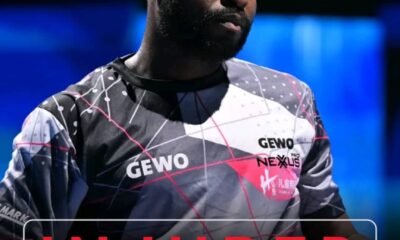
Germany’s progression to the FIFA World Cup 2026 Round of 32 has provided a proud moment for Nigerian football followers, with German-Nigerian stars Jamal Musiala and Felix Nmecha playing key roles in Die Mannschaft’s campaign.

Musiala and Nmecha are the two players of Nigerian descent included in Germany’s final 26-man squad for the tournament.

Read Also: Doma United Is Land Of Grace; We Believe In Ability, Commitment, Hard Work – Alhaji Suleiman Umar

While several other German-Nigerian talents were in contention ahead of the World Cup, only the duo made manager Julian Nagelsmann’s final selection.

Musiala, the Bayern Munich midfielder, was born in Stuttgart to a German mother and a British-Nigerian father.

Regarded as one of Germany’s most influential attacking players, he previously represented both England and Germany at youth level before committing his senior international future to Germany.

Nmecha, who plays for Borussia Dortmund, was born in Hamburg to a Nigerian father and a German mother.

Having developed through Manchester City’s academy and represented England at youth level, he later switched allegiance to Germany and secured his place in the World Cup squad.

Germany booked their place in the knockout stage on Saturday after a dramatic 2-1 comeback victory over Ivory Coast in Toronto.

Substitute striker Deniz Undav emerged as the hero, scoring twice in the second half to overturn an early deficit and secure Germany’s second consecutive win in Group E.

Germany appeared in control for much of the first half but saw two goals ruled out.

Aleksandar Pavlovic had a header disallowed for a foul on goalkeeper Yahia Fofana, while Kai Havertz also had an effort chalked off following a foul by Musiala in the build-up.

Despite Germany’s dominance, Ivory Coast struck first in the 30th minute. Youngster Yan Diomande initiated the move before Amad Diallo tested Nathaniel Brown.

The rebound fell kindly to captain Franck Kessie, who fired home to give the Elephants a surprise lead.

The African side threatened to increase their advantage after the break, but missed opportunities from Kessie and Christ Inao Oulai kept Germany within touching distance.

Nagelsmann’s tactical changes eventually turned the contest. In the 68th minute, substitute Nadiem Amiri delivered an inviting cross that Undav converted to level the score.
As the game seemed destined for a draw, Germany found a late winner deep into stoppage time.

In the 94th minute, Felix Nmecha provided the decisive assist, threading a pass to Undav, who controlled brilliantly before turning and firing beyond Fofana to complete the comeback.

The victory moved Germany onto six points from two matches and secured their place in the Round of 32.

Ivory Coast remain in contention and must defeat World Cup debutants Curacao in their final group-stage match to boost their qualification hopes.

Undav’s latest match-winning display further enhanced his reputation as one of the tournament’s most effective impact substitutes.

Having already registered a goal and two assists in Germany’s 7-1 victory over Curacao, the striker once again delivered when it mattered most.

Germany’s perfect start to the competition has strengthened their status as genuine contenders for a fifth World Cup title, while Musiala and Nmecha continue to represent Nigerian heritage on football’s biggest stage.
Continue Reading
Click to comment

Leave a Reply

Your email address will not be published. Required fields are marked *

News

Smart glasses without a camera? Even Realities bets productivity beats recording everyone

info

Published

on

By

Even g2 a smart glasses front view closed grey.jpeg

In the past few years, multiple tech executives have told us that glasses could be the next big interface for consumer hardware. And yet, today’s smart glasses rely a lot on phones, even if they have good hardware. Even Realities’ G2 smart glasses are in the same boat. They’re a premium-looking pair of glasses with a neon-style heads-up display you can see in any lighting — but their functionality relies heavily on their connectivity with the phone, which can be** unreliable and frustrating.

Even Realities takes a different approach to smart glasses than players like Meta. Their devices have a monochrome heads-up display that shows text and information in green, giving it the look of a neon board.

There are no cameras or speakers, and that is by design. The company wants to focus on productivity rather than recording, so the people around you don’t have to worry about being filmed.

The G2 is the second pair of smart glasses from Even Realities and an improvement over the G1 released a few years ago. The G2 has a brighter 1,200-nit display (vs. 1,000 nits on the G1), four mics (vs. two), and a 75% larger display area than its predecessor. The new display also has a better 60Hz refresh rate, compared with 20Hz on the G1.

In the few months I’ve used the G2, the connectivity with the phone has improved tremendously. Early on, the glasses would disconnect from the app so frequently that I nearly gave up on them. But after a few app updates, that issue got better.

The glasses are targeted at people who might be constantly in meetings, giving presentations, and traveling to countries where different languages are spoken. 

Design

The glasses, which come in two frame designs, are very light at 35 grams. The frame is made out of magnesium alloy, and the temples (the arms that go over your ears) are made out of titanium alloy. In terms of weight and fit, the glasses were comfortable to wear. 

Since I work from home most of the time, though, I didn’t feel much need to wear them all day. That said, the lenses have UV protection built in, so they’re still worth wearing outside just for eye protection — smart features or not.

Even Realities G2 Glasses case
Image Credits: Even RealitiesImage Credits:Even Realities

The company claims that, based on typical usage, G2’s battery can last up to two days on a single charge. The glasses come with a protective case that can recharge them up to seven times before needing to be plugged in itself. I personally didn’t test the two-day claim, but the battery lasted me long enough to put them back into the case without running out of juice.

That case is big — you can’t shove it in a pocket — but it’s solid, and the glasses fit in snugly.

Features and operation

The glasses act as your companion for schedules, reminders, and access to notes. You can wake them up by tapping on the stem-based controls. If you double-tap on the control pad on the stem, you will see a dashboard with information like your upcoming meetings, stocks, and top news. 

The G2 can also show real-time phone notifications, but the pop-ups weren’t always reliable — and since my phone is usually within reach anyway, I didn’t find much use for the feature.

Long-pressing the temple control opens a menu with several functions: a notifications tray, Translate, Conversate, Teleprompt, a to-do list, and Navigate. Translate lets you set a target language and converse with anyone. At the recent Global Connect Show (GCS) in China, I wore the glasses while talking to company reps doing demos, and the translation was good enough for me to follow along when someone spoke Chinese. I also tried it with other journalists speaking various languages, including French and Spanish. (The downside of this feature is that the other person doesn’t know what you’re saying in your language unless they’re also using the app.)

Navigate is a cool feature that shows turn-by-turn directions on the heads-up display. The catch: it doesn’t work with Google or Apple Maps. Instead, you have to set your route through the Even Realities app. I tried it a few times walking to cafes near my house. The directions showed up well on the display, but the app kept getting the addresses wrong, so I can’t rely on it for places I don’t already know how to get to. Still, I could see cyclists or motorbike riders finding it useful once the company fixes the accuracy issues.

Conversate, at first, just showed a live transcript of the conversation on the glasses, which felt pointless since you can just as easily record a meeting with an app or an external notetaker. Later, the company added a “prep notes” feature that surfaces more context: you can manually add notes or documents ahead of a meeting and let the AI reference them during the conversation, or let it listen in real time and pop up short explainer bubbles for concepts as they come up. For instance, during a briefing about energy, it showed me a bubble for “Green Hydrogen,” and tapping it brought up a definition right in front of my eyes. That was genuinely useful — though I wouldn’t want a transcript or explainer bubbles for every conversation I have.

At the center of all this is the built-in assistant, Even AI. As with any voice assistant, you say a wake word to activate it and ask questions or add items to your to-do list. It often misunderstood my to-do list requests, and for general questions, the answers were often long paragraphs that streamed across the screen with no way to interrupt or skip ahead.

Another issue: despite having four mics, Even AI often failed to activate, or misheard me, when I was outside. The ambient noise in India could have played a part, but I’d still expect a modern gadget to have better noise handling.

The G2’s screen was legible in most conditions, but in a bright room I had to adjust the brightness manually through the app. Even if the company hasn’t built an automatic-brightness sensor yet, I’d like to see a manual brightness control built into the glasses themselves, rather than requiring the phone app.

Don’t put the R1 ring on it

Even launched a companion ring called the R1 alongside the G2. The idea is to control the glasses through a touch surface on the ring instead of the glasses’ own touch controls. But its price and functionality don’t quite justify the cost.

The ring works well, and I didn’t have any issues using it. But I struggled to find scenarios where I actually needed it, since the touch-sensitive temples on the glasses already do the same job.

Even Realities R1 ring
Image Credits: Even RealitiesImage Credits:Even Realities

On top of that, Even built health tracking into the ring — heart rate, calories, steps, sleep, and SpO2 (blood oxygen level). Personally, I’d rather go for a dedicated ring like Oura or Ultrahuman if I wanted that form factor with health tracking. Second, if I already use a fitness tracker, I wouldn’t want to buy a ring where health is an auxiliary function for a ring that is meant to control the glass. 

All this functionality bumps up the ring’s price to $249, which is not cheap. If I used my smart glasses a lot, I would consider buying a controller ring at a lower price if it also had a mic, which I could use for issuing commands to the AI assistant. As it stands, I’d skip the R1. 

Where does Even G2 stand?

Smart glasses are coming out fast. Camera-equipped, screen-free models like the Meta Ray-Bans are popular, but Meta, Snap, and other competitors are racing to build glasses with color screens, too. Only a handful of Chinese companies — like Rokid and Inmo — are making glasses with this same neon-display style.

The Even G2 costs $599 and delivers solid hardware in a light, good-looking frame. The company is also working to make the glasses more customizable by supporting third-party apps, though I didn’t find any app compelling enough to make me reach for the glasses more often. They’re a nice-to-have: fun to explore if you like tinkering with new hardware and don’t mind trying out third-party apps.

The hardware itself is good, but outside of jobs that require constant translation or teleprompting, it’s hard to find a clear everyday use case for smart glasses like these.

Even’s bet is that skipping the camera and speakers is the right move for a productivity-focused device — and I don’t disagree with that direction. But now that the company has newly reached unicorn status, it needs to build out more first-party software to make the glasses something people actually reach for every day.

When you purchase through links in our articles, we may earn a small commission. This doesn’t affect our editorial independence.

Continue Reading

News

PDP Taraba assistant secretary resigns, joins APC after Kefas appointment

info

Published

on

By

APC.jpg

The State Assistant Secretary of the Peoples Democratic Party (PDP) in Taraba State, James Chimin, has resigned from the party and declared his support for the All Progressives Congress (APC) after accepting an appointment as Senior Special Assistant (SSA) to Governor Agbu Kefas.

Speaking with journalists in Jalingo on Saturday, Chimin said his decision was driven by his desire to support the development of Taraba State under Governor Kefas’ administration.

Announcing his resignation from the PDP, he pledged to work for the success of President Bola Tinubu, Governor Agbu Kefas, and other APC candidates from Taraba South seeking elective positions in the forthcoming general elections.

“Our people are indeed happy and grateful to governor Agbu Kefas, who has demonstrated uncommon love for the Tiv people by considering them for appointments into his administration,” Chimin said.

“On my part, I have accepted to work with him and for the APC. Today, I have left the PDP and joined the APC to support the vision of governor Agbu Kefas. I therefore pledge my unalloyed loyalty to governor Kefas and the APC,” he added.

Continue Reading

Trending