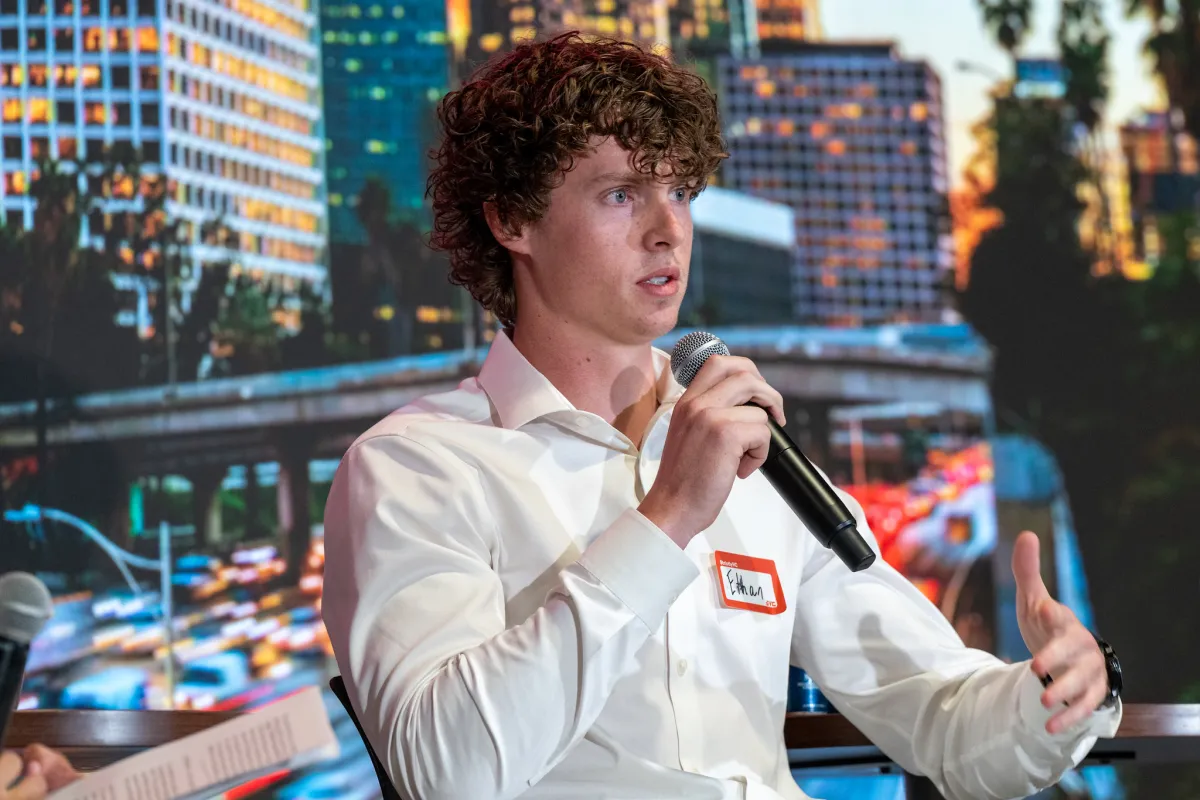
Ethan Thornton dropped out of MIT at 19 to build weapons. The first one, a hydrogen-powered system he prototyped with parts from Home Depot and Amazon, didn’t work out — “hydrogen was just a bad bet in general,” he told me this past week at TechCrunch’s StrictlyVC event in Los Angeles. Three years later, his company, Mach Industries, is running six weapons programs and earlier this month closed a $300 million Series C round at a $1.8 billion valuation. The startup has now raised roughly $485 million altogether.
Thornton grew up in Burnet, Texas, a town with roughly 6,500 residents, in a family with deep military ties. Around 2017 or 2018 — when he was still in his early teens — he started becoming, by his own account, “really, really concerned” about the rise of China and what he saw as an impending great-power conflict. That concern eventually sharpened into a conviction that unmanned systems were about to redefine warfare, and that the U.S. was moving too slowly to meet the moment.
What that looks like in practice, midway through 2026, is those six simultaneous weapons programs and a company that has a lot to prove instead of focusing on one thing, getting that right, and then expanding. Thornton is aware that Mach’s diffuse focus creates some lingering questions for outsiders. “It’s very hard,” he volunteered Thursday night. But he doesn’t think defense rewards the kind of single-minded focus that rocket launch, say, demands. “It is a chess game you’re playing with an adversary,” he said, “with hundreds of different products that need to be shipped if we want security.” Pick just one, he suggested, and you’ve already lost the game.
These aren’t simple products. Mach is working on a vertical-takeoff strike aircraft, a long-range anti-ship missile, two stratospheric systems, a cheap surface-to-air interceptor built to kill drones, and — announced earlier this week — a 40-foot, roughly 4,000-pound Navy logistics-and-strike aircraft that takes off near-vertically and flies over a thousand miles with a thousand-pound payload.
That last one is a real jump for a company whose biggest aircraft to date has been about 13 feet long. And none of the six is in full-rate production yet. Thornton says Mach has won around 13 government contracts, most sitting in the middle stage of defense procurement — past initial design, into testing on a government range, but short of the rate-manufacturing tier that fewer than 10 programs industry-wide have ever reached.
He says several systems should see operational deployment by the end of this year, and that his goal is to push three of the six into rate manufacturing in that same window — which would mean going from hundreds of units a month to hundreds of thousands, at a factory that Thornton says Mach plans to stand up soon.
It’s an aggressive timeline laid on top of an already aggressive bet. But Mach’s underlying thesis is that the U.S. can’t out-manufacture China so it has to out-create it — find the first-mover advantage the way Ukraine has against Russia, despite being outproduced. “I don’t think we’re going to outmanufacture China,” Thornton said. “The thing America continues to do well, time after time, compared to China centers on creativity and productization.”
Thornton argues — as do other defense tech startups — that the true bottleneck isn’t the various platforms being built — it’s the supply chain beneath them. “The hard part is actually getting the stuff into the building,” he said: jet engines, solid rocket motors, radar. Mach built and fired two jet engines from scratch in about eight months, a process he says traditionally takes four years; it also in May acquired a 24-year-old solid rocket motor company, Exquadrum, for $50 million, beating out roughly eight other bidders per its own telling. Selling components, not just vehicles, now accounts for about half of Mach’s revenue.
Mach’s approach differs sharply from some of its peers. Shield AI, founded in 2015, spent years as essentially a one-product company around its V-BAT drone before unveiling a second platform, the autonomous X-BAT fighter, last October — and even that is being positioned as one large, deliberate bet, not a portfolio. Saronic, founded in 2022, builds only autonomous surface vessels, scaling one unified autonomy stack across hull sizes from six feet to 180 feet.
Both have been rewarded for that discipline: Shield AI raised $2 billion this year at a $12.7 billion valuation; Saronic raised $1.75 billion at $9.25 billion.
The company Mach’s strategy more closely resembles is Anduril — which is bigger, older, and the one company against which every other defense-tech startup gets measured, fairly or not. Thornton draws the comparison himself, though he argues there’s a meaningful difference between the two companies. “Anduril’s playbook has been very much top-down, starting with the software stack,” he said. “We’re very much bottom-up, starting from the hardware stack and then starting to wrap software around it.”
It’s a distinction, yes, but Mach is still inevitably operating in Anduril’s shadow. Anduril raised $5 billion in May at a $61 billion valuation — more than 30 times Mach’s — and in March it landed a 10-year, $20 billion-ceiling Army enterprise contract consolidating over 120 separate procurement actions. Whatever Mach is building toward, Anduril got there years and tens of billions of dollars earlier.
Thornton insists the field isn’t zero-sum. He points to the scale of the problem: China reportedly builds something like a thousand cruise missiles a day; the U.S. builds roughly one every three days. “X company and Y company and Z company could all go build these things and it still wouldn’t be enough production,” he said. He also argues the Pentagon structurally won’t allow a monopoly — that it deliberately keeps two or three vendors alive in each category rather than picking one winner.
Whether or not that’s a generous reading of the competitive landscape, I put it to him that Anduril’s most famous co-founder, Palmer Luckey, has never, as far as I can tell, acknowledged Mach publicly. Thornton shrugs off any suggestion that Anduril isn’t interested in making room for Mach, telling me he respects Luckey, and that they’re “on the same team,” fighting for the same goal of Western sovereignty.
No doubt his investors, including Sequoia, Khosla Ventures, and Ribbit Capital, couldn’t care less. Strip away the founder-prodigy framing — the Texas workshop, the MIT dropout story every profile leads with, including this one — and what’s left is a genuinely interesting experiment led by a founder who seems, at least, to know what he doesn’t know.
Thornton has been candid that the hardest part of running Mach changes every six months: engineering first, then sales, and now manufacturing at scale, which he expects to dominate the next year. He says he tries to protect four or five hours a day to think and “war game the future,” sometimes pulling colleagues off their work to do it with him — which, he admits, “can kind of frustrate them sometimes.”
On the question of who pushes back on him — who keeps a fast-rising founder honest — Thornton said the most valuable feedback doesn’t come from investors or even his executive team, who can end up in the same echo chamber as the CEO. It comes, he said, from the people actually doing the work.
He described routine company-wide forums, his COO’s idea, where employees get microphones and ask him anything. It started with Thornton quietly recruiting a few trusted colleagues to ask aggressive questions. It’s since evolved into something harder to control — and, he suggested, more useful for it. “I basically stand up there for like an hour,” he said, “and get asked the most aggressive possible questions by people in the company.” He seems to relish it.
For more, you can watch our sit-down with Thornton below.
When you purchase through links in our articles, we may earn a small commission. This doesn’t affect our editorial independence.
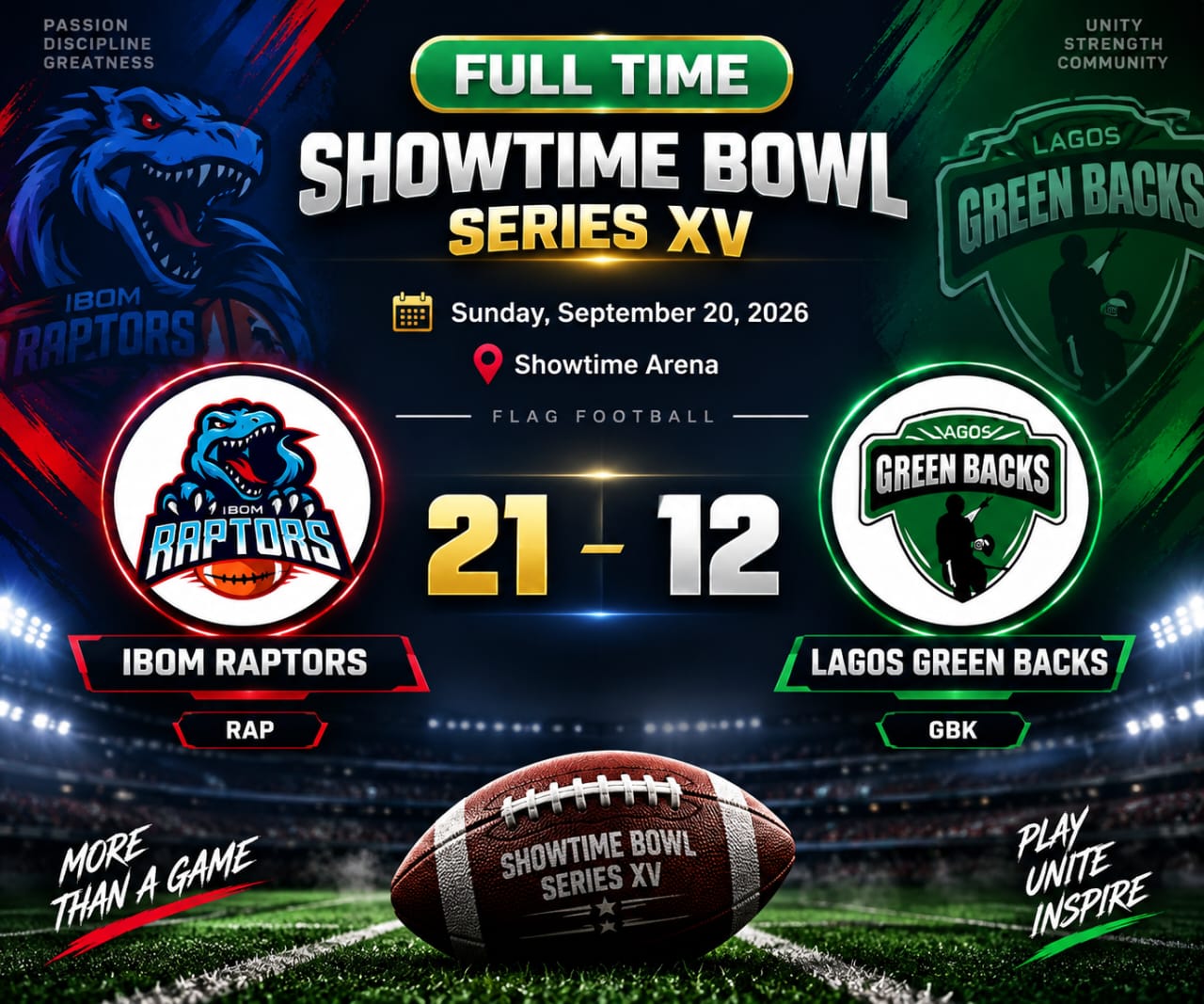
Ibom Raptors made an impressive start to SHOWTIME Bowl Series XV, defeating Lagos Greenbacks 21-12 at Showtime Arena on Sunday as another competitive chapter of Nigeria’s professional flag football league got underway.
The final score tells only part of the story. The contest produced momentum swings, defensive stops and several opportunities for both teams, but the Raptors ultimately found the execution required to secure their opening victory.
Quarterback Taiwo Oluwalanu was at the heart of the Raptors’ performance and finished with the team’s highest player rating of 7.5. He consistently moved the offence downfield and connected with his receivers in serious situations, including touchdown combinations with Titilayo Happiness Abanikanda as Ibom turned pressure into points.
The player ratings also highlighted contributions beyond the quarterback position. Aisha Raji Oluwatosin earned 7.0, Moyosore Adolphus recorded 6.6, while Billie Oyebanji Anuoluwapo finished on 6.3, reflecting the collective effort behind the victory.
Lagos Greenbacks had their own standout performer in Precious George, whose 7.6 rating was the highest displayed across the two teams. Her defensive influence included several pass break-ups as Greenbacks battled to stay in the contest. Emmanuel Ojirinnaka also impressed with a 7.0 rating, while Philip Osakwe and Divine Chidera both recorded 6.6.
For SHOWTIME, the growing emphasis on detailed player ratings adds another dimension to Series XV. Fans are no longer following only wins and losses; individual performances can now be tracked, compared and discussed throughout the season, giving emerging athletes greater visibility and creating additional storytelling opportunities for commercial partners.
That visibility matters as SHOWTIME continues building a professional sporting product around its players. Every touchdown, interception, defensive play and standout rating can help transform previously unfamiliar names into recognisable sporting personalities.
For the Raptors, however, the immediate prize is the result. They have opened Series XV with a victory and valuable early momentum.
Ibom Raptors have landed the first blow — and Taiwo Oluwalanu has given SHOWTIME fans another name to watch.
Over 100 people living with disabilities in Lagos State have completed a two-day workshop organized by the Nigerian Communications Commission (NCC), focused on building digital literacy, online safety awareness, and familiarity with assistive tools.
The session, held on September 9 and 10, 2026, carried the theme “Empowering Persons with Disabilities Through Digital Citizenship for an Inclusive Digital Economy.”
Participates covered topics including basic digital literacy, internet usage, online safety practices, privacy protection, adaptive technology, and responsible online conduct. Rather than simply teaching device operation, organizers emphasized how digital tools could enhance participants’ independence, personal safety, and access to broader opportunities — including recognizing fraudulent schemes and safeguarding personal data online.
They also explored adaptive tools such as voice-to-text software, designed to simplify device interaction for people with certain disabilities. Organizers additionally addressed the stigma and exclusion that many disabled Nigerians continue to face, noting how such attitudes restrict full participation in society.
NCC Executive Vice Chairman Dr. Aminu Maida — represented at the event by Helen Obi, Director of the Commission’s Digital Economy Department — described the program as evidence of the regulator’s dedication to removing disability-related obstacles to involvement in Nigeria’s expanding digital economy.
Maida noted that genuine digital inclusion requires more than simply expanding internet access. He explained that being digitally literate means understanding how to engage online safely, guard personal information, spot deception and false information, and grasp one’s rights and obligations in digital spaces. He added that technology could help disabled individuals overcome obstacles in schooling and employment while opening doors in business ownership, remote work, and access to public resources.
The Lagos workshop forms part of a broader NCC effort to extend digital training to disabled Nigerians nationwide. Maida pointed to other accessibility initiatives, including the Commission’s E-Accessibility Project, research into adaptive devices such as an assistive cane prototype for visually impaired persons, and the fourth annual Hackathon themed “Technology Without Barriers,” which invited developers to build accessibility-focused solutions.
According to the NCC, expanding internet access alone won’t achieve meaningful inclusion unless people also gain the confidence and skills to use technology effectively and securely. Maida called for closer cooperation among government bodies, regulators, tech firms, service providers, international partners, civil society groups, and disability advocacy organizations, arguing that accessibility should be built into digital products from the design stage onward.
The Commission credited the Lagos State Government, the National Commission for Persons with Disabilities, the Lagos State Office for Disability Affairs, and other partners for supporting the program. For participants, the training offered tools they can put to immediate use — from spotting scams and securing personal data to navigating assistive technology with greater confidence.



 Business16 hours ago