
Business
Satellite Data Powers New Era of Insurance Expansion in Nigeria

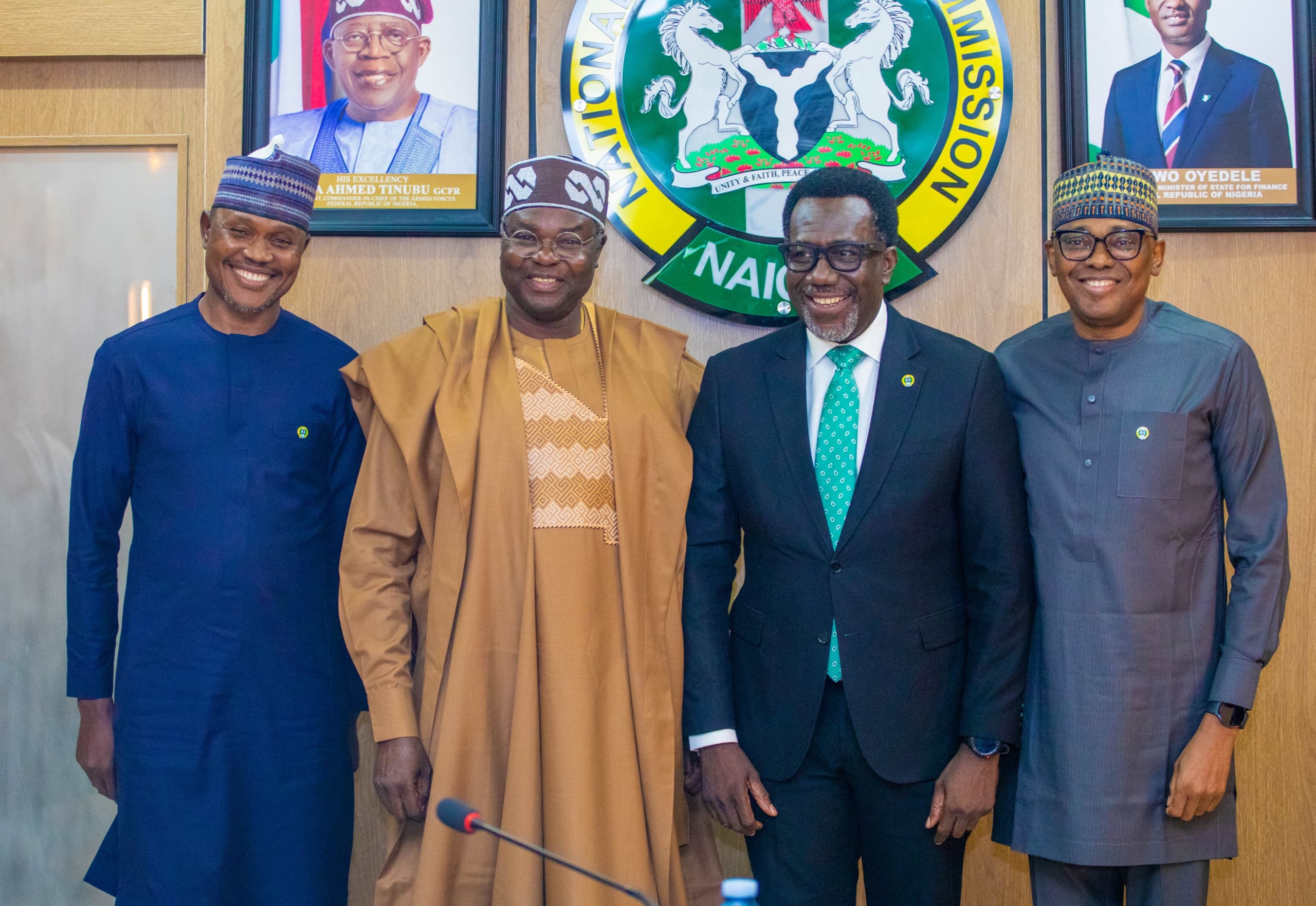
L-R Dr Usman Jankara (Deputy Commissioner Technical; National Insurance Commission), Dr Mathew Olumide Adepoju (Director General NASRDA), Mr Olusegun Ayo Omosehin (Commissioner for Insurance National Insurance Commission) and Mr Ekerete Ola Gam-Ikon (Deputy Commissioner Finance and Administration National Insurance Commission)
BY NKECHI NAECHE-ESEZOBOR—Nigeria’s insurance industry is set for a Satellite Data Powers New Era of Insurance Expansion in Nigeria transformation as the National Insurance Commission (NAICOM) and the National Space Research and Development Agency (NASRDA) move to harness satellite and geospatial technology to deepen market penetration, strengthen enforcement, and modernize risk management nationwide.
At a high-level meeting between both institutions, leaders agreed on a strategic partnership that will deploy space-based intelligence to unlock new insurance opportunities, improve compliance, and support broader economic resilience. The initiative signals a shift toward data-driven regulation and innovation in Nigeria’s insurance ecosystem.
Director General of NASRDA, explained that the partnership would harness NASRDA’s geospatial and satellite capabilities to generate accurate, evidence‑based datasets. According to him, these datasets will underpin modern insurance products, strengthen regulatory enforcement, and unlock economic value at both federal and sub‑national levels. He further highlighted the importance of insurance in safeguarding high‑value national assets, citing a previous insured satellite replacement as a practical demonstration of insurance effectiveness in managing sovereign risk.
On his part, Mr. Olusegun Ayo Omosehin, Commissioner for Insurance and Chief Executive Officer of NAICOM, emphasized that the initiative aligns strongly with NAICOM’s strategic transformation agenda and its commitment to swift, results‑oriented reforms. He noted the opportunity to deploy geospatial intelligence to identify public buildings and other insurable assets for compulsory coverage, as well as to support the development of a robust national catastrophic risk insurance framework.
NAICOM reaffirmed its core regulatory pillars—policyholder protection, regulatory capacity enhancement, legal and regulatory modernization, financial soundness through recapitalization, and innovation and sustainability—underscoring that the partnership directly advances its innovation and access objectives.
Under the partnership framework, both agencies will collaborate on the development of a national catastrophic insurance framework, high‑resolution property mapping and the creation of a national property database, enhanced enforcement of compulsory insurance for public buildings, and the advancement of insurance penetration through innovation and sustainability initiatives.
The post Satellite Data Powers New Era of Insurance Expansion in Nigeria appeared first on Business Today NG.

Fidelity Bank Plc has redeemed its 5-year $400 million Senior Unsecured Notes at maturity, reaffirming its commitment to meeting investor obligations and reinforcing its track record in the international debt capital markets.
Issued on 28 October 2021, the 5-year Eurobond matured on 28 October 2026 and carried an annual coupon of 7.625 per cent, payable semi-annually. Fidelity Bank met all scheduled coupon payments throughout the life of the instrument and has now fulfilled its final repayment obligation in full, covering both principal and accrued interest.
The redemption was funded from internally generated liquidity as part of the bank’s forward-looking liquidity management strategy. Through a dedicated sinking fund, Fidelity Bank progressively provided for the maturing obligation, enabling the bank to meet its commitment while maintaining business-as-usual operations and compliance with applicable regulatory liquidity requirements.
Commenting on the development, Fidelity Bank Plc’s Managing Director and Chief Executive Officer, Nneka Onyeali-Ikpe, said the successful redemption reflected the bank’s disciplined approach to financial management and its commitment to delivering on its obligations.
“This successful redemption demonstrates the strength of our franchise, the discipline of our balance sheet management and our commitment to honouring our obligations to investors and other stakeholders. We anticipated this maturity from the outset and planned accordingly, which reflects our commitment to responsible financial management,” Mrs Onyeali-Ikpe said.
The redemption further strengthens Fidelity Bank’s record in the international debt capital markets. The 2021 issuance marked the bank’s third Eurobond transaction, following earlier issuances in 2013 and 2017, in which the bank raised $300 million and $400 million, respectively. The 2021 offer attracted investor orders exceeding US$700 million, reflecting strong demand for the bank’s international debt offering.


READ ALSO: World Bank projects 23% rise in global commodity prices in 2026
The successful Eurobond redemption follows the completion of Fidelity Bank’s recapitalisation programme ahead of the regulatory deadline. The bank’s capital-raising efforts increased its eligible regulatory capital to approximately N533 billion, exceeding the N500 billion minimum capital requirement for banks with international authorisation.
The completion of these milestones underscores Fidelity Bank’s strong capital position, prudent liquidity management and disciplined approach to financial execution. It also reinforces the Bank’s capacity to meet its financial obligations while pursuing its strategic growth objectives across domestic and international markets.
Discover more from Premium Times Nigeria
Subscribe to get the latest posts sent to your email.
-

 Business4 days ago
CBD COP17: Nigeria, France Push for Faster Action on 30×30 Biodiversity Target
-
News3 days ago
Poor AI data pipelines could fuel cyber exploitation in Nigeria, regulator warns – Technology Times
-
Health2 days ago
Ebola: ₦100,000 weekly allowance for quarantined contacts was unplanned
-
Health4 days ago
UPDATED: Ebola: Nigeria identifies 53 contacts linked to confirmed case