Business
PenCom, NLC move against pension non-remittance by employers


The National Pension Commission (PenCom) and Nigeria Labour Congress (NLC), Lagos State Council, have agreed to tackle the persistent non-remittance of pension contributions by employers in both the public and private sectors, warning that employers’ failure to meet obligations would no longer be tolerated.
The effort was disclosed during an interactive session on the Contributory Pension Scheme (CPS), organised by PenCom and attended by the executives of the NLC, Lagos chapter, on Tuesday in Ikeja, Lagos.
CPS, which commenced in June 2004 under the Pension Reform Act, is a structured retirement plan in which both employers and employees make monthly contributions to an individual Retirement Savings Account (RSA) managed by a Pension Fund Administrator (PFA) in Nigeria.
The total minimum contribution is 18 per cent of the employee’s monthly emolument, while the workers receive their retirement benefits when due, mostly after retirement.
Speaking at the event, the Head of Compliance and Enforcement Department at PenCom, Ahmed Lawan, who represented the Director-General of PenCom, Omolola Oloworaran, said the CPS had transformed pension administration from a mere promise into a funded and enforceable obligation.


Pension reform
According to him, before the pension reforms, pension payments in the public sector were largely based on promises by the government without corresponding savings or funding arrangements.
“Before 2000, in the public sector, pensions were an arrangement that the government tried to make work. You started work, and the government promised you that after 35 years or at retirement age, it was going to pay you a pension. But within that period, the government was not setting aside pension funds. It was just a promise.
“In the private sector, it was also a mere provision in the books of employers. Employers promised workers a pension and gratuity when they retired, but the money remained in the business. So when workers retired, sometimes the promise was kept, but most often there was no guarantee,” he said.
Mr Lawan explained that the Pension Reform Act changed the narrative by making it mandatory for employers to remit pension contributions into individual RSAs, thereby protecting workers even if employers ceased operations.
Speaking on the challenges faced over the years, he disclosed that while the previous government had delayed remittances of accrued pension rights in the past, the situation had improved significantly under the current administration.
“The government was supposed to have kept its part by remitting the agreed percentage to pay the accrued pension rights, which is the past liability. But along the line, the government failed in its obligation over the years.
“The good thing today is that the current president has remitted all outstanding accrued rights. So currently, any worker in the public sector who is going to retire, their accrued pension is already in his account. That means the money is waiting for people to retire, not like before,” he stated.

Non-remittances
The PenCom official, however, raised concerns over widespread non-remittance among private sector employers, stressing that the commission was adopting a stricter compliance strategy to address the problem.
“For compliance, we are no longer going to do compliance based on the weak strategy. We are going to do compliance at the standard level.
“The money contributed by Nigerian workers has grown to almost N30 trillion, then nobody should participate in our ecosystem without contributing. Meaning that nobody should participate in terms of investment until they demonstrate commitment by ensuring that, as an employer, they have made pension contributions for their workers,” he said.
He added that PenCom had already introduced measures preventing non-compliant organisations from benefiting from government business or pension-related investments.
“You cannot do business with the Federal Government until you show evidence that you have fulfilled your obligation in terms of pension contributions for your employees.
“Likewise, as a bank, company, or investor, you cannot take pension investments unless you have made contributions for all your employees. Not only that, for all your service providers, vendors, and contractors, you have to make sure they are also making pension contributions,” he explained.
Mr Lawan further reiterated that PenCom was deepening collaboration with labour unions and industry associations to expose and sanction defaulting employers.
“We will not leave any gap for any employer that has refused to make pension contributions for employees who have worked hard and earned those benefits.
“The essence of this interactive session is to educate, enlighten, and build partnerships so that everybody understands that you cannot hide or run if you fail to make pension contributions,” he added.
He commended stakeholders for supporting PenCom’s enforcement drive and urged workers and unions to continue championing compliance to safeguard retirees’ welfare.
Non-compliance
Speaking at the interactive session on pension compliance and enforcement, the Chairperson of NLC, Lagos State chapter, Funmilayo Sessi, announced plans to commence enforcement actions against employers who fail to remit workers’ pension deductions, warning that defaulters would face public exposure and possible legal action.
Ms Sessi expressed concern over what she described as the growing trend of non-remittance of pension contributions by both government agencies and private employers.
“The Nigeria Labour Congress, Lagos State Council, expresses our deep concern over the continued failure of some government agencies and private employers of labour to remit pension deductions of workers as required under the Pension Reform Act.
“It is unacceptable that despite monthly deductions from workers’ salaries under the Contributory Pension Scheme, many employers have deliberately failed to remit these funds to the appropriate Pension Fund Administrators, thereby jeopardising the future and retirement security of hard-working Nigerian workers,” she said.
Ms Sessi described the non-remittance of pension deductions as a violation of labour laws and workers’ rights, insisting that pension benefits should not be treated as privileges.
“The non-remittance of pension contributions constitutes a gross violation of labour laws, an abuse of workers’ rights, and an act of economic injustice against employees who have faithfully rendered services to their employers.
“The Nigeria Labour Congress, Lagos State Council, wishes to state clearly that pensions are a fundamental right and not a privilege. Workers deserve to retire with dignity after years of productive service to the nation and the country,” the NLC chairperson stated.
Task force
Ms Sessi said the labour movement would immediately begin monitoring and enforcement activities across the state following increasing complaints from affected workers in both public and private establishments.
“In view of the alarming increase in complaints from affected workers across both public and private sectors, the NLC Lagos State Council hereby announces that immediate enforcement and monitoring actions will commence immediately. Generally, we welcome another engagement that brings all employers within Lagos State together.
“The NLC Lagos State Council remains committed to protecting the welfare, rights, and future security of workers, and we will not fold our arms while employees are subjected to exploitation and uncertainty after retirement,” she added.
READ ALSO: PenCom to channel pension capital into national development projects
Lagos NLC chair also announced plans to inaugurate task force commanders drawn from labour unions to strengthen pension compliance enforcement across the state.
At the event, volunteer members of the Lagos NLC constituted the task force to ensure remittances of pension funds to retirees in Lagos, starting operations from 1 June.
“In this instance, we are going to inaugurate task force commanders at the state level amongst the SAGE and SEC members. This is a task force to implement and also to enforce compliance on a particular employer of labour; we will not fail to do so,” she declared.
The labour leader further warned that defaulting employers would be publicly exposed and prosecuted where necessary.
“We therefore call on all employers to act responsibly and comply fully with pension remittance obligations in the interest of industrial harmony, social justice, and national development.
“Any recalcitrant employer of labour will be taken to the court of public opinion in Nigeria, and legal action will be taken against them as well.
“We want to reiterate once again that we are the voice for the voiceless. We are the power for the workers. And we are their last hope. And we will do everything to ensure the protection of the workers and their pension,” Ms Sessi said.




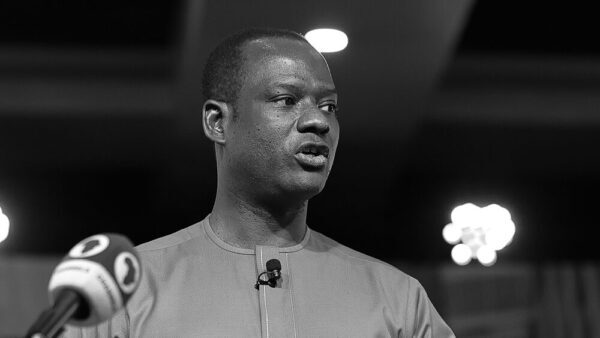
Nigeria’s Finance Minister and the Coordinating Minister of the Economy, Taiwo Oyedele, on Wednesday said the country is fortunate to have President Bola Tinubu at the helm of affairs at a time of economic challenges and global uncertainty.
Mr Oyedele made the remark on Wednesday on the sidelines of the World Bank/International Monetary Fund (IMF) meetings in Bangkok, Thailand, where he praised the president for his willingness to implement difficult economic reforms and his understanding of economic and monetary policy issues.
“I say to myself every time that Nigeria is lucky to have a leader like Mr President,” the minister said.
“A leader that says ‘I’ll do the right thing, even when it’s not popular’. There are so very few of them, and our president is not saying it; he’s doing it, he’s doing it even with pre-election (concerns),” he added.
Since assuming office in May 2023, the Tinubu administration has introduced a series of economic reforms, the impact of which international institutions like the World Bank and the IMF have acknowledged
The reforms include the removal of costly petrol subsidies, which had been a major drain on public finance for years, the unification of the foreign exchange rates and the sharp devaluation of the naira to attract foreign capital.

Although abolishing fuel subsidies has boosted government revenue and is seen as an investor-friendly move, it has triggered a cost-of-living crisis and spurred inflationary pressures.
Reforms in the foreign exchange market have helped increase accretion to external reserves, which stood at $55.1 billion as of 9 October, its peak level in over 18 years.
The banking sector also underwent a recapitalisation exercise that ended in March and helped Nigerian banks raise N4.7 trillion in new capital.
According to the Central Bank of Nigeria, the recapitalisation strengthened banks’ capital adequacy ratios, keeping the sector above international Basel benchmarks.
Mr Oyedele said President Tinubu possesses two attributes uncommon among leaders, notably those of democratic governments.
READ ALSO: AFC appoints Cardoso as board chairman
The first is his willingness to do what he considers right, even when the decision is unpopular or politically difficult.
“I remember at least three issues that were discussed with him recently, and on my own I would offer to say ‘maybe we wait until after the election’. And his question is always, ‘Is it the right thing to do?’ Yes, yes, it is. Why do we have to wait?” Mr Oyedele said.
“Number two attribute is that our President gets it. It’s not easy to understand issues to do with the economy, finance, monetary policy, like respect for the independence of the monetary authority. For Mr President, it’s 100 per cent,” he added.
The minister added that the president’s position on such matters has made it unnecessary for officials to discuss the issue with him repeatedly.
“We don’t even talk about it. So, I feel like we are so blessed, we cannot afford to wait even one minute,” he said.
Discover more from Premium Times Nigeria
Subscribe to get the latest posts sent to your email.
-
Business4 days ago
Veritas Kapital CEO Nwakuche Joins Coal City University Governing Council
-

 News2 days ago
Meta releases its first frontier model, Muse Wonder
-
News4 days ago
2027: INEC publishes final names of governorship candidates across states [FULL LIST]
-
News4 days ago
‘Anarchy will consume everybody’ – Peter Obi breaks silence on Enugu NDC attack [VIDEO]