Connect with us

News

APC Primaries: Gagdi Loses 3rd Term Bid as Dr. John Tongshinen Clinches PKK Ticket

info

Published

on

IMG 20260517 WA0011.jpg

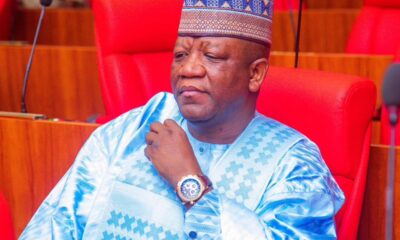
The member representing Pankshin/Kanke/Kanam Federal Constituency in the House of Representatives, Yusuf Adamu Gagdi, has lost his re-election bid following the conclusion of the All Progressives Congress (APC) primary election for the constituency.

The returning officer, Koshyap Yusuf Yaghi, announced the results, declaring John Tongshinen winner of the keenly contested primary after polling 29,968 votes. Gagdi secured 5,849 votes.

The outcome marks a major political shift in the Pankshin/Kanke/Kanam Federal Constituency, where Gagdi has served in the House of Representatives since 2019 and previously chaired the House Committee on Navy.

Delegates, party faithful, and supporters from across Pankshin, Kanke, and Kanam participated in the exercise, which was conducted under the supervision of APC officials and members of the party’s electoral committee.

With the victory, Dr. Tongshinen is set to emerge as the APC flag bearer for the Pankshin/Kanke/Kanam Federal Constituency ahead of the 2027 general elections.

Prior to the primaries, Gagdi had intensified consultations across the constituency, showcasing his achievements in infrastructure, healthcare, education, empowerment, and employment while seeking support for another term.

The primary election attracted widespread attention across Plateau State due to Gagdi’s political influence and long-standing presence within the constituency.

Continue Reading
Click to comment

Leave a Reply

Your email address will not be published. Required fields are marked *

News

Plateau APC lawmaker Gagdi loses third-term bid in primary election

info

Published

on

By

Gagdi.jpeg

Yusuf Gagdi, a member of the House of Representatives representing Pankshin/Kanke/Kanam Federal Constituency of Plateau State, has failed to secure the All Progressives Congress (APC) ticket for a third term in the National Assembly. 

Mr Gagdi, a two-term lawmaker and current chairman of the House of Representatives standing committee on Navy, lost his party’s primaries held across the three local government areas that make up his constituency.

Daspan Ishaya, the chairman of the electoral committee, announced the results of the polls in Pankshin on Sunday.

Mr Ishaya said that Dr John Tongshinen scored 29,968 to defeat Mr Gagdi, his closest opponent, who polled 5,849 votes.

“By the powers conferred on me as the chairman of this committee, I hereby declare Mr John Tongshinen as the winner of the APC primaries for Pankshin/Kanke/Kanam federal constituency,” he said.

Mr Ishaya explained that the primaries were observed by officials of the Independent National Electoral Commission (INEC).

 (NAN)

Continue Reading

Business

CPPE cautions CBN against monetary tightening ahead of the MPC meeting

info

Published

on

By

468939862 570688608903404 8583644854384931658 n.jpg

The Centre for the Promotion of Private Enterprise (CPPE) has warned the Central Bank of Nigeria (CBN) against excessive monetary tightening ahead of the 305th meeting of the Monetary Policy Committee (MPC).

The group cautioned that higher interest rates could weaken economic growth, private-sector investment, industrial productivity, and employment.

The warning came in a statement signed by the Chief Executive Officer of CPPE, Muda Yusuf, on Sunday.

At the February MPC meeting, the committee reduced the borrowing rate by 50 basis points to 26.5 per cent, and scheduled the 305th meeting for 19 and 20 May.

CPPE said expectations ahead of the MPC meeting should be viewed in the context of growing domestic macroeconomic pressures, geopolitical tensions, and rising fiscal liquidity risks.

PT WHATSAPP CHANNEL

According to the think tank, escalating geopolitical tensions involving the United States, Israel, and Iran have already triggered volatility in the global energy market, with implications for inflation, energy costs, and business operations in Nigeria.

“Of immediate significance are the escalating geopolitical tensions involving the United States, Israel, and Iran, which have triggered renewed volatility in the global energy market.

“The resulting surge in crude oil prices is already transmitting into higher domestic energy costs, with significant implications for inflationary pressures, production costs, transportation, logistics, and overall business operating conditions within the economy,” CPPE said.

Concerns

CPPE also raised concerns over increasing liquidity injections linked to political activities ahead of the 2027 general elections, warning that rising political spending and improved Federation Account Allocation Committee (FAAC) disbursements to states could worsen inflationary pressures.

“At the domestic level, early signs of election-related liquidity injections ahead of the 2027 electoral cycle are also becoming increasingly evident.

“Rising political spending by aspirants and political parties, increased election-related expenditures, and substantially improved Federation Account Allocation Committee [FAAC] disbursements to subnational governments present material risks to liquidity management and inflation containment,” the group stated.

It said recent engagement by the CBN with state governments on inflationary risks associated with fiscal injections reflects growing official concerns over excess liquidity in the economy.

CPPE noted that the MPC may therefore adopt a cautious tightening stance or maintain its current restrictive monetary policy position to manage inflation expectations and sustain investor confidence.

“Accordingly, there is a strong possibility that the Committee may be inclined towards a cautious tightening bias or a prolonged retention of the current tight monetary stance in order to contain inflation expectations, reinforce policy credibility and sustain investor confidence,” CPPE said

Warning

The CPPE warned that additional monetary tightening could significantly hurt the productive sector and undermine economic recovery.

“The Nigerian economy remains fragile and structurally constrained. Further tightening of monetary conditions could significantly weaken credit expansion, dampen investment appetite, and undermine the fragile momentum of the real-sector recovery.

“Excessively elevated interest rates also heighten the risks of loan defaults, weaken the financial sustainability of businesses, and exacerbate sovereign debt service pressures,” it said.

The think tank argued that Nigeria’s inflation challenge remains largely structural and supply-side driven, making aggressive monetary tightening less effective in addressing the root causes of inflation.

“It is equally important to recognise that the current inflationary pressures are predominantly cost-push and supply-side driven. The major inflation drivers remain energy costs, transportation expenses, logistics bottlenecks, and structural inefficiencies within the production environment.

“Monetary tightening is generally more effective in addressing demand-pull inflation arising from heightened aggregate demand and liquidity expansion. Its effectiveness in addressing supply-side inflation shocks is considerably more limited,” the group explained.

According to CPPE, further tightening under current economic conditions could raise the cost of capital, weaken manufacturing competitiveness, suppress SME growth, constrain household consumption, and slow investment expansion.

“Further tightening under prevailing conditions, therefore, risks imposing disproportionate costs on the productive sector without necessarily delivering commensurate gains in inflation moderation.

“Higher interest rates would increase the cost of capital, weaken manufacturing competitiveness, suppress SME growth, constrain household consumption, and slow investment expansion at a time when the economy urgently requires productivity-enhancing investments and job creation,” CPPE stated.

Advocacy

The think tank called for a balanced, carefully calibrated monetary policy framework that supports growth while maintaining macroeconomic stability and controlling inflation.

“The CPPE therefore advocates a carefully calibrated and balanced monetary policy stance that preserves macroeconomic stability while avoiding excessive tightening capable of undermining economic recovery and private sector resilience.

“The overarching policy priority should be to sustain investor confidence, support productive investments, stimulate output growth, and strengthen the economy’s supply-side capacity while maintaining vigilance on inflation management.”

READ ALSO: CPPE speaks on capital importation surge, raises structural concerns

The statement concluded that Nigeria’s long-term disinflation process would depend more on structural reforms and productivity improvements than on aggressive monetary tightening.

The group urged the monetary authorities to avoid excessive reliance on monetary policy orthodoxy in managing what is fundamentally a structurally-driven inflation environment.

“Sustainable disinflation in Nigeria will depend far more on improvements in productivity, energy security, logistics efficiency, exchange rate stability, domestic petroleum refining capacity, and overall supply-side reforms than on aggressive monetary tightening,” CPPE stated.


Continue Reading

Trending