Connect with us

News

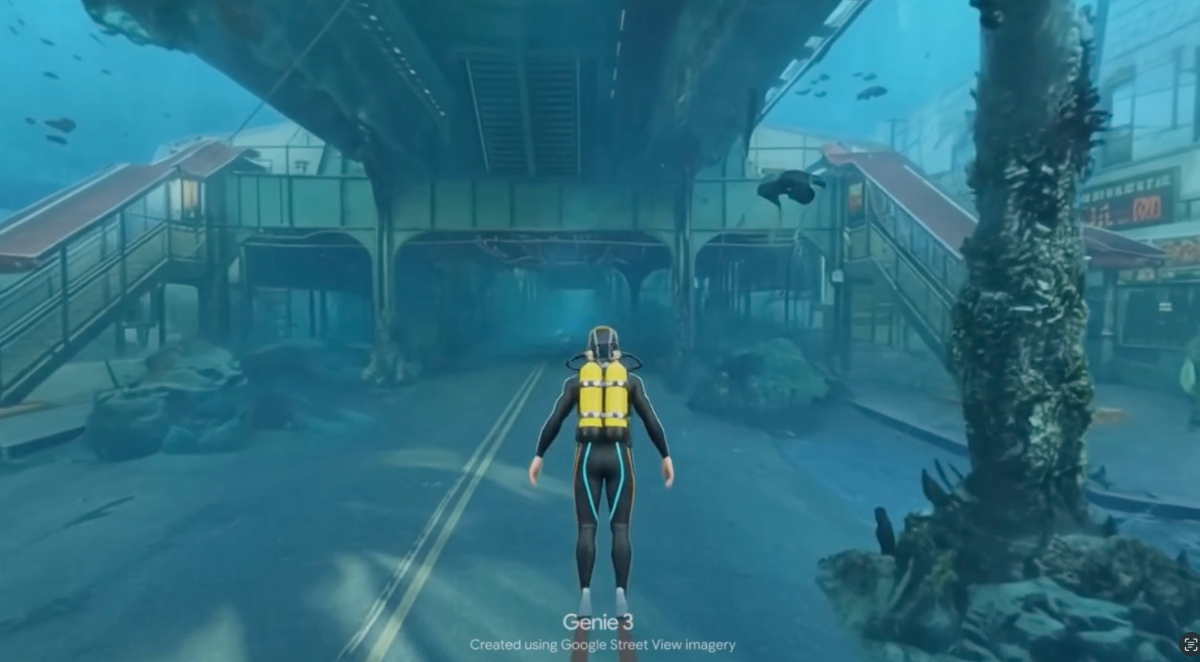
Google’s Genie world model can now simulate real streets with Street View

info

Published

on

Genie Street View NYC.png

We’ve all pulled up Street View on Google Maps to show a friend what our childhood home looked like, or dropped that little person icon onto the streets of Paris to see if we booked a hotel in a cool neighborhood. Imagine being able to do that, but in a more immersive, interactive way that allows you to really simulate the street and its environs, and even do things like adjust the weather or see what it would look like in a “Day After Tomorrow” scenario.

That’s one of the goals of Google’s latest integration. Starting today, Google DeepMind is connecting Street View to Project Genie, the company’s general-purpose world model that can generate diverse, interactive environments. The new feature launched during the Google I/O developer conference. 

“It’s really powerful for both the agent [and robotics] use case and for humans to play with, and that’s always been the thesis of Genie,” Jack Parker-Holder, a research scientist on DeepMind’s open-endedness team, told TechCrunch.

He gave the example of a new robot being deployed in London, which rarely sees the sun. Genie could, Parker-Holder says, simulate those scarce occasions when the sun glints off the Victorian housing, so the rays don’t shock the robot when it happens.

“Simultaneously, you might say, ‘I’m going to New York City, but not this time of year,’” he continued. “‘It’s going to be snowy. I want to see what that block looks like in the snow.’” 

Google has been collecting Street View data for 20 years via cars with cameras and individuals strapped with “tracker backpacks.” The tech giant has collected north of 280 billion images across 110 countries and seven continents. 

“With Street View, we have imagery from a large quantity of the world,” Jack said. “You can imagine how potentially powerful it is to combine this rich source of real-world information and data with an ability to simulate worlds.”

Google released its latest world model Genie 3 for research preview last August and opened up access to the tool to Google AI Ultra subscribers in the U.S. in January, allowing customers to create interactive game worlds from text prompts or images. The goal is to use Genie for educational experiences, gaming, and robotics training. 

Genie 3 is already helping to power one of Waymo’s simulators to train its self-driving cars on “exceedingly rare events” like tornadoes or casual elephant encounters. Adding Street View data to that could help Waymo prepare to launch in more cities around the globe.

Waymo has its own simulator that it relied on to scale to 11 U.S. cities and test its AI driver in several more. The difference with Genie, says Parker-Holder, is that those are all from the car’s point of view. Street View allows for not only simulating a world anchored to a real place, but also shifting the point of view to other types of agents, like a human or a robot. 

Google is launching Street View in Genie to some Ultra users in the United States starting today, with access rolling out at scale over time. Global Ultra users will gain access over the next few weeks, per the company.

The researchers’ goal is to put this new capability into as many hands as possible, per Diego Rivas, a product manager at DeepMind. He cautioned that Street View in particular and Genie in general is still an experiment, so there’s much to improve upon in terms of accuracy.

In the samples the Google team showed me — including an underwater simulation of a neighborhood I used to live in — the results are impressive and recognizable, but still video game quality rather than photorealistic. The models are also not yet physics-aware, meaning they don’t yet understand cause and effect. For example, in a simulation of a woman running through a snowy Joshua Tree, she ran right through cacti and bushes.

Compare that to, say, Google’s image generator Nano Banana — which can now generate perfect text in infographics — or its video generator Veo — which understands that paper boats drift on water currents, smoke disperses into the air, and fabric drapes over forms. 

Physics isn’t hard-coded into these models; they learn it intuitively over time through passive observation, as a living being would. 

“I think for this kind of model, it’s maybe six to 12 months behind video in terms of the accuracy and quality, so I think it’s something we will solve,” Parker-Holder said. 

Jonathan Herbert, director of Google Maps who started on the Street View team as an intern 12 years ago, said that Genie can’t yet create a faithful reconstruction of a street. He thinks the real breakthrough is the AI’s spatial continuity. If you turn 360 degrees, the AI correctly remembers and simulates the environment behind you. From that point on, the model can build a new environment on top of that.

“We have long thought about how we can build out the best and richest model of the world on top of Street View data,” Herbert said. “It’s definitely been an idea of ours to use Maps Data in new ways and for new kinds of AI research for a pretty long time.”

When you purchase through links in our articles, we may earn a small commission. This doesn’t affect our editorial independence.

Continue Reading
Click to comment

Leave a Reply

Your email address will not be published. Required fields are marked *

News

Sen Jang Opposes Indigene Certificates for Hausa/Fulani Residents, Raises Concerns Over Plateau Identity

info

Published

on

By

IMG 8535.jpeg

Former Plateau State Governor and elder statesman, Senator Jonah David Jang, has voiced strong opposition to proposals that would allow Hausa/Fulani residents in Plateau State to obtain indigene certificates, describing the issue as one with far-reaching implications for the state’s cultural heritage, identity, and indigenous rights. Jang made his position known while addressing ongoing debates surrounding citizenship, residency, and indigeneity, topics that have remained at the center of political and social discussions in Plateau State for decades.

According to the former governor, indigene certificates are historically linked to communities and ethnic groups recognized as the original inhabitants of Plateau State and should not be granted solely on the basis of long-term residence. He argued that while every Nigerian has the constitutional right to live and conduct lawful activities anywhere in the country, such rights should not automatically translate into indigene status, which he said carries unique cultural and historical significance.

Jang further maintained that preserving the distinction between residents and indigenes is necessary to protect the interests, heritage, and political representation of indigenous communities. He warned that altering the existing framework could create tensions and undermine the rights of groups that have historically been recognized as native to the state. The former governor emphasized the need for careful consideration of any policy changes relating to indigene certificates to avoid unintended consequences.

The comments have since generated mixed reactions among stakeholders across the state and beyond. While supporters of Jang’s position argue that protecting indigenous identity is essential for maintaining social and cultural balance, others contend that individuals who have lived in Plateau for generations should be afforded broader recognition and inclusion. The debate continues to spark conversations on the broader issues of citizenship, belonging, and equal opportunities within Nigeria’s diverse society.

Continue Reading

News

Vincent Ugwoke Makes Nigerian Athletics History with NCAA Discus Bronze

info

Published

on

By

IMG 20260613 WA0316.jpg

Nigerian thrower Vincent Ugwoke produced one of the most significant performances in Nigerian field event history, launching a massive personal best of 63.89 metres to claim the bronze medal in the men’s discus throw at the NCAA Outdoor Track and Field Championships.

READ ALSO: Fakorede Caps Outstanding NCAA Season with First Team All-American Honour

Sports247 reports that the outstanding effort not only secured Ugwoke a place on the podium but also elevated him into the history books, recording the furthest discus throw by a Nigerian athlete since 2004.

Competing against one of the strongest collegiate fields in the world, Ugwoke delivered when it mattered most, producing a career-best mark to earn his first NCAA medal and underline his growing status among Nigeria’s elite field athletes.

The event was won by Jamaican star Ralford Mullings, who captured gold with a throw of 65.81m, while compatriot Racquil Broderick secured silver with a personal best of 64.15m. Ugwoke’s 63.89m throw completed the podium and ensured Nigeria was represented among the medal winners.

Beyond the medal itself, the significance of the performance lies in its historical context. Nigerian athletics has traditionally been known for its success in sprinting and jumping events, making Ugwoke’s achievement particularly noteworthy.

His mark stands as the best by a Nigerian discus thrower in more than two decades, highlighting both the quality of his performance and its importance for the development of field events in the country.

The bronze medal also caps an impressive season of progress for the Nigerian, whose steady improvement culminated in a breakthrough performance on one of collegiate athletics’ biggest stages.

Delivering a personal best under championship pressure is a testament to both his preparation and competitive mindset.

For Nigerian athletics, Ugwoke’s achievement serves as a reminder of the growing depth of talent emerging across different disciplines.

His success could provide inspiration for a new generation of throwers looking to make their mark nationally and internationally.

With a personal best, an NCAA bronze medal, and a place in the record books now secured, Vincent Ugwoke leaves the championships having achieved a truly memorable milestone.

His 63.89m throw will be remembered as one of the finest Nigerian discus performances of the modern era and a significant moment in the resurgence of Nigerian field events.

Continue Reading

Trending