Connect with us

News

One killed, two monarchs abducted in Plateau

editor

Published

on

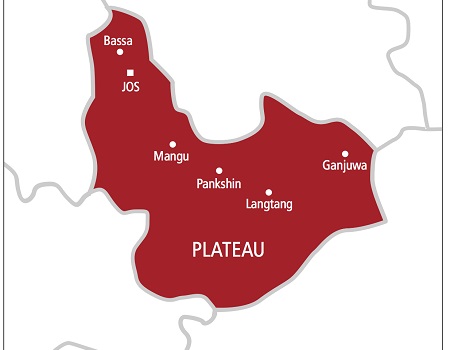
Plateau map

The supreme ruler of Tal chiefdom, the Golong Tal, His Highness Nanleng Yusuf Gotus, in the Pankshin local government area of Plateau State, has been kidnapped by gunmen.

Newsmen gathered from residents that the gunmen stormed the palace of the supreme ruler at about 1:00 am on Monday, and whisked him to an unknown destination.

The kidnappers have contacted the palace, demanding N50 million in ransom.

Still in Plateau Gunmen riding on motorcycles have reportedly kidnapped the traditional ruler of  Wase Local Government Area of Plateau State.

Residents said that the traditional ruler identified as His Royal Highness, Dauda Mohammed Suleiman, was abducted when the gunmen attacked his palace in Pinau community of the council area on Monday night, 26th September.

A resident in Wase town and Chairman of Action Democratic Congress in the Wase LGA, Hon. Abdullahi Gadole confirmed the kidnap of the monarch to journalists in Jos on Tuesday 27 September.

Gadole said that since the traditional ruler was whisked away to an unknown destination, the residents of the community had been searching for him without success.

Gadole said, “he was kidnapped yesterday (Monday). The kidnappers rode on motorcycles to his house in Pinau community and abducted the traditional ruler. Since then, we have not seen him nor have his abductors contacted anyone to know what they want.”

Also in a separate attack on Monday, by bandits in Jannaret Town, Mangu Local Government Area of Plateau State, one person was confirmed dead while two others sustained injuries. 

It was gathered that the deceased in Mangu LGA, identified as Mapack Linus, and the two injured victims were shot by the bandits when they opened fire on the residents after arriving in the community.

A resident of Jannaret town, Yusuf Charles, confirmed the attack to newsmen in Jos on Monday.

According to Charles, “It was on Sunday night that bandits arrived in Jannaret Town, around 7:30 pm, and just opened fire on people in the community.”


Continue Reading
Click to comment

Leave a Reply

Your email address will not be published. Required fields are marked *

News

How one venture firm is investing in an increasingly fragmented world

info

Published

on

By

GettyImages 1176441713.jpeg

The world today is riven by cultural differences, political divisions, and geopolitical disputes — a challenging environment for any investor hunting for startups that can grow large enough to deliver venture-scale returns.

Kompas VC has developed a regionally sensitive strategy to help it navigate, and invest in, this fragmented world. And it’s putting fresh capital towards this approach with a new €160 million fund ($187.5 million), the firm told TechCrunch.

“We see the world really falling into three main spheres of economic activity, of political activity — the U.S., Europe, and China,” Sebastian Peck, partner at Kompas VC, told TechCrunch. “We certainly see today that these three domains follow very, very different trajectories.”

Kompas has staked its reputation on backing startups that tackle core industrial competitiveness challenges, from manufacturing and supply chains to critical infrastructure and sustainability. Those themes haven’t disappeared, but different regions emphasize them to varying degrees.

“There was a lot of enthusiasm around these themes back in 2021,” Peck said. “In 2026, we’re in a very, very different paradigm. It’s all about AI, it’s all about fast growth, very explosive growth. A lot of big topics that we partially play to but also are not really part of what we stand for.”

“Our focus is in the physical world, anything around producing physical goods,” he added, saying that Kompas focuses on startups working on decarbonization, productivity, and risk management. “We’ve found our niche.”

Three people standing on a stone stairway.
Kompas VC partners, from left: Talia Rafaeli, Andreas Winter-Extra, and Sebastian PeckImage Credits:Kompas VC /

That niche turns out to be pretty broad. Reshoring is en vogue in nearly every market, and depending on the startup, those markets typically have more than enough scale for a firm like Kompas.

Techcrunch event

San Francisco, CA
|
October 13-15, 2026

Though dwarfed by some venture funds these days, Kompas’s newly raised second fund should give it ample opportunity to lead early stage rounds with checks ranging from €3 million to €5 million. 

As a European fund, Kompas has access to a range of founders and startups in the region. But it must weigh how global fragmentation might limit the potential for some to deliver venture returns. Peck cites prefab housing as an example. The approach is widely used in Scandinavian countries, but it isn’t as common in Germany or the rest of Europe, let alone the United States.

“It feels like such an intuitive solution. It’s a product that is effectively an industrial product. It should be highly scalable,” he said. Ultimately, the reason it doesn’t resonate outside Scandinavia has more to do with “cultural conditioning” than the technology itself, he said. “In that industry, if the U.S. isn’t the market you can go to, you need to look very, very carefully at whether there’s a large enough addressable market.”

The fragmentation extends beyond housing. For example, in Europe, sustainability is still broadly attractive, in contrast to the U.S., where the theme doesn’t have the cachet it did several years ago. 

Still, a lot can change quickly, Peck acknowledges. “We are investing over 10-, 15-year horizons. That’s a few legislative periods to bridge, and sometimes things swing in unexpected directions.”

The shifting landscape poses a challenge, but also an opportunity for a smaller investor like Kompas. “I think there’s a great space for highly focused, highly specialized, smaller funds like ours to be the first check-in and bring sweep up certain themes and certain founders,” Peck said. 

When you purchase through links in our articles, we may earn a small commission. This doesn’t affect our editorial independence.

Continue Reading

News

At his OpenAI trial, Musk relitigates an old friendship

info

Published

on

By

A3c4057e7d804c79b4bfb3278f4afced.jpg

Among the most interesting parts of Elon Musk’s testimony Tuesday in his lawsuit against OpenAI wasn’t the charity he claims was stolen from him (we all knew that was coming). It was about an old friend.

Musk testified that one of his core motivations for co-founding OpenAI was a falling-out with Google’s Larry Page over AI safety — specifically, a conversation in which Musk raised the prospect of AI wiping out humanity and Page shrugged it off as “fine,” so long as AI itself survived. Page called Musk a “speciest” for being “pro human.” Musk called the attitude “insane.”

That’s mostly notable given how close the two once were. Fortune included them on its 2016 list of secretly best-friend business leaders; Musk was so comfortable with Page that he regularly crashed at his Palo Alto home. Page once told Charlie Rose that he’d rather give his money to Musk than to charity.

The friendship didn’t survive OpenAI. When Musk recruited Google AI star Ilya Sutskever to help launch the company in 2015, Page felt personally betrayed and cut off contact.

It’s a story Musk has told before — including to author Walter Isaacson for his bestselling biography of Musk — but Tuesday was the first time he said it under oath. Page hasn’t commented, and it’s worth remembering everything that Musk said was in service of a lawsuit. Still, as recently as 2023 he told tech podcaster Lex Fridman he wanted to patch things up: “We were friends for a very long time.”

Continue Reading

Trending