Business
How NDLEA intercepts Chinese grandma with 31.0Kg of drug consignment at Lagos airport

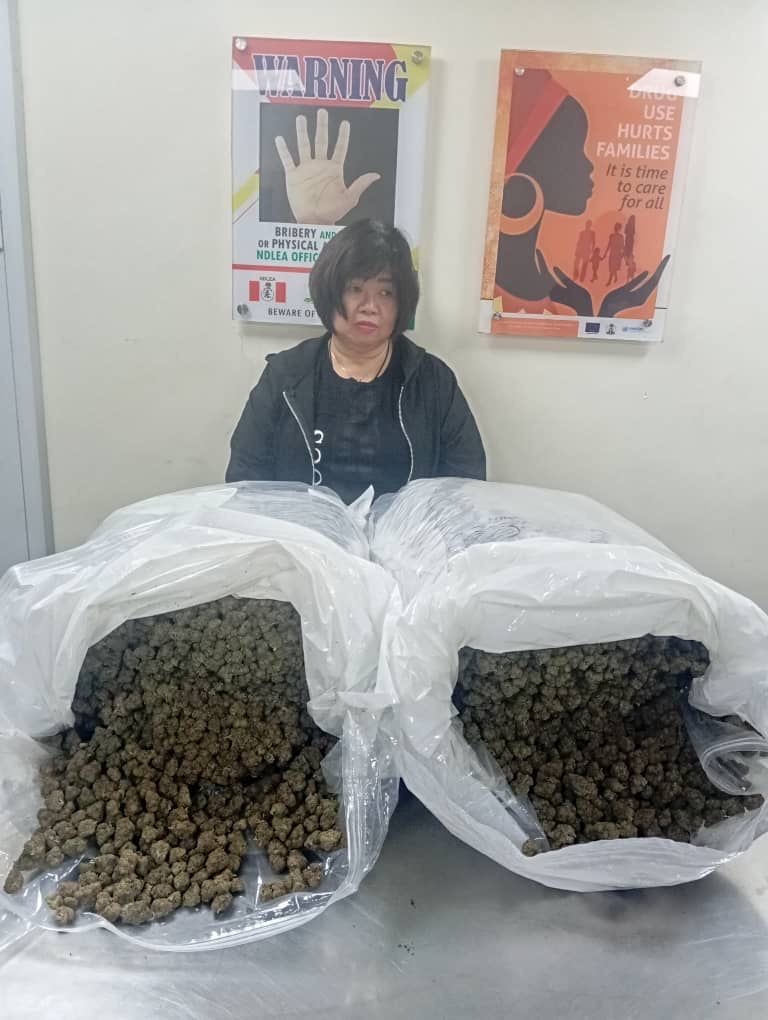
BY NKECHI NAECHE-ESEZOBOR—-A 63-year-old Chinese grandma Ting Hung Kiong has been arrested by operatives of the National Drug Law Enforcement Agency (NDLEA) following her attempt to smuggle large consignment of Canadian Loud, a synthetic strain of cannabis into Nigeria.
The female Chinese national who naturalised in Malaysia was arrested on Sunday 17th May 2026 upon her arrival in Nigeria from Thailand via Dubai, UAE, aboard an Emirates Airline flight. She was intercepted by NDLEA operatives attached to the Terminal 2 Arrival Hall of the Murtala Muhammed International Airport (MMIA), Ikeja, Lagos.
Investigation revealed that the suspect travelled from Malaysia to Thailand and subsequently to Nigeria via the UAE with two large travel boxes containing the synthetic cannabis consignment weighing 31.0 kilograms.
During an interview, the 63-year-old suspect who claims she works as a caregiver in Malaysia stated that her daughter sponsored her trip from Malaysia to Thailand and subsequently to Nigeria.
She further disclosed that she spent two weeks in Thailand, before she was handed the illicit consignment at the Thailand airport to deliver in Nigeria.
Meanwhile, another major shipment of illicit drug consignment has been recovered at the import shed of the Lagos airport. Following close monitoring of the consignment by NDLEA operatives since its arrival from India aboard an Emirates Cargo flight, the 29 large cartons containing One Million, Eight Hundred and Twenty-Five Thousand, Seven Hundred and Ten (1,825,710) tablets of Tapentadol 250mg, worth Two Billion, One Hundred and Ninety Million, Eight Hundred and Fifty-Two Thousand Naira (N2,190,852,000) were eventually handed over to the NDLEA by the Customs Service on Friday 22nd May 2026.
In another successful interdiction operation, NDLEA operatives at the Akanu Ibiam International Airport, Enugu on Wednesday 20th May intercepted a suspect Onyeka Valentine Emeka during the inward clearance of passengers on Ethiopian Airlines flight from Sierra Leone via Addis Ababa, Ethiopia. When placed under observation, the suspect excreted a total of 185.36 grams of cocaine.
At the Nnamdi Azikiwe International Airport, Abuja, a 29-year-old building engineer, Babatunde Prosper Afekhide was on Wednesday 21st May arrested by NDLEA operatives while attempting to board an Ethiopian Airlines flight from Abuja via Addis Ababa to Milan Malpensa, Italy.
A search conducted on his luggage led to the recovery of 10,280 pills of Tramaking 225mg; Tramadol 200mg and Tapentadol 250mg. The opioids were concealed using foil paper and hidden inside a carton, in a suitcase, obviously to evade detection.
In yet another operation at a courier company in Lagos, NDLEA operatives intercepted 1,174 pills of MDMA (Ecstasy) concealed in bicycle luggage carrier heading to Netherlands; 66 pills of tramadol 225mg hidden in soap container going to the United States and 18 tablets of tramadol 225mg concealed in body cream container heading to the United Kingdom.
In Edo state, NDLEA operatives acting on intelligence raided Igwe community in Owan East LGA where a total of 59 jumbo bags of skunk weighing 489kg and cannabis seeds weighing 9kg were recovered.
While a suspect Isah Sani, 30, was nabbed with 196,000 pills of exol-5 on Wednesday 20th May along Zaria/Kano road, Kano state, NDLEA officers at Seme border, Badagry area of Lagos recovered 59kg skunk from a warehouse in Mowo, Badagry on Tuesday 19th May.
Another operational success was recorded in Ekiti state where NDLEA operatives on Saturday 23rd May raided a warehouse located at N/56, Ikoyi community, Ikole-Ekiti and recovered 1,116 kilograms of skunk, while 54-year-old suspect Ogundana Adebayo Julius was arrested in connection with the seizure.
With the same zeal, Commands and formations of the Agency across the country continued their War Against Drug Abuse (WADA) sensitization activities in schools, worship centres, work places and communities among others in the past week.
These include: WADA enlightenment lecture to students and staff of Command Day School, Mokola, Ibadan, Oyo state; Girls Secondary School, Amenyi, Anambra; Matazu Model Primary School, Matazu LGA, Katsina; C&S Primary School, Majidun, Ikorodu, Lagos; Alufo High School, Apugo, Enugu; Aramoko District Commercial Secondary School, Aramoko Ekiti; and Government Girls Secondary School, Kurna, Kano state, among others.
While commending the officers and men of MMIA, NAIA, AIIA, Edo, Ekiti, Seme, and Kano Commands as well as those of DOGI for the arrests and seizures, Chairman/Chief Executive Officer of NDLEA, Brig. Gen. Mohamed Buba Marwa (Rtd) noted their drug supply reduction efforts balanced with WADA sensitization activities while he charged them and their compatriots across the country to continue to raise the operational bar.
The post How NDLEA intercepts Chinese grandma with 31.0Kg of drug consignment at Lagos airport appeared first on Business Today NG.




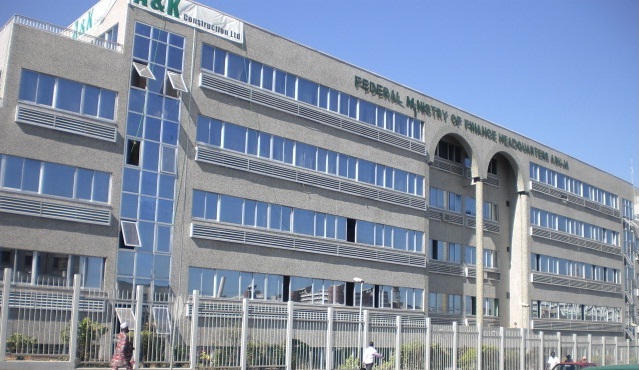
The Federal Ministry of Finance has disputed a claim that the Federal Government’s interest payments reached 124 per cent of its revenue in the first half of 2026, describing the figure as misleading.
The ministry said recent analysis and public commentary, which cited the World Bank’s October 2026 Nigeria Development Update, compared mismatched interest figures against an incomplete revenue base.
In a statement released on Sunday, the ministry said the 124 per cent interest calculation includes the debt serviced by the federal government on behalf of other tiers of government, including external loans to states.
“Measuring this against federal revenue alone overstates the ratio, which is only meaningful when debt and revenue cover the same level of government,” the statement said.
The ministry also asserted that the reported revenue is incomplete as it excludes the independent revenue earned by government agencies and enterprises but not yet remitted to the treasury.
“In addition, more revenue is typically earned in the second half of the year than in the first due to the statutory timing of certain payments. This is why the ratio stood at 156% in H1 2025, while the full-year 2025 debt service-to-revenue ratio was below 60%, down from 97% before the reforms,” it stated.


The ministry explained that federal revenue rose by 72 per cent from ₦3.6 trillion in the first half of 2025 to ₦6.2 trillion in the corresponding period of 2026.
Interest payments, however, rose by 38 per cent, from ₦5.6 trillion to ₦7.7 trillion over the same period, according to the ministry.
“The interest-to-revenue ratio fell by 32 percentage points in a single year, from 156% to 124%, and the gap between interest and revenue narrowed from ₦2.0 trillion to ₦1.5 trillion,” the ministry said.
The ministry attributed the changes to the current administration’s economic reforms, arguing that revenue is growing faster than interest costs.
It argued that a six-month figure alone should not be used to evaluate the sustainability of government debt.
“Debt sustainability is assessed on a full-year basis, not over six months,” the statement said.
READ ALSO: Federal government approves upgrade of four South-South ports
Citing the World Bank report, the ministry said Nigeria’s full-year 2026 debt service, covering both interest and principal, is projected at 46 per cent of revenue, and that this forecast is the appropriate benchmark for assessing the country’s debt-service burden.
The ministry noted that all borrowing falls within the limits approved by the National Assembly under the 2026 Appropriation Act and the approved borrowing plan, in compliance with the Fiscal Responsibility Act 2007 and the Debt Management Office (Establishment) Act 2003.
“We encourage analysts and commentators to apply the same rigour they seek to hold the government to: compare like with like, read figures in context, and seek clarification where the data is unclear,” the ministry said.
Discover more from Premium Times Nigeria
Subscribe to get the latest posts sent to your email.
-
News4 days ago
Miners Association Seeks Support To Unlock $3bn Gemstone Export Potential
-

 Health4 days ago
Katsina health professionals declare 7-day warning strike
-
News1 day ago
NUCAP: Nigeria targets 20 million people with 3,700 telecom towers – Technology Times
-
News2 days ago
Gunmen storm Plateau mining site, kill two persons