News
NPFL Shock: Remo Stars Confirm Relegation After Painful 2025/26 Season Collapse

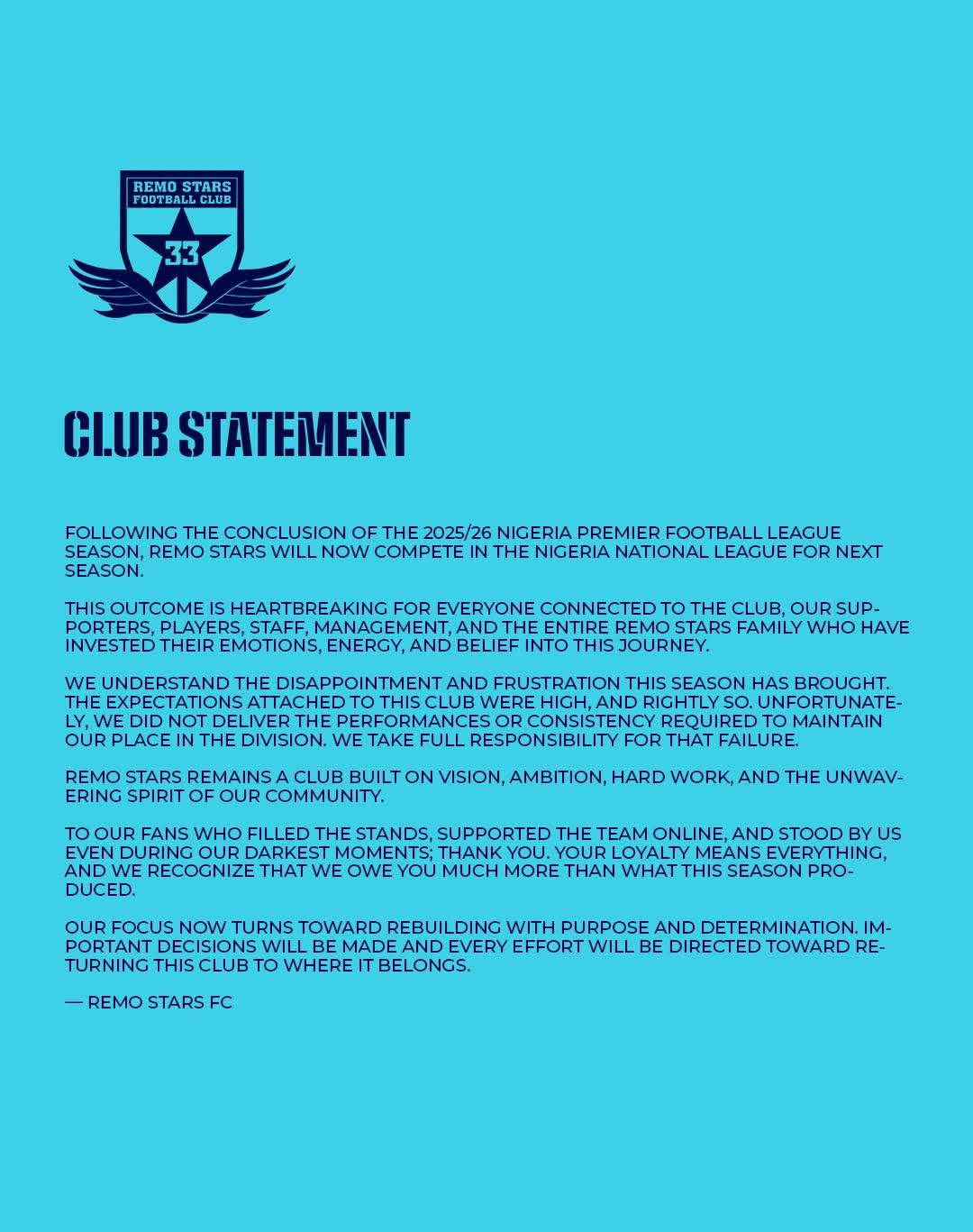
Remo Stars F.C. have officially confirmed their relegation from the Nigeria Premier Football League following the conclusion of the 2025/26 season.
In an emotional statement released by the club, Remo Stars admitted the campaign ended far below expectations and described the outcome as heartbreaking for everyone connected to the team.
“This outcome is heartbreaking for everyone connected to the club,” the statement read.
The club acknowledged the disappointment experienced by supporters, players, management, and staff after failing to secure enough consistency throughout the season.
“We did not deliver the performances required to remain in the division,” the club implied.
Remo Stars also accepted responsibility for the disappointing campaign while recognizing the high expectations surrounding the team before the season began.
“We take full responsibility for the failure,” the statement noted.
Despite the setback, the club insisted it remains committed to rebuilding and returning stronger in the future.
“Our focus now shifts toward rebuilding with purpose and determination,” the statement added.
The club also expressed gratitude to supporters who continued standing by the team during difficult moments across the season.
“Your loyalty means everything to us,” Remo Stars stressed.
The relegation has sparked emotional reactions among fans, especially considering the club’s ambitions and recent progress within Nigerian football.
“It’s a painful moment for the club and supporters,” many football observers reacted.
Remo Stars, however, remain optimistic about rebuilding and fighting for a return to the top division.
For the club, the message is clear.
Mistakes have been acknowledged.
A rebuilding process is coming.
And the ambition to return stronger remains alive.
Because setbacks in football often become the beginning of a new chapter of growth and recovery.






Health workers in Katsina State have suspended their seven-day warning strike following talks with Governor Dikko Radda over outstanding salary adjustments and welfare demands.
The suspension took effect on Sunday, 18 October, according to a circular reportedly issued by the Assembly of Healthcare Professionals (AHCP).
The development was announced in a newsflash attributed to the governor’s Chief Press Secretary, Ibrahim Mohammed, and also reported by Katsina Times.
The circular, dated 17 October and attributed to the assembly’s chairman, Ibrahim Balange, directed members to resume clinical and administrative duties across public health facilities following a meeting with the governor on 16 October.
The assembly comprises the Medical and Health Workers Union of Nigeria (MHWUN), the National Association of Nigerian Nurses and Midwives (NANNM), and the National Union of Allied Health Professionals (NUAHP).
According to the statement, the governor committed to reopening negotiations over the workers’ outstanding demands, including salary adjustments, allowances and career progression.


However, the announcement did not establish whether the government had agreed to the workers’ proposed salary adjustments or when outstanding payments would be made.
Government’s commitments
The statement attributed to Mr Kaula said the government agreed to reopen negotiations through a technical roundtable.
The commitments include a review and implementation of the Consolidated Health Salary Structure (CONHESS) in accordance with applicable government circulars, alongside a comprehensive review of hazard, call duty and shift duty allowances.
The government also reportedly agreed to address the skipping of CONHESS grade level 10 for eligible officers, in line with the applicable scheme of service.
A joint technical committee is expected to be established with defined terms of reference and a timeline for addressing the outstanding issues.
However, neither the statement nor the reported circular specified when the committee would begin work or when the proposed adjustments would be implemented.
The assembly reportedly commended Mr Radda for intervening in the dispute and thanked its members for their cooperation during the industrial action.
How the dispute began
The suspension follows months of disagreement between health workers and the Katsina State Government over salary disparities and allowances.
As PREMIUM TIMES reported on 15 October, the assembly declared the warning strike after a seven-day notice issued on 7 October expired without a satisfactory resolution.
Mr Balange said the dispute dated back to 2024, when the government indicated plans to review health workers’ remuneration in line with what their counterparts receive in federal health institutions.
A committee established to examine the complaints subsequently submitted recommendations in March 2025, but the union said the government failed to implement them.
According to the union, the state’s Office of Public Service Reform initially offered workers 10 per cent of the salary difference between state and federal health professionals.
The government later increased the offer to 15 per cent, but the workers rejected it as inadequate.
Mr Balange said the assembly had sought full implementation of the applicable federal salary structure and allowances but was willing to accept 75 per cent as a compromise.
The disagreement eventually led to the warning strike, which began on 14 October.
Patients affected by strike
The industrial action disrupted services at public hospitals, leaving patients and caregivers uncertain about access to treatment.
A PREMIUM TIMES report published on Sunday documented disruptions at Turai Yar’Adua Maternal and Child Hospital in Katsina.
During a visit to the hospital on Saturday, only a few patients were seen around the surgical ward.
Caregivers expressed concern over the disruption, including difficulties accessing treatment for patients requiring medical attention.
The state Head of Service, Masa’ud Banye, had confirmed that government officials were engaging the unions to resolve the disagreement.
Although the assembly has now directed its members to return to work, the extent to which normal services have resumed across affected hospitals has not been independently established.
What remains unresolved
The suspension ends the immediate industrial action but leaves questions about the implementation of the government’s commitments.
The reported agreement does not clarify whether the government has withdrawn its earlier 15 per cent offer, accepted the union’s proposed 75 per cent compromise or agreed to another salary adjustment.
It also provides no specific date for settling outstanding allowances or completing negotiations.
The workers are seeking improved remuneration and allowances comparable to those available to their counterparts in federal health institutions.
For now, the reported agreement provides a basis for renewed negotiations, while the resolution of the underlying dispute depends on whether the government and unions reach an implementable settlement.
Discover more from Premium Times Nigeria
Subscribe to get the latest posts sent to your email.

Arise News Director of News and Politics, Sumner Sambo says no political party can compete with the ruling All Progressives Congress, APC, in terms of political structure.
Sambo made this assertion on Monday while fielding questions in an interview on Arise Television's 'Morning Show'.
According to him, the APC possesses the most formidable organisational structure and campaign council among major political parties.
"The APC appears to have the strongest political organisation, with no other party matching its structure.
"I've seen President Bola Tinubu having a formidable team, and I can tell you that the APC is doing very well because, as it stands right now, they seem the most formidable in terms of political organization.
"Look at the composition of their presidential campaign council. Look at the structures they put in place, they look very well organized.
"But if you look at the sentiments that are coming in from the major voting blocs, like in the North, you see that the projections by ThisDay is actually right.
"A lot of people in the major voting blocs are feeling the heat, economic heat, political heat, and then of course the issues of insurgency. So it's a very difficult one, and I think what will worsen it is the internal contradictions within the APC.
"The NDC is going to launch its own presidential campaign council tomorrow. We are hoping that it will be able to set up a formidable presidential campaign council," he said.
2027: No party can compete with APC political structure – Sambo