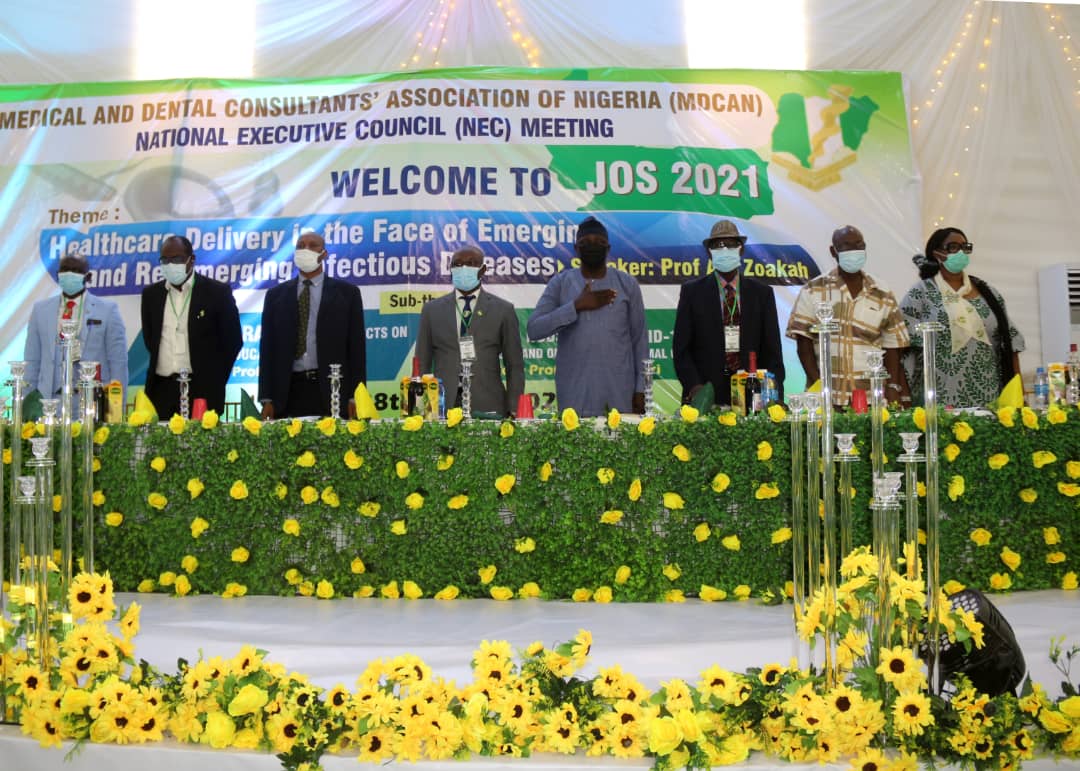
The medical and dental consultants association of Nigeria (MDCAN) held its National Executive Council meeting in Jos Plateau State on the 26th April 2021 at the Villa Grande Hotel
The theme; “Healthcare Delivery in the Face of Emerging and Re-Emerging Infectious Diseases” had the MDCAN president, Prof Kenneth Ozoilo delivering a welcome address in which urged members to continue to chart a path forward for the medical profession given the present challenges as was part of the issues that will be discussed at the NEC meeting.
The Vice-Chancellor of the University of Jos, Professor Sabastain Seddi Maimako. Chairman of the occasion was represented by the Deputy VC Academics, Prof Tanko Ishaya was full of commendable remarks for the efforts of MDCAN members, however, admonished them as medical practitioners to continue to strive in finding a lasting solution to the medical problems bedeviling Nigeria.
Guest lecture on the occasion, Prof A.I Zoakah, delivered his talk centered on the theme “Healthcare delivery in the face of emerging and reemerging infectious diseases”
Prof. Zoakah outlined his presentation on Healthcare delivery, the characteristics of Healthcare delivery system, Models of Healthcare delivery, Healthcare delivery in Nigeria, Challenges of Healthcare delivery in Nigeria, The Emerging & Re-Emerging Infectious Diseases, Why Infections Emerging & Re-Emerging?, Healthcare delivery in the Era of Emerging & Re-Emerging Infections and How to strengthen Healthcare delivery in the face of Emerging & Re-Emerging Diseases Nigeria.
Talking about healthcare delivery in Nigeria, He said; “Health system in Nigeria consists of organized public and private health services, in the public health sector a decentralized system is operated and regulated at the three tiers of government”
He noted that “Health is on the concurrent list meaning that each tier of government has concurrent responsibility of providing healthcare services” further stating that ‘In Nigeria, health services are delivered through primary, secondary and tertiary health facilities by both the public and private sectors.” “Various health development plans and reforms have been implemented to strengthen the Health Systems, but the impact has been dismal”
Talking about the Challenges of Healthcare delivery in Nigeria, Prof Zoakah mentioned some as; Inequitable distribution of health facilities and low service coverage, Shortage and mal-distribution of HRH, Recurrent disruption of services, Poor and uncourteous attitude of health workers, Inadequate funding, Poor regulation, Relatively expensive nature of modern healthcare system, Poor implementation of reforms and Absence of adequate medical intelligence and surveillance systems.
He said the Emerging diseases are those that are new to man or have existed but in isolated few, or have been in existence but only recently identified as an independent disease entity (NIH, 2007). He said emerging infectious diseases include SARS, HIV/AIDS, Ebola Virus Diseases, Nipah Virus Infection, Covid-19
While the Re-emerging diseases on the other hand, are those that have declined considerably, but are now becoming a major health problem to a reasonable proportion of the population (NIH, 2007). He said Re-emerging infectious diseases include; West Nile Virus, Monkey Pox, Tuberculosis, Drug-Resistant Malaria, etc.
The Nigerian healthcare delivery is not optimal as such in an era of Emerging & Re-Emerging Infections, health systems should be strengthened to prevent & control these diseases. There is urgent need to establish Infectious Disease Control Centres (IDCC) in all our tertiary hospitals in the country, with capacity for diagnostics and research and there should be HRH development on Emerging & Re-Emerging Infectious, in preparation for NEXT PANDEMIC!
The meeting also had Sub Theme Lectures on “Brain drain and its effects on medical education center in Nigeria” which was earlier delivered by Prof Nuhu Kutan Dakumafter was followed by prof A J K Madaki who spoke on “Managing Non-Communicable Deceases NCDs in the COVID19 era, challenges and options for optimal care”
The meeting gathered reputable Medical Practitioners across the country with goodwill messages also delivered not the occasion by the President Nigerian Medical Association NMA, The speaker Plateau state house of assembly, The Chief Medical Director of JUTH amongst others
The event is will continue in Jos with other activities till 28th April 2021.
Japan's immigration act may affect relocation plans
For many Nigerians exploring “japa” options beyond the usual destinations, Japan has become an attractive destination. But with the Japanese government’s new immigration protocol the move will become more expensive.
Authorities in Japan have considered changes to visa and residency fees under amendments to the Immigration Control Act. It proposes increased charges due to administrative costs—meaning more expenses for immigrants, such as Nigerians planning work and study relocation or long-term settlement.
An immediate impact on visa renewals, the cost of renewing a five-year visa could jump from 6,000 yen to about 70,000 yen (roughly $440). Short-term renewals may also increase to around 10,000 yen.
For Nigerians thinking long-term, permanent residency application fees could rise from 10,000 yen to 200,000 yen, with a proposed cap of 300,000 yen. This marks a financial shift for migrants who plan years ahead to transition from temporary stay to permanent status.
As of April 2026, eligibility tightens for foreign nationals who must now live in Japan continuously for at least 10 years before qualifying for citizenship. Twice the previous requirement, this could slow down long-term plans.
For Nigerian students who often use education as a pathway to international work opportunities, these changes may alter decisions about where to study. Japan has been gaining attention for its growing demand for skilled workers and relatively structured immigration pathways. However, higher costs could push many to reconsider options more carefully.
Professionals and skilled workers will likely feel the impact. High residency costs may influence job mobility, contract negotiations, and employer decisions to hire foreign talent.
While the policy is not yet official, the direction is clear: moving to Japan may require deeper financial planning.
For Nigerians considering “japa,” this development reinforces an important reality—migration is no longer just about opportunity, but also about affordability, timing, and long-term sustainability.
Nigerians should watch out for final decision on fees increase, implementation timeline, possible exemptions or reductions for students or low-income applicants, and changes in job sponsorship policies for foreign workers.
The Federal Government has commenced applications for the second batch of its Technical and Vocational Education and Training (TVET) programme, with selected participants set to receive a monthly stipend of N22,500.
This was made known in a statement issued on Monday by Boriowo Folasade, Director of Press and Public Relations at the Federal Ministry of Education.
The initiative is part of ongoing efforts to equip young Nigerians with practical, job-ready skills that can drive employment, entrepreneurship, and economic growth.
Programme details
According to the ministry, applications opened on April 13, 2026, and interested candidates are encouraged to apply for the nationwide training scheme designed to boost technical capacity and reduce unemployment.
Minister of Education, Tunji Alausa, described the programme as a key intervention to prepare youths for opportunities in a rapidly changing economy.
Tunji Alausa, Minister of Education
He noted that the government is investing in skills development to enable self-reliance, innovation, and long-term economic advancement through practical training and certification.
As part of efforts to expand its scope, the Ministry will collaborate with the Federal Ministry of Arts, Culture and Tourism to incorporate creative and cultural skills into the training.
Training structure and benefits
The programme offers intensive hands-on training lasting between six months and one year at accredited centres across all 36 states and the Federal Capital Territory.
Participants will receive monthly stipends throughout the training period and will be awarded nationally recognised certificates upon completion.
Training areas include construction, ICT, automotive technology, agriculture, beekeeping, creative media, fashion, cosmetology, hospitality, catering, tourism, and leather works, among others.
To ensure accountability, attendance will be tracked using biometric verification, and only participants who meet attendance requirements will receive stipends.
Applicants are required to provide their National Identification Number (NIN) and Bank Verification Number (BVN) during registration and must be available for full participation.
Interested individuals can apply via the official TVET portal.
Background
In December 2025, the Federal Government disbursed N4.7 billion as the first tranche of payments to trainees and accredited training centres under the programme.
The TVET initiative, which began rollout in May 2025, is part of a broader strategy to tackle unemployment and strengthen Nigeria’s skilled workforce.
Earlier, the Ministry had invited vocational institutions and master craftsmen to register for accreditation, allowing them to receive funding for training participants.
The programme adopts a practical-focused model, with 80% of training dedicated to hands-on experience and 20% to classroom learning.
Initial response to the scheme was strong, with over 90,000 applications recorded within the first week of launching the portal, while participation in entrance examinations rose significantly from 2024 to 2025.
Additionally, an artisan-led mentorship model has been introduced across upgraded technical colleges, enabling experienced professionals to guide trainees through their learning process.