News
Local Stakeholders Task Plateau Committee on Community-Led Peace Solutions in Kanam, Kanke

Local Stakeholders Task Plateau Committee on Community-Led Peace Solutions in Kanam, Kanke
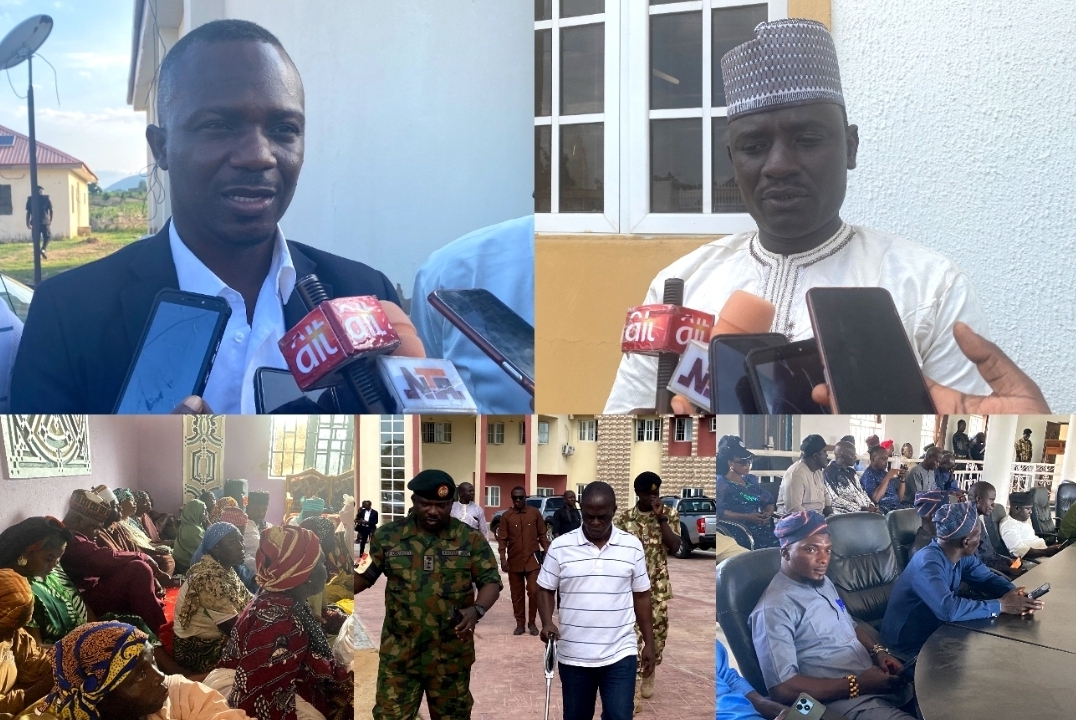
As the Plateau State High-Powered Fact-Finding Committee continued its assessment tour on Monday, July 28, 2025, stakeholders in Kanam and Kanke Local Government Areas emphasized the importance of locally-driven solutions, urging the committee to prioritize community input and traditional structures in its final recommendations.
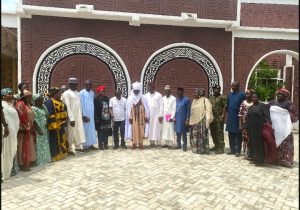
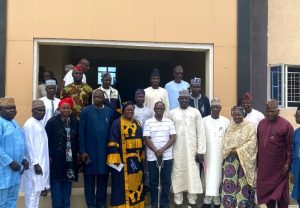 In Kanam, where the committee was received by the Deputy Chairman Hon. Aliyu S. Ali and other officials, leaders expressed that enduring peace can only be achieved through inclusivity and grassroots engagement. Hon. Aliyu noted that while Kanam had experienced violent attacks in the past, its relative stability today was due to collective community vigilance, religious tolerance, and strong leadership at both local and traditional levels.
“This visit is crucial,” Hon. Aliyu said. “Our people believe in dialogue and peace, and our traditional leaders have played a central role in preserving harmony. We call on the committee to reflect these local strengths in their recommendations.”
The committee, led by Maj. Gen. Nicholas Rogers (rtd), assured that their task was not only to identify the causes of violence but also to highlight what is working in each community.
“Kanam presents an opportunity to learn from a community that has experienced crisis and still managed to sustain internal peace,” Maj. Gen. Rogers noted. “We want to hear the voices of the people and understand how traditional and local systems contribute to security.”
The Emir of Kanam, HRH Alh. Muhammadu Mu’azu Muhammadu II, hosted the committee at his palace, where a closed-door session was held with district heads, youth leaders, and members of the traditional council. The Emir emphasized that traditional institutions must remain central to any peacebuilding initiative, citing the community’s historical roots and the unique role kingmakers and elders play in resolving conflicts.
“Our palace is a hub of dialogue,” the Emir said. “We bring people of different faiths and backgrounds together to foster mutual respect. Our responsibility is not political—it is moral and cultural. That’s why peace in Kanam is not by accident but by design.”
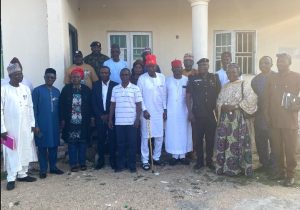
In Kanke LGA, where the committee met with Chairman Hon. Lapching Ezet Golime and his team, discussions focused on youth inclusion, land disputes, and intergenerational trauma stemming from past conflicts.
Hon. Lapching recalled personal encounters with violence during earlier crises and stressed the importance of empowering young leaders to shape a more secure future.
“Our generation is rising, and we carry the memory of past conflicts,” he said. “That’s why this engagement matters. We’ve shared our concerns with the committee, especially the need for structured resolution of land and chieftaincy disputes before they escalate.”
The committee chairman commended the youthful and proactive leadership in Kanke, noting that while the LGA faced minor challenges like kidnapping and transit insecurity, it had not experienced the scale of violence seen elsewhere.
“This kind of leadership gives us hope,” Maj. Gen. Rogers stated. “What we see in Kanke is a model of early response and youth-led governance that can be scaled.”
At the end of both visits, the committee reaffirmed its commitment to incorporating local voices, challenges, and existing community efforts into its final report to Governor Caleb Mutfwang. According to the chairman, the success of any state-led intervention depends largely on how well it aligns with grassroots realities.
“As we move from one LGA to another, one thing is clear: communities want peace, and they have ideas about how to achieve it,” he said. “Our job is to listen, document, and propose realistic solutions that empower the people.”
The tour continues as the committee engages remaining LGAs in its mission to restore Plateau State’s long-standing identity as the Home of Peace and Tourism.




Nigerian table tennis prospect Matthew Kuti has set his sights on winning two gold medals for the country at the 2026 Youth Olympic Games in Dakar, Senegal, as he intensifies preparations for the competition.
Kuti is targeting victory in both the men’s singles and mixed doubles events, expressing confidence in his preparation while acknowledging the technical demands of table tennis at the highest level.
“Thinking game is a very difficult game and it’s very scientific game. So I’m very, very happy that I participate in today’s game,” Kuti said.
The young Nigerian explained that his ambition is to represent the country successfully in Dakar, where he hopes to compete across multiple events and convert his preparations into gold medals.
“My challenge is to go there and take a gold for Nigeria, play many tournament and also there is mixed doubles in Dakar and singles. I want to win the two,” he said.
Kuti acknowledged that achieving the double target would require commitment and hard work, noting that he is currently in training as he works towards peak performance for the Games.
“So I will try my best. I will try what I can do because now I’m in training. So I will try my best,” he added.
The Youth Olympic Games will take place in Senegal from October 31 to November 13, 2026, bringing together young athletes from across the world in a multi-sport competition.
For Kuti, the tournament represents an opportunity to test himself against international opposition and contribute to Nigeria’s medal ambitions. His focus on both singles and mixed doubles reflects his determination to make the most of the opportunities available to him in Dakar.
With preparations ongoing, the Nigerian youngster will be hoping that his training, tournament experience and determination can translate into strong performances when the competition begins.

The Lagos State House of Assembly has unanimously supported the proposed establishment of state police, following its consideration of the Constitution Amendment Bill transmitted by the National Assembly.
The speaker, Mudashiru Obasa, disclosed this on Tuesday during plenary, which lawmakers reconvened for after cutting their recess short to consider the proposed amendment.
Mr Obasa said the establishment of state police had remained a recurring issue from the fifth to the 10th assembly, with successive legislatures discussing ways to strengthen security and protect lives and property.
He described the development as a step forward but expressed concern that some issues raised by state legislatures had not been adequately addressed.
“I am pleased that the issue of state police has received attention, but there are concerns that must be addressed to ensure that the arrangement works effectively,” Mr Obasa said.
The bill, titled the Constitution of the Federal Republic of Nigeria, 1999 (Sixth Alteration) Bill, 2026, seeks to provide for the establishment of the State Police Service and related matters.
The speaker said further developments in the amendment process should give states greater control over policing arrangements but stressed the need to clearly define the relationship between federal and state police, particularly regarding powers, control and responsibilities.
“The functions and responsibilities of state police should be clearly defined, with appropriate provisions made for state legislatures,” he said.
He commended President Bola Tinubu for commitment to democracy and democratic institutions, as well as the Senate and House of Representatives for advancing the proposal.
Mr Obasa further called for a clear constitutional provision for parliamentary police to protect legislative institutions and preserve their independence.
He cited past incidents in which state legislative buildings were allegedly demolished or locked up at the instance of governors, describing such developments as threats to legislative autonomy.
“There should also be provisions for parliamentary police, as we have in the United States Congress and at Westminster in the United Kingdom, to protect democracy and safeguard state legislatures.
“We must learn from past incidents in which a governor could order demolition of a legislative building or have a state legislature locked up simply to serve personal interests.
“To prevent such incidents from happening again and protect our nascent democracy, we must safeguard our existing state legislatures. Establishing parliamentary police will help protect legislative institutions and ensure that independence of the legislature is not undermined,” he said.
The speaker expressed confidence that outstanding concerns would be addressed as the constitutional amendment process progressed.
The House subsequently adjourned plenary until November 9, 2026.
The Lagos assembly‘s position comes as the push for state police has crossed its most critical constitutional hurdle.
The Presidential Working Group on the National Policing Bill, chaired by the Chief of Staff to the President, Femi Gbajabiamila, had on Friday announced that 24 State Houses of Assembly had approved the Constitution (Sixth Alteration) Bill, 2026.
According to him, the approval meets the two-thirds threshold—24 of 36 states—required under Section 9 of the 1999 Constitution for alteration.
The Working Group chairman commended the state assemblies and the National Assembly for passing the amendment in both chambers.
The 24 states are Adamawa, Delta, Edo, Kwara, Nasarawa, Ogun, Osun, Oyo, Plateau, Rivers, Taraba, Zamfara, Enugu, Anambra, Imo, Ekiti, Kebbi, Akwa Ibom, Bayelsa, Benue, Cross River, Abia, Yobe, and Kaduna.
With Lagos’ unanimous vote on Tuesday, the figure has now risen to 25, leaving 11 states yet to formally communicate their positions.
The National Assembly transmitted the bill to the states on September 16 with a 30-day administrative window.
(NAN)

-

 News3 days ago
Troops rescued 70 abductees, recovered N10 million ransom: DHQ
-
News3 days ago
Plateau Activates Ebola Preparedness Measures, Urges Residents to Observe Safety Guidelines
-
Business3 days ago
CBN grants JP Morgan approval-in-principle to set up merchant bank
-
Business3 days ago
REA Ends 16 Years of Darkness in Two Kano Communities