Connect with us

News

Deputy Chair Attributes Langtang North’s Peace to Tolerance and Respect for Local Laws

editor

Published

on

Screenshot 20250727

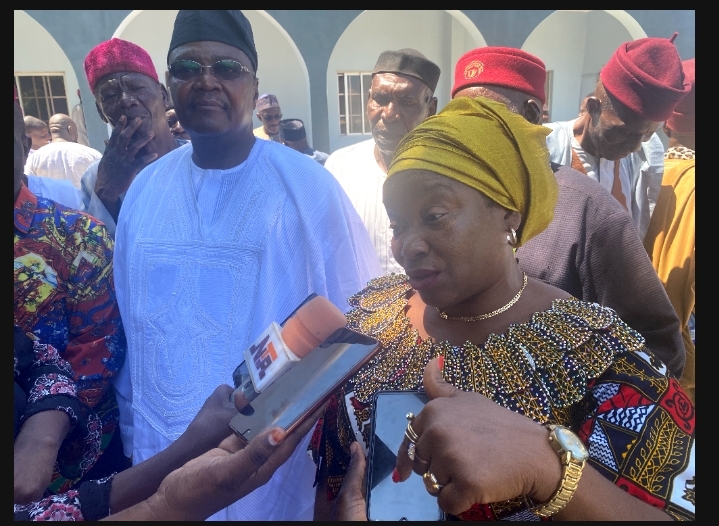
As violent conflicts continue to afflict various parts of Plateau State, the Deputy Chairperson of Langtang North Local Government Area, Hon. Deborah Daniel, has highlighted tolerance, mutual respect, and adherence to local laws as key factors sustaining peace in the area.

She made this known on Saturday, July 26, 2025, when the Plateau State High-Powered Fact-Finding Committee visited the council as part of its statewide assessment aimed at addressing recurring killings and insecurity.

Welcoming the delegation on behalf of the Executive Chairman, Hon. Pirfa Jingfa Tyem, who was unavoidably absent, Hon. Deborah noted that while Langtang North has not been immune to disputes—particularly over land—it has largely avoided the large-scale violence seen in other parts of the state due to its people’s deep-rooted culture of peaceful coexistence.

“We are a welcoming people, but we also believe strongly in law and order,” she said. “When you come to Langtang North and you respect our customs and abide by the rules, you’ll have no problem. But when someone refuses to follow the laid-down regulations, that’s when there’s tension.”

Hon. Deborah stressed the community’s reputation for hospitality and added that most internal issues are resolved through tolerance and dialogue rather than confrontation. “We tolerate a lot. We believe in telling people the truth in peace. That’s how we have been able to live with others. We are peacemakers,” she emphasized.

She commended Governor Caleb Manasseh Mutfwang for establishing the committee, describing him as “a true father of the state” for seeking to understand the root causes of violence rather than ignoring the suffering of citizens.

The committee, led by Maj. Gen. Nicholas Ragas (Rtd), had earlier stated that its visit was aimed at collecting firsthand accounts to formulate realistic and sustainable recommendations to restore peace in Plateau. He expressed satisfaction with the peaceful atmosphere in Langtang North, contrasting it with the devastation witnessed in other LGAs.

In addition to a meeting with local officials, the committee held separate engagements with security agencies and the traditional council led by His Royal Highness Nimnan Langnim, the Ponzhi Zinni. The monarch affirmed that peace in the area is the result of collective vigilance and sacrifice. “We watch each other’s backs. The interest of the community comes first,” he said.

In her final remarks, Hon. Deborah appealed for greater inclusion of women in peace building and governance. “There are only two women among ten committee members. We need to be carried along more because women are natural peace advocates,” she added.

Concluding the visit, Maj. Gen. Ragas praised the people of Langtang North for prioritizing unity and dialogue, noting that while land disputes exist, the absence of major attacks or reprisals was commendable. “We’ve seen the difference here,” he said. “This kind of community-based peace approach is what we hope to replicate elsewhere across the state.”

Continue Reading
Click to comment

Leave a Reply

Your email address will not be published. Required fields are marked *

News

Breast Cancer Survivors Face Challenges Beyond Treatment – News Agency Of Nigeria

info

Published

on

Breast cancer survivors face challenges beyond treatment – News Agency of Nigeria


By Hafsah Tilde, News Agency of Nigeria (NAN)
When Gloria Orji-Nwajiogu discovered a lump in her breast in 2009, it was removed and she was told it was benign.
A second lump was removed in 2010, when she was diagnosed with breast cancer.
Eight years later, in 2018, she received a second diagnosis.
Today, Orji-Nwajiogu, co-founder of the Network of People Impacted by Cancer in Nigeria (NePiCiN), draws on her experience of surviving the disease twice to support others affected by cancer.
She said the support she received from her family helped her speak openly about her diagnosis and the challenges she faced.
“I was free to tell my story. I was free to confide in people. I was free to, you know, talk to people about my journey because there’s nobody holding me back,” she said.
She added that her family’s acceptance meant she did not have to hide her experience.
“I realised that the more I talk, the more people love the fact that I was talking,” she said.
Orji-Nwajiogu began her advocacy work in 2015 through Project PINK BLUE, participating in cancer awareness outreach activities.
As she became more involved, she heard accounts of women who faced rejection and abandonment after a cancer diagnosis.
“Women don’t always get support from families. In fact, when I started, I went deep into advocacy and I started hearing stories of women whose husbands left because they had cancer, women whose husbands abandoned them at the hospital,” she said.
She also recounted cases in which some religious leaders blamed women for their illness, compounding their distress.
For Orji-Nwajiogu, faith should go hand in hand with medical care.
“Pray and go to the hospital. That is my watchword,” she said.
Her experience highlights the need for support beyond medical treatment, especially for women facing financial hardship, emotional distress and rejection.
The scale of the challenge is reflected in Nigeria’s cancer statistics.
The International Agency for Research on Cancer (IARC), through its Global Cancer Observatory, estimated that Nigeria recorded 32,278 new breast cancer cases among women in 2022.
The cases accounted for 40.5 per cent of all new cancer cases among women that year.
The disease was also the leading cause of cancer-related deaths among Nigerian women, with an estimated 16,332 deaths.
More recent IARC estimates put Nigeria’s breast cancer burden at 44,196 new cases and 21,309 deaths in 2024, highlighting the continuing public health challenge.
Globally, breast cancer remains the most commonly diagnosed cancer among women.
The World Health Organisation (WHO) says about 99 per cent of breast cancer cases occur in women, although men can also develop the disease.
In spite of the burden, early diagnosis and appropriate treatment can improve outcomes.
The WHO says treatment is more effective when started early and completed, making timely diagnosis and continued access to care essential.
However, patients may face financial and social barriers that interrupt treatment.
Alice Matawal, an oncology nurse and breast cancer survivor at Jos University Teaching Hospital (JUTH), said the cost of care remained a major challenge for many patients.
She said some patients missed appointments or abandoned treatment because they could not afford it.
“As a nurse in the unit, many patients drop out. I look for them; some, before I get them, they come back when it is worse,” she said.
“When I try to find out, they tell me there was no money. And if I insist they must come, will I give them the money?” she asked.
Matawal said some patients were also discouraged from continuing hospital treatment by relatives or others who attributed cancer to spiritual causes or advised them against chemotherapy.
“They would tell her, it is not supposed to be something that you should take injection for. Or, this is spiritual,” she said.
These experiences point to the importance of reliable health information and family support in helping patients make informed decisions about treatment.
The financial burden is compounded by the wider cost of healthcare in Nigeria.
A 2025 review published in JCO Global Oncology identified treatment costs, limited access to diagnostic facilities and cultural, religious and socioeconomic barriers as major challenges to effective breast cancer screening and early diagnosis in the country.
Beyond treatment costs, Matawal said women who underwent mastectomy, the surgical removal of a breast, could struggle with their body image and confidence.
“Maybe they remove one breast, she’s ashamed to come out.
“Some lose hope and decide, ‘It is okay, it is over, let me just stay,” she said.
Drawing on her experience as both a nurse and a survivor, Matawal urged patients not to allow the physical and emotional effects of the disease to define their future.
“But if you are determined, you want to live, breast cancer cannot bring you down or decide the end of your life, no,” she said.
Prof. Khadijat Musah, Dean, Faculty of Nursing Sciences, Federal University Otuoke, Bayelsa, said cancer care should recognise patients as individuals with different experiences and needs.
“We must show empathy, but we must also allow them to write their story, say their story,” she said.
Musah said survivors needed to be accepted back into their families and communities rather than being defined by their illness or physical changes following treatment.
“You allow them to come to the society, to be well integrated,” she said.
Her emphasis on social reintegration reflects the challenges highlighted by Matawal, who said some women became ashamed to appear in public after losing a breast.
Nurse Ann Joachim, an oncology nurse in training at the School of Post-Basic Oncology Nursing, National Hospital Abuja, said patients also needed reliable information and people they could approach for guidance and emotional support.
She said patients felt better supported when someone listened to their concerns and helped them navigate the health system to access appropriate cancer care.
“Another important point is we cannot take out psychosocial support for cancer patients,” she said.
Psychosocial support helps patients cope with anxiety, fear, changes in body image and difficulties in personal relationships.
It can also help families understand the needs of patients and provide appropriate support during and after treatment.
The WHO’s Global Breast Cancer Initiative identifies three priorities for reducing deaths from the disease by promoting early detection, ensuring timely diagnosis and providing comprehensive cancer management.
Launched in 2021, the initiative aims to reduce global breast cancer mortality by 2.5 per cent annually, potentially averting 2.5 million deaths by 2040.
The initiative underscores that effective cancer care requires more than diagnosis and surgery.
Patients may need chemotherapy, radiotherapy, rehabilitation, psychological support and follow-up care, depending on their individual circumstances.
Joachim stressed that a breast cancer diagnosis should not be regarded as the end of a person’s life.
“Detecting breast cancer is not the end of life. It’s not a death sentence.
“It means that there is hope. Once it is detected and treatment is commenced, it saves lives,” she said.
For Orji-Nwajiogu, the support that enabled her to speak openly about her experience has become part of her motivation to help others affected by cancer.
Reflecting on her advocacy, she said her experience had strengthened her commitment to supporting others.
“So even when for any reason I want to feel bad, I would tell myself, don’t give yourself a second chance at life. You can’t use it only for yourself. You have to use it for others,” she said.
Her journey from surviving two cancer diagnoses to supporting other patients underscores the importance of families, healthcare professionals and communities standing alongside women throughout treatment and beyond.
Overall, the experiences of survivors and healthcare professionals show that breast cancer care must extend beyond hospitals to include financial assistance, emotional support, family acceptance and social reintegration.
Such support can help survivors regain confidence, maintain social connections and rebuild their lives with dignity and hope. (NANFeatures)
Edited by Tosin Kolade
***If used, credit the writer and the News Agency of Nigeria.
(NAN)


Continue Reading

News

2027: INEC controversy has made NDC more popular in Kano – Gwarzo’s aide

info

Published

on

Ibrahim Garba Shuaibu, spokesperson for the Nigeria Democratic Congress, NDC, governorship candidate in Kano State, Aminu Gwarzo, says the controversy over the removal and subsequent restoration of his principal’s name from the Independent National Electoral Commission’s list has increased the party’s popularity.

Shuaibu made this known on Friday while reacting to INEC’s decision to restore Gwarzo’s name ahead of the 2027 governorship election.

He said the party was never worried about the initial omission because it was confident that it had followed all the necessary electoral procedures.

According to him, the development was only a temporary challenge that the party expected would be resolved.

“We were not frightened because we followed all the laid-down procedures from party membership to the nomination process and submission of our candidate’s details,” he said.

Shuaibu further claimed that the controversy had attracted public sympathy and encouraged more people to support the party.

“What the electoral commission intended as a setback has actually worked in our favour. It has increased our supporters, strengthened our popularity and made more people identify with us,” he said.

He added that the NDC would continue its campaign and grassroots mobilisation across Kano State while promoting its plans and policies to voters.

The spokesperson expressed confidence that the development would improve the party’s chances in the 2027 governorship election.

INEC restored Gwarzo’s name following public controversy over its earlier omission from the list of candidates for the forthcoming election.

2027: INEC controversy has made NDC more popular in Kano – Gwarzo’s aide

Continue Reading

Trending