News
Globacom pushes back on subscriber-led narrative, reframes telecoms competition around ‘depth, not speed’ – Technology Times

Nigeria’s telecoms market narrative is facing a fresh counterpoint after Globacom issued a strongly worded response to a recent industry analysis by Technology Times, arguing that prevailing interpretations of subscriber growth figures risk obscuring the deeper structural shifts shaping the nation’s digital future.
In a statement titled “Reframing Momentum: Globacom and the Expanding Horizon of Nigeria’s Digital Future,” the Second National Operator (SNO) challenges what it suggests is an overly narrow fixation on headline metrics such as net additions and market share movements, urging a broader reassessment of how leadership is defined in Nigeria’s evolving telecoms ecosystem.
“At first glance, the latest industry analysis reads like a ledger of familiar figures—subscriber gains, market shares, incremental rises and falls,” the telecoms group founded by Dr Mike Adenuga, Jr, the Nigerian business maganate with stakes in telecoms, oil and gas, banking, among others, says, setting the tone for its critique. “Yet, beneath this arithmetic lies something far more evocative: a nation stirring into a fuller digital consciousness.”


“At first glance, the latest industry analysis reads like a ledger of familiar figures—subscriber gains, market shares, incremental rises and falls,” the telecoms group founded by Dr Mike Adenuga, Jr, the Nigerian business maganate with stakes in telecoms, oil and gas, banking, among others, says, setting the tone for its critique. “Yet, beneath this arithmetic lies something far more evocative: a nation stirring into a fuller digital consciousness.”
Globacom: Nigeria telecoms evolving from pursuit of volume to refinement of value
The statement is a direct reaction to Technology Times’ analysis of recent subscriber data trends, where industry growth, marked by the addition of over 2.39 million new subscribers in the month of February 2026, was framed within the context of competitive positioning among operators. While not disputing the figures themselves, Globacom shares a different view of their significance, describing the surge not as “merely numerical progress” but as “the pulsebeat of a country leaning decisively into connectivity, commerce, and digital expression.”
However, the SNO, whose fully-owned mobile unit, Glo mobile, ranks as number three by subscriber base in the Nigerian telecoms market, draws a clear distinction between growth and leadership, arguing that “true leadership is not defined by the haste of footsteps, but by the clarity of foresight and the strength of foundations laid beneath the surface.”
This distinction forms the core of Globacom’s rebuttal. While industry commentary often spotlights operators leading in subscriber acquisition, the telecoms company suggests that such narratives “perhaps unwittingly” overlook what it calls “a subtler transition: a market evolving from the pursuit of volume to the refinement of value.”
The Nigerian SNO, which launched its Glo mobile service in August 2003, two years after its mobile competitors, MTN Nigeria and Airtel Nigeria, with the disruptive per second billing which made mobile services more affordable for subscribers, has recorded a number of telecoms industry’s feat including the launch of the Glo 1 undersea cable.
In positioning itself within this transition, Globacom states that it has deliberately chosen a different competitive arena. “This is the quiet theatre in which Globacom has elected to perform,” the company says, “not chasing the flicker of transient gains, but tending the enduring flame of data excellence, network resilience, and inclusive access.”
The language signals a strategic repositioning, from volume-driven competition to what the operator frames as infrastructure-led, value-centric growth. In doing so, Globacom implicitly challenges the industry’s traditional scorecard, which has long prioritised subscriber numbers as the primary indicator of market leadership.


This distinction forms the core of Globacom’s rebuttal. While industry commentary often spotlights operators leading in subscriber acquisition, the telecoms company suggests that such narratives “perhaps unwittingly” overlook what it calls “a subtler transition: a market evolving from the pursuit of volume to the refinement of value.”
Instead, SNO points to its long-term capital investments as the true measure of competitive strength. “Globacom’s strategy resembles less a hurried harvest and more a patient cultivation,” the statement notes, invoking a recurring metaphor that contrasts short-term gains with long-term infrastructure development.
Its investments, Globacom says, span “undersea cable infrastructure, expansive fibre networks, and democratised data pricing,” which it describes not as isolated initiatives but as “the subterranean roots feeding a vast digital canopy.”
From these “roots,” Globacom argues, emerge broader economic and technological outcomes, including “enterprise innovation, rural connectivity, and the widening of Nigeria’s technological commons.”
Globacom’s repositioning of its place in annals of Nigeria’s telecoms, aligns with a growing shift in global telecoms discourse, where infrastructure ownership, data capacity, and service quality are increasingly seen as strategic differentiators, particularly in emerging markets undergoing rapid digital transformation.
Globacom’s underscores this shift, asserting that “in an era increasingly defined by high-value data ecosystems and experiential quality, the true currency of competition is no longer subscriber count alone, but depth of service, affordability of access, and sovereignty of infrastructure.”
These three pillars, service depth, affordability, and infrastructure sovereignty, are presented as the new axes of competition, implicitly repositioning the operator’s role within the market. Rather than contesting leadership on subscriber metrics, Globacom seeks to anchor its relevance in foundational capabilities that enable long-term digital growth.
The emphasis on “sovereignty of infrastructure” is particularly notable, reflecting broader national and continental conversations around digital independence, local data hosting, and control over critical connectivity assets.
In this context, Globacom’s investments in subsea cables and fibre backbone infrastructure are positioned not just as corporate strategy, but as contributions to national capacity-building. The telecoms group suggests that such investments are “neither incidental nor invisible, but quietly consequential.”
Yet, the statement stops short of directly critiquing specific competitors, instead underscoring the telecoms industry’s evolution as a divergence in strategic tempo. “What emerges, therefore, is not a story of disparity, but of divergent tempos,” Globacom says.
“While some advance with visible velocity,” the SNO adds, “Globacom advances with depth—sinking its pillars into the bedrock of national connectivity, affordability, and long-term digital empowerment.”
This notion of “divergent tempos” offers a diplomatic but pointed response to analyses that foreground rapid subscriber acquisition as the dominant narrative. It suggests that while some operators may prioritise short-term growth indicators, others, like Globacom, are pursuing longer investment cycles that may not immediately reflect in headline figures.
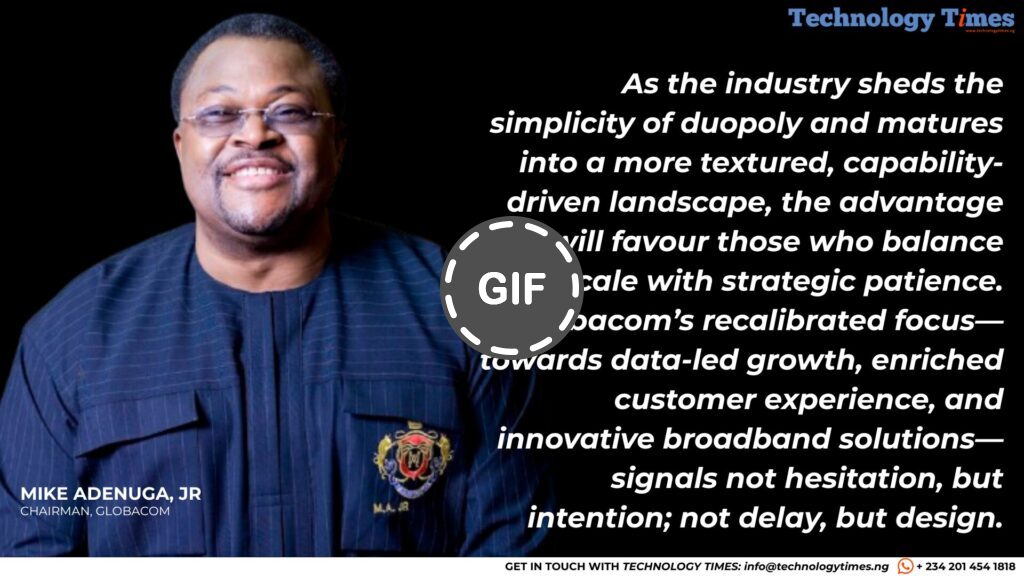
The company further situates its approach within the broader maturation of Nigeria’s telecoms market. “As the industry sheds the simplicity of duopoly and matures into a more textured, capability-driven landscape, the advantage will favour those who balance scale with strategic patience,” it says.
This observation reflects an industry in transition, from early-stage expansion characterised by aggressive subscriber acquisition, to a more complex phase defined by service differentiation, data monetisation, and infrastructure optimisation.
Globacom’s also sends signals about the recalibration of its own priorities. The SNO highlights a “recalibrated focus, towards data-led growth, enriched customer experience, and innovative broadband solutions,” describing this shift as “not hesitation, but intention; not delay, but design.”
The phrasing suggests an awareness of how its performance may be perceived in comparative analyses, and an effort to proactively shape that narrative by repositioning the strategic intent.
The company positions this recalibration not as a defensive move, but as a forward-looking strategy aligned with the demands of a digital economy. By emphasising broadband, data quality, and customer experience, Globacom aligns itself with key growth drivers in Nigeria’s telecoms sector, where data consumption continues to outpace traditional voice services.
At a broader level, the company’s response highlights a tension at the heart of telecoms reporting and analysis: the balance between quantitative metrics and qualitative impact.
While subscriber numbers provide a clear and comparable benchmark, they may not fully capture dimensions such as network reliability, data speeds, pricing innovation, or infrastructure reach, factors that increasingly shape user experience and economic outcomes.
Globacom’s insistence on these dimensions suggests a push for a more nuanced analytical framework, one that goes beyond “the simplicity of duopoly” and recognises the multi-layered nature of competition in a maturing market.
The company reinforce this perspective with a philosophical note on the future of the industry. “For in the final reckoning, the future of telecommunications will not be won by those who merely move fastest, but by those who build most wisely,” it says.
“And in that unfolding narrative, Globacom stands not at the margins, but at the very blueprint of a digitally awakened nation—steady, deliberate, and profoundly enduring.”
This encapsulates Globacom’s core argument: that its competitive position should be assessed not through the immediacy of subscriber gains, but through the durability and strategic relevance of its infrastructure and service ecosystem.
For Technology Times and its audience across Nigeria, Africa and beyond, the response provides a valuable counterbalance to data-driven analysis, introducing a qualitative lens through which to interpret industry trends.
It also raises important editorial questions about how telecoms performance is measured and communicated, particularly in a market like Nigeria, where digital transformation is accelerating and the stakes extend beyond commercial competition to national development outcomes.
As Nigeria continues to expand its digital infrastructure and deepen internet penetration, the interplay between speed and depth, volume and value, will likely become more pronounced. Globacom’s intervention suggests that operators are increasingly aware of this shift, and are seeking to shape not just market outcomes, but the narrative frameworks through which those outcomes are understood.
Stay ahead with real-time reports, breaking news, and exclusive insights delivered directly to your phone. Don’t settle for outdated information. Join TECHNOLOGYTIMES NEWS on WhatsApp for 24/7 updates.
Join Our Whatsapp Channel


Scottish Premiership club Aberdeen have secured the permanent signing of London-born Nigerian striker Toyosi Olusanya, with the forward committing his future to the club on a two-year contract after an impressive loan spell.
READ ALSO: Isaac John Turns Heads at Ex-Internationals Cup in Lagos, Declares Himself Ready for the Big Stage
Sports247 reports that the 28-year-old joins the Dons as a free agent following the expiration of his contract with Major League Soccer side Houston Dynamo. His arrival marks another key addition to manager Stephen Robinson’s rebuilding project ahead of the new season.
Olusanya spent the second half of the previous campaign on loan at Aberdeen, where he quickly adapted to life in Scottish football.
During his stint, he made 18 appearances across all competitions and contributed three goal involvements, earning the confidence of the coaching staff and convincing the club to pursue a permanent deal.
The striker’s work rate, physical presence, and attacking versatility made him a valuable option during his loan spell, and Aberdeen will be hoping he can build on that foundation as they prepare for the challenges of the upcoming Premiership campaign.
His signing represents the fifth addition to Robinson’s squad during the summer transfer window as the club continues to strengthen its roster with an eye on domestic success and improved performances across all competitions.
Born in London and eligible to represent Nigeria, Olusanya has enjoyed a career spanning English football and Major League Soccer before making the move north of the border.
The permanent transfer offers him the opportunity to continue his development in a familiar environment after settling into the team during his loan period.
For Aberdeen, retaining a player who already understands the club’s style and expectations provides continuity as they reshape the squad for the new season.
Supporters will be eager to see the Nigerian forward translate his promising displays into consistent goals and assists over the course of the campaign.
With his future now secured at Pittodrie, Olusanya begins the next chapter of his career aiming to establish himself as a key figure in Aberdeen’s attack and help the club compete strongly in the Scottish Premiership.
-

 News13 hours ago
JUST IN: Gunmen Attack NIPSS in Plateau, Kill Three Security Operatives
-
Health1 day ago
Five dead, 11 cases confirmed in Plateau cholera outbreak
-
News2 days ago
Troops Arrest Notorious Gun-runner In Plateau (Photo)
-
News4 days ago
Democracy Day: Imo PDP accuses Uzodinma of undermining rule of law, separation of power