News
Abdul Mahmud: When President Tinubu visited Jos Airport


There are moments in the life of a nation when grief demands presence, when sorrow calls not for practised choreography but for courage, and when leadership is measured not by the distance one can maintain from pain but by the willingness to step into it, absorb it, and be seen sharing in its unbearable weight. What the grieving residents of Jos and Nigerians witnessed at the Jos airport was something altogether different; something staged, distant, and unsettlingly hollow.
That President Bola Ahmed Tinubu merely touched down at the airport in Jos, receiving grieving families assembled and conveyed to him as though they were a delegation to a visiting dignitary, rather than walking the blood-soaked earth where lives were shattered or sitting in homes where silence now weighs heavier than grief, is telling. He did not stand in the presence of loss unmediated; he did not meet the hollowed gaze of mothers and fathers whose sorrow defies the brevity of official briefings.
What unfolded was not condolence, but choreography; not empathy, but insulation; not leadership, but a distant, carefully managed encounter with tragedy observed from the sterile remove of power, untouched by the rawness of inflicted human pains. What is most troubling is that the burden of dignity was displaced onto the victims themselves, that those who had lost everything were compelled to journey to receive sympathy, that grief itself was summoned to the airport’s arrival lounge and reduced to a brief ritual before Bola Ahmed Tinubu departed for Lagos.
He left behind not comfort, but questions; not reassurance, but the quiet and unsettling sense that the distance between power and the people has become not only physical, but profoundly moral.
The role of Governor Caleb Mutfwang in this theatre of sorrow raises its own difficult questions, for it was under his watch that grieving citizens were gathered and presented in this manner, and it was he who earlier moved through Angwan Rukuba in an armoured personnel carrier, a symbol not merely of security but of separation, of leadership encased and removed, observing devastation through the roof hatch while grieving residents endured it without shield or shelter, and one is compelled to ask whether governance has now become an exercise in managing optics rather than confronting reality.
History offers a different script, one written by leaders who understood that the legitimacy of power is deepened, not diminished, by proximity to suffering, and that in times of tragedy the President must be seen not above the people but among them. When George W. Bush visited the ruins of the World Trade Center after the attacks of September 11, he stood amid the dust and debris, not as a distant commander but as a presence among the wounded, and when Barack Obama travelled to communities shattered by mass shootings, he entered their spaces, embraced their pain, and allowed himself to be confronted by the rawness of their loss, understanding that leadership in such moments requires not detachment but vulnerability, not speed but stillness.
Even within our country’s memory, there were instances where leaders, despite all limitations, made the effort to stand where tragedy struck, to walk the ground, to listen without filters, to show that the state, for all its failings, could still muster the humanity to be present. In 2015, President Jonathan visited Maiduguri to comfort citizens displaced by the sect’s acts of terrorism, which Professor Ango Abdullahi described as a “political move to get the votes of Borno people who were yet to be killed by Boko Haram”.
What unfolded in Jos suggests a retreat from that standard, a shrinking of leadership into something cautious, curated, and curiously afraid.
For what exactly is President Tinubu afraid of when he avoids the people, when he chooses the airport over the village, the briefing over the burial ground, the controlled encounter over the unpredictable reality of human grief? Is it fear of security threats, which would be understandable but not insurmountable, or is it something deeper, a fear of confrontation, of unscripted emotion, of the possibility that in the eyes of the bereaved, he might see not just sorrow but accusation? And, of course, there is the astonishing presidential suggestion that the answer to the relentless violence visited upon the plateau people lies in the installation of CCTV cameras, as though terror that moves with rifles and land mines can be deterred by surveillance alone, as though the problem is one of visibility rather than will, as though what is required is not decisive security action but the quiet gaze of cameras recording.
There is something profoundly dissonant in this approach, something that speaks to a misunderstanding of both the scale of the crisis and the depth of the people’s anguish. What Nigerians in Plateau and elsewhere seek is not the illusion of safety but its substance, not technological gestures but tangible protection, not distant condolences but present leadership.
Grief, when mishandled, does not simply fade; it hardens into resentment, into a quiet but enduring belief that those who govern are no longer willing to share in the burdens of those they govern. This is the real danger, not the revelation of a lapse in empathy, but the deepening of the fracture between state and citizens, between authority and legitimacy. Yet all of this seemed lost on Bola Ahmed Tinubu as he remained in the arrival lounge of Jos airport, removed and unseeing, like an imperial sovereign long estranged from the quiet obligations of empathy and the simple, human duty of compassion.
A president is judged not only by the policies he announces or the statements he releases, but by where he stands when citizens are hurting. In moments of grief, leadership is not exhibited from a distance; it is seen in the willingness to step into homes where loss sits heavy, to walk the ground where lives have been shattered, and to meet sorrow at close range. It is there, in the presence of the bereaved and the broken, that the true measure of leadership is taken.
In Jos, that measure fell short. President Tinubu did not walk Angwan Rukuba shadowed by mourning, or sit with families whose lives had been torn apart. He sat in the arrival lounge at Jos Airport to receive the grieving rather than visit them. The encounter was brief, controlled, and removed from the places where the pain was deepest. Suffering was acknowledged, but not assuaged; condolences were offered, but not shared in the spaces where they carried weight, leaving the silence of what was not done. Empathy. Those who gathered, those who waited, and those who watched were left with the simple but troubling question: Why, at a time that called for closeness, did President Tinubu keep his distance? President Tinubu’s visit bore less the character of sympathy than of routine; a scheduled stop at Jos airport, rather than a deliberate journey into the midst of grieving citizens. What a shame.
Abdul Mahmud, a human rights attorney in Abuja, writes weekly for The Gazette



News
SSA Adeboye Opens Talks With Morocco on Grassroots Sports Partnership, International Opportunities for Nigerian Talents

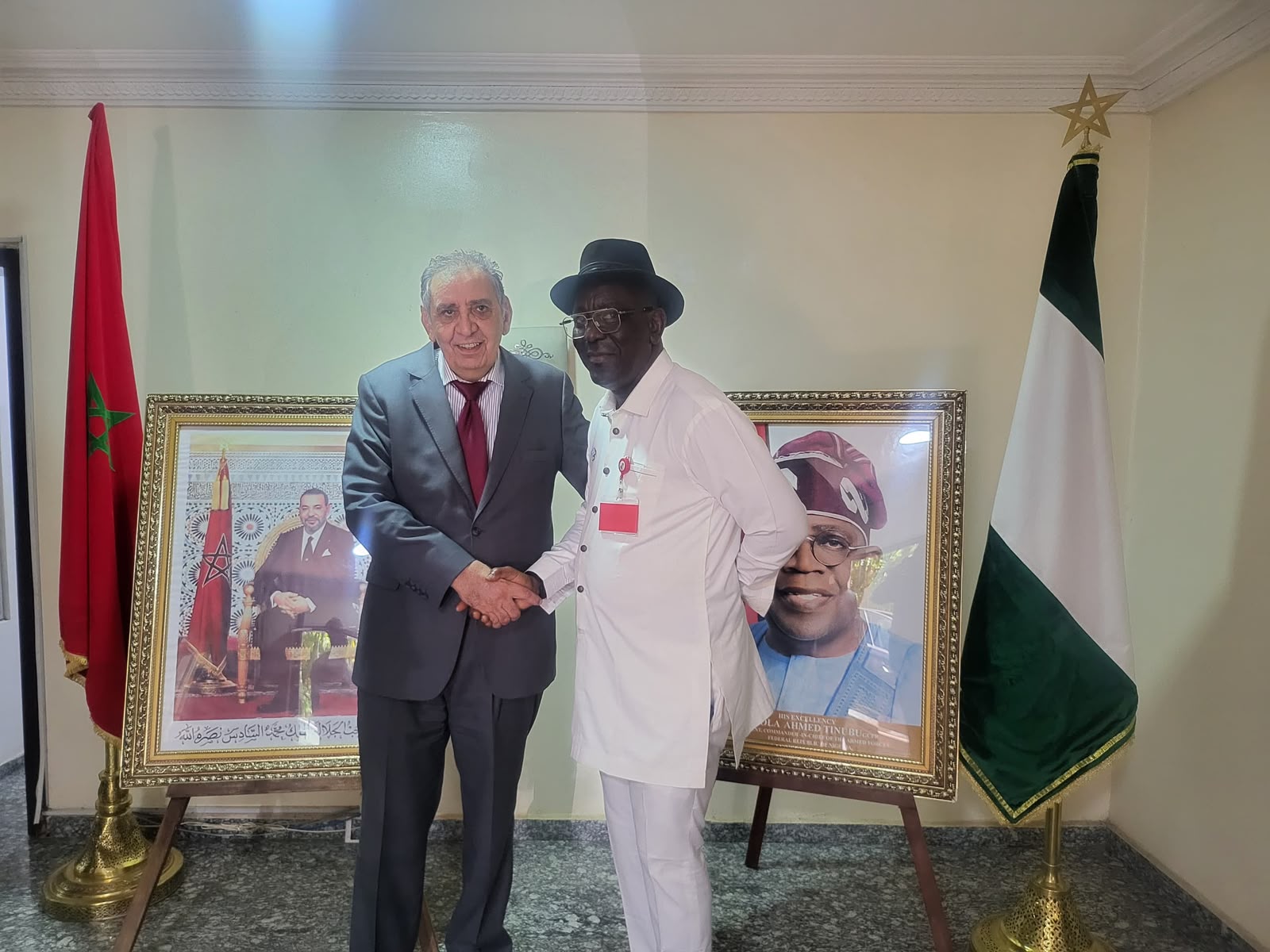
The Senior Special Assistant to the President on Grassroots Sports Development, Hon. Adeboye Anthony Adeyinka, has taken another step towards expanding international opportunities for young Nigerian athletes following a diplomatic engagement with the Ambassador of the Kingdom of Morocco to Nigeria, His Excellency Moha Ou Ali Tagma, in Abuja.
Adeboye, who paid a courtesy visit to the Moroccan Embassy on Tuesday, held discussions with the Ambassador on strengthening bilateral cooperation in grassroots sports development, talent discovery, technical exchange and youth empowerment.
The meeting explored opportunities for both countries to leverage their sporting relationships to create sustainable development pathways for young athletes, coaches and sports administrators.
Speaking during the engagement, Adeboye emphasised that Nigeria’s ambition to become a stronger sporting nation requires strategic international partnerships capable of connecting grassroots talents with modern training methods, technical expertise and competitive opportunities.
“Our responsibility is not simply to discover talents but to ensure they have the right environment, exposure and opportunities to develop. Morocco has made significant investments in sports development, and there are valuable areas where both countries can collaborate for the benefit of our young people,” Adeboye stated.
The Presidential aide noted that sports diplomacy has become an important instrument for strengthening international relationships while creating opportunities for economic growth, cultural exchange and youth development.
He explained that collaboration between Nigeria and Morocco could open doors for coaching education, technical assistance, youth competitions, institutional partnerships and knowledge-sharing initiatives.
“We want partnerships that move beyond discussions to practical programmes. When young athletes, coaches and administrators have opportunities to learn, compete and exchange ideas internationally, the benefits ultimately return to our communities and national sporting system,” he added.
Adeboye also stressed the importance of creating structured pathways through which talented young Nigerians, particularly those emerging from schools, academies and community competitions, can access development opportunities without being limited by their backgrounds.
The visit comes as the Office of the Senior Special Assistant continues preparations for the National Grassroots Sports Development Summit 2026, scheduled for November 18 and 19 at the Banquet Hall, Presidential Villa, Abuja.
The Summit, themed “Creating a New Pathway for Sustainable Grassroots Sports Development,” is expected to provide a platform for strengthening domestic and international partnerships towards a more sustainable sports development framework.
Adeboye expressed appreciation to Ambassador Tagma for the warm reception and constructive discussions, describing the engagement as an encouraging foundation for exploring mutually beneficial cooperation.
“Nigeria and Morocco share a passion for sports and a strong belief in the potential of young people. We must translate that shared interest into opportunities that can positively impact the next generation,” he said.
The Presidential aide reaffirmed his Office’s commitment to pursuing partnerships that strengthen grassroots participation, improve talent development and position Nigerian youths for greater sporting opportunities internationally.
-

 News2 days ago
Euromatch NPFL: Matchday 9 results
-
News3 days ago
NUCAP: Nigeria targets 20 million people with 3,700 telecom towers – Technology Times
-
News4 days ago
Gunmen storm Plateau mining site, kill two persons
-
News4 days ago
Nigeria needs stronger collaboration ‘to shape internet governance’ – Technology Times