Business
At Africa Forward Summit, Tinubu calls for reform of global financial architecture

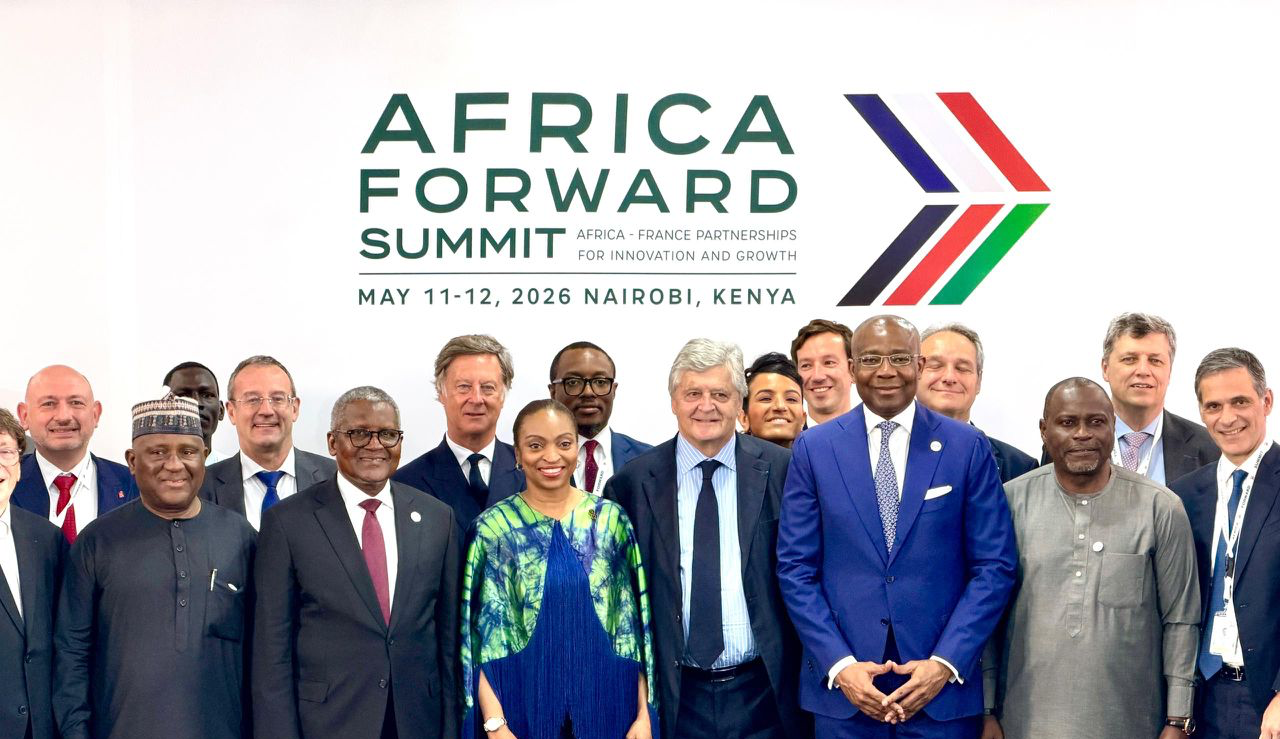
President Bola Tinubu, on Tuesday, led Nigeria’s government, diplomatic, and business delegation to the Africa Forward Summit at the Kenyatta Convention Centre in Nairobi, Kenya, advocating for stronger economic integration that prioritises Africa’s growth and prosperity.
The Africa/France summit, co-hosted by Presidents Emmanuel Macron of France and William Ruto of Kenya, brought together leaders and top officials from more than 30 countries across the continent.
Messrs Ruto and Macron, Antonio Guterres, Secretary-General of the United Nations, and Mahamoud Youssouf, Chairman of the African Union Commission, delivered opening statements.
On the sidelines of the summit, President Tinubu held a bilateral meeting with Madagascar’s President, Michael Randrianirina. He also met with the President of the Confederation of African Football, Patrice Motsepe, and expressed Nigeria’s readiness to host the 2026 CAF awards.
At the summit, the French government advocated restructuring economic and political relations on the basis of equality and fairness. At the same time, African leaders emphasised the need for greater access to credit to fund major investments and stimulate economic growth.

President Tinubu highlighted Nigeria’s potential in the blue economy as one of the cornerstones of Africa’s development. Governments and the business community had long neglected this potential due to insecurity and uncertainty.
“Today, I make an explicit commitment: Nigeria will intensify regional coordination by offering our Deep Blue Project’s maritime intelligence infrastructure as a shared data hub for willing Gulf of Guinea states. Interoperable systems, harmonised laws, and seamless joint enforcement must become the daily reality, not an aspiration on paper.
“Let no one misunderstand: maritime sovereignty does not repel investment — it attracts it. Secure sea lanes, predictable regulation, and functional courts are the preconditions that unlock private capital. Governance has de-risked Nigeria’s maritime proposition. We now invite partners to build on these gains as we advance climate-aligned port modernisation and the digital transformation of our maritime sector.
“As we endorse the Nairobi Declaration, Nigeria affirms that maritime sovereignty and ocean governance are the non-negotiable foundations of Africa’s Blue Economy transformation. We will continue to earn that sovereignty — through institutions, through assets, through law, and through iron-clad regional solidarity that turns our waters from a theatre of risk into a story of shared resilience.
“The oceans have no duplicate as a common heritage of mankind. For Africa, moving from sea blindness to ocean sovereignty is not a choice — it is a generational duty. Nigeria is ready, and we invite all present to join us in that duty,’’ the president stated.
On the reform of the international financial architecture, the president stated Nigeria’s position:
“Last September, from the podium of the United Nations General Assembly, Nigeria warned that the international system must reform or risk irrelevance. We spoke not only of the Security Council but of the financial and trade structures that quietly de-industrialise our nations. The evidence is before us. Despite decades of independence, Africa’s share of global manufacturing value added remains below 2 per cent.
“We export raw minerals, crude oil, and agricultural commodities, and we import processed goods at a premium. This pattern is not an accident. It is the product of a global financial architecture that starves our industries of affordable capital, tolerates massive illicit financial flows, and imposes policy constraints that our competitors themselves never observed when they built their own industrial bases.

“Nigeria does not come to this discussion as a supplicant. We come as a nation that has taken painful, homegrown decisions to put our house in order — removing fuel subsidies, unifying our exchange rate, recapitalising our banking system with over $3.4 billion, and exiting the FATF grey list. These reforms were sovereign choices, not external conditions. They have delivered a declining debt-to-GDP ratio, now projected at 32.3 per cent in 2026, stronger external reserves of $45.5 billion, and a return of investor confidence. But, Excellencies, even a reforming nation like Nigeria is being forced to de-industrialise by a financial system that is stacked against us,’’ he noted.
The president added that in 2026, Nigeria will spend about $11.6 billion on debt service — nearly half of projected revenue.
“Every single dollar that leaves our treasury to pay punitive interest rates is a dollar that did not go into our steel sector, our textile mills, our agro-processing plants, or our digital industries. It is a dollar that did not train a young Nigerian engineer or provide affordable power for our factories. Our industrial base is being starved of the blood it needs — long-term, affordable finance — while creditors and rating agencies treat African sovereigns as permanent high-risk borrowers, regardless of our fiscal performance.
“So, I ask this gathering: how can an African manufacturer compete with a competitor in Europe, Asia, or North America when the cost of borrowing in our nations is five to ten times higher? How can we build cross-border industrial value chains under the African Continental Free Trade Area when our infrastructure projects face a financing gap deepened by the very institutions meant to bridge it? The answer is plain: we cannot. The international financial architecture, as currently constituted, is an instrument of industrial disarmament for Africa.
“Nigeria is not asking for charity. We are demanding a financial system that intentionally enables Africa to industrialise — to process its own minerals, refine its own crude oil, manufacture its own pharmaceuticals, and compete fairly in global markets. We will continue to borrow responsibly, but we insist that our creditworthiness be measured by our economic fundamentals and our industrial potential, not by outdated stereotypes,’’ he noted.
The president stated that immigration issues must be addressed by expanding safe, orderly, and legal pathways to improve security.
“First, cooperation must address root causes in countries of origin. People who have jobs, security, and hope at home do not typically risk their lives in the back of a smuggler’s truck. That is why Nigeria has embedded migration management within our broader economic transformation agenda—removing fuel subsidies to invest in infrastructure, recapitalising banks to fund enterprise, and modernising agriculture to create rural livelihoods, among other initiatives.
“But we cannot do it alone. International partners must move beyond rhetoric and match words with investments that make staying at home a genuine choice—investments in climate adaptation, energy access, digital skills, and the productive sectors that employ young people. As we intensify the implementation of these domestic measures, I therefore call on our development partners to ring-fence a portion of Official Development Assistance (ODA) for programmes that demonstrably reduce the desperation that fuels irregular migration,’’ he stated.
On Nigeria’s position on peace and security, President Tinubu urged African countries to work together in building a global migration governance architecture that is fit for purpose.
READ ALSO: UBA Group reaffirms commitment to Africa’s growth agenda at Africa Forward Summit 2026
“The Global Compact for Safe, Orderly and Regular Migration was a start, but it remains non-binding and underfunded. Nigeria supports the African Union’s Migration Policy Framework and the Khartoum Process, but we need a more coherent link between these regional efforts and global institutions”.
President Tinubu was accompanied by the Minister of Foreign Affairs, Bianca Odumegwu-Ojukwu, Minister of Finance and Coordinating Minister of the Economy, Taiwo Oyedele, Minister of Agriculture and Food Security, Abubakar Kyari, Minister of Marine and Blue Economy, Adegboyega Oyetola, Minister of Environment, Balarabe Lawal, Minister of Industry, Trade and Investment, Jumoke Oduwole and Minister of Communications, Innovation and Digital Economy, Bosun Tijani.
The Chairman of the Dangote Group, Aliko Dangote; Chairman of BUA, Abdulsamad Rabiu; Chairman of the UBA Group, Tony Elumelu; and Chairman of Access Holdings Plc, Aigboje Aig-Imoukhuede, attended the summit.
Others were the Chief Executive Officer of the Nigerian Investment Promotion Council (NIPCO), Aisha Rimi; the Minister of State designate for Foreign Affairs, Sola Enikanolaiye; the Director General of the National Council on Climate Change (NCCC), Omotenioye Majekodunmi; the Nigerian Ambassador to France, Ayodele Oke and Director General of the National Intelligence Agency (NIA), Mohammed Mohammed.
The ministers had bilateral meetings with their counterparts from Kenya, France and other African countries. Also, they participated in plenaries at the Nairobi University and the KICC, with a focus on engagement, entrepreneurship and Africa’s demographic dividend.
The ministers also brainstormed on dynamic CEO and business leadership, AI and digitalisation as drivers of business, investment opportunities, innovation, agro-industry, cultural and creative industries, trade and innovation, and the creation of frameworks for moving from political rhetoric to concrete industrialisation, competitive, supporting agro-industries, AFCTA, healthcare and climate change as a collective effort.
Bayo Onanuga
Special Adviser to the President
(Information & Strategy)
May 12, 2026




The Auditor-General of the Federation flagged an alleged ₦345.5 million duplicate payment by the Federal Ministry of Communications, Innovation, and Digital Economy to a contractor handling the Abuja ICT Park project.
The finding was contained in the Auditor-General’s Annual Report on Non-Compliance and Internal Control Weaknesses in Ministries, Departments and Agencies of the Federal Government for the year ended 31 December 2024.
The special audit of the communication ministry covered the period from 1 January to 31 December 2021 and raised 14 issues concerning the planning, funding, procurement and implementation of the ICT Park project.
At the time the project was being implemented, Isa Ali Pantami, who was appointed by former President Muhammadu Buhari, served as Minister of Communications and Digital Economy from 2019 to 2023. He was succeeded by Bosun Tijani, who was appointed by President Bola Tinubu.
₦345.5 million duplicate payment
In Issue 13 of the findings, titled “Loss of Fund Due to Duplicated Payments to Contractor,” the Auditor-General said the ministry processed and approved two separate payments of ₦345,499,262.74 each as the third tranche of the 15 per cent mobilisation advance to the contractor.
The payment was intended to establish the Information and Communication Technology (ICT) Park, Abuja.

The Permanent Secretary approved the first payment on 19 January 2022 through payment voucher No. FMCDE/CAP/606/2021 dated 24 January 2022.
The same accounting officer approved the second payment on 17 January 2023 through payment voucher No. FMCDE/CAP/149/2022 dated 8 February 2023.
The report said the two paid vouchers had identical contract references, amounts, and narrative descriptions, which it said indicated duplicate payment.
It added that no record showed the first payment had been reversed, adjusted, or treated as an accounting error.
“There was also no journal entry, refund, or internal memo linking the 2023 approval to any prior transactions. These omissions demonstrate a failure of supervisory review, record reconciliation, and payment verification within the Ministry,” the findings stated.
The Finance and Accounts Department also failed to justify the repeated authorisation or the lack of reconciliation between the Cash Book and Vote Book, according to the report.
The findings said the contractor, while claiming it received only one payment in 2023, submitted a bank statement that excluded the critical period between 2 January 2022 and 8 February 2023, preventing independent verification of its claim.
The audit said the payments posed risks of fund diversion and loss of public funds, attributing this to weaknesses in the ministry’s internal control system.
The audit said the ministry’s management did not respond to the alleged duplicate payment under the contract.
The Auditor-General recommended that ₦345.499 million be recovered and remitted to the Treasury, and that evidence of remittance be forwarded to the Public Accounts Committee of the National Assembly.
₦447.67m from undisclosed funding sources
In Issue 11, the auditors questioned ₦447.67 million in payments to the ICT Park contractor, which they said could not be traced to the Government Integrated Financial Management Information System (GIFMIS).
The amount comprised ₦102,166,730 and ₦345,499,262.74 paid to the contractor, vide paid vouchers, Ref. No. FMCDE/CAP/061/2021 and FCMDE/606/2022 on 11 June 2021 and 19 February 2022, respectively.
According to the report, the payments appeared in the cash book. The contractor acknowledged them in the progress report and bank statement, but they did not appear in GIFMIS records, indicating they were processed off the system.
The audit said officials in the ministry’s Finance and Accounts Department could not explain the existence or authorisation of the alternative funding sources.
The report said the ministry also failed to provide documentation showing lawful appropriation, supplementary approval, or an external funding agreement for the payments.
The audit said the action posed a risk of misappropriation of funds and diversion of public property.
It said the ministry’s management did not respond to questions about the history of the payments in the GIFMIS records.
The Auditor-General recommended recovering and remitting ₦447.67 million to the Treasury, with sanctions under paragraphs 3106 and 3129 of the Financial Regulations (2009) if the ministry fails to comply.
₦396.65 million project funds used for unrelated items
In Issue 9, the findings showed that N396.65 million from the ICT Park project fund was used to pay for consultancy services, office consumables, furniture, and stationery printing.
The audit said approvals had been processed for consultancy services relating to the ICT Park. Still, payments were made to unrelated suppliers for consumables and office furniture that were not contained in the project’s Bill of Quantities.
The report said this reduced funds meant for the mobilisation and execution of the ICT Park project.
It also said the ministry failed to provide evidence of approval for the virement from the Minister of Finance, Budget and National Planning and the National Assembly.
It said the actions posed a risk of misappropriation of funds and undue delay in completion of the project, noting that the ministry failed to respond to the question on the use of the project funds for unrelated items.
The Auditor-General recommended recovering and remitting ₦396.655 million to the Treasury, with sanctions under paragraphs 3106 and 3129 of the Financial Regulations (2009) if the ministry fails to comply.
₦1.85bn paid without performance bond
In Issue 10, the auditors also found that N1.848 billion was paid to the contractor without securing a valid Performance Bond.
The report said the Bureau of Public Procurement had directed in December 2020 that a minimum 10 per cent Performance Bond be secured for major contracts before payment of mobilisation fees.
However, the ministry first released ₦1.348 billion in mobilisation payments between March 2021 and February 2023 without obtaining the required bond.
The report said that nearly three years after the contract award, the contractor submitted a commitment letter dated 29 December 2023, promising to furnish a Performance Bond upon receiving an additional N500 million. This amounts to ₦1.848 billion.
It said the actions exposed public funds to loss, noting that the ministry failed to respond to the question on the payment.
The Auditor-General recommended recovering and remitting ₦1.848 billion to the Treasury, and imposing sanctions under paragraphs 3106 and 3129 of the Financial Regulations (2009) if the ministry fails to comply.
₦500 million paid without interim performance certificate
In Issue 12, the Auditor-General said the ministry released an additional ₦500 million to the contractor on 29 December 2023 without an Interim Performance Certificate or verified progress report.
The report said the payment was made after the contractor received the 15 per cent mobilisation fee.
Instead of an Interim Performance Certificate, the ministry relied on a commitment letter from the contractor promising to provide project vehicles and undertake overseas technical trips upon receipt of the additional funds.
The audit said the actions posed a risk of diverting public funds and losing government funds. It said that the ministry failed to respond to the question on the payment.
The Auditor-General recommended recovering and remitting N500 million to the Treasury and imposing sanctions under paragraph 3106 of the Financial Regulations (2009) if the ministry fails to comply.
Premature foreign trips of ₦90 million
In Issue 8, the auditors questioned a ₦90 million provisional sum for foreign trips to inspect technical equipment for the ICT Park.
According to the findings, the sum of ₦90 million was included and described as “Allow a provisional sum of N90 million to cater for Client’s and Consultants’ representatives for foreign trips for the inspection of technical equipment to be deployed for the project,” in the priced Bill of Quantities (BOQ) for the contract for the ICT Park project, with a contract sum of ₦8.984 billion.
The report said the expenditure was being planned while the project was still at foundation level, before structural works, equipment procurement or installation had commenced.
It said no evidence was provided to justify the technical need, approved schedule, or cost-benefit assessment supporting the timing of the proposed trips.
The audit said the action demonstrated weak expenditure prioritisation and poor sequencing of project activities, noting that it posed a risk of undue delay in completion of the project and diversion of public funds.
Again, the ministry did not respond to questions about the premature foreign trip.
The Auditor-General recommended recovering and remitting the N90 million. It also recommended sanctions under paragraphs 3106 and 3115 of the Financial Regulations (2009) if the ministry fails to comply.
Denial of access to project documents
The audit also raised concerns about the ministry’s failure to give auditors access to project documents.
In Issue 14, the report said auditors were denied access to documents including needs assessment reports, bank mandates for ICT project payments, payment vouchers, due diligence reports on the contractor and the Environmental and Social Impact Assessment report.
READ ALSO: How Nigeria’s Population Commission mismanaged N245 billion on undelivered products, other controversial contracts – Auditor-General
The report said several requests for project-related documents made between March and June 2025 were not answered by the ministry.
It said the denial of access to procurement documents contravened the Constitution and risked concealing financial information, diverting government revenue, and the loss of public funds.
The Auditor-General asked the Permanent Secretary to justify the denial of access and produce all documents relating to the ICT Park project.
The report stated that the ministry did not respond to the issues raised in the audit and that the findings remained valid until the recommendations were implemented.
Other issues
Other issues included a ₦94.05 million cost overrun attributed to the failure to conduct feasibility studies and an Environmental Impact Assessment before the ICT Park project began.
The Auditor-General also flagged ₦19.47 million in costs linked to delayed site handover, while questioning the absence of resident technical supervision despite a ₦160 million provision for it.
The report further cited inadequate budgetary provisions that contributed to project delays and the ministry’s failure to conduct or document a needs assessment before procurement.
Discover more from Premium Times Nigeria
Subscribe to get the latest posts sent to your email.
-

 News4 days ago
Lucid Motors’ EV output falls to lowest level in almost 2 years
-
News3 days ago
Mirror Particle is building a ‘world model’ of human behavior
-
News3 days ago
I Never Prayed for Tinubu, Shettima to Win 2027 Election – Plateau Cleric
-
News3 days ago
FCCPC reviews rules for Nigeria’s online sales promotions, giveaways – Technology Times