Health
Tinubu establishes Ebola task force, approves ₦10bn for preparedness



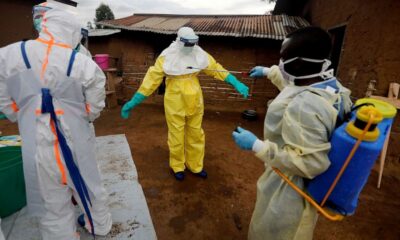
President Bola Tinubu has approved the establishment of a Presidential Task Force on Ebola Virus Disease Preparedness and Emerging Public Health Threats.
The president also ordered the immediate release of ₦10 billion for emergency preparedness.
The fund is expected to strengthen the operational readiness of the Nigeria Centre for Disease Control and Prevention (NCDC) and support critical national public health emergency response activities.
This was contained in a statement issued on Tuesday in Abuja by the presidential spokesperson, Bayo Onanuga.
The Presidential Task Force will be chaired by the Chief of Staff to the President, Femi Gbajabiamila, with membership drawn from relevant Ministries, Departments and Agencies (MDAs) as well as state representatives.

The approval followed a high-level stakeholder meeting convened by the Chief of Staff to assess Nigeria’s preparedness and develop strategies against the possible importation of Ebola into the country.
The meeting was attended by representatives of the Ministry of Interior, the Federal Airports Authority of Nigeria (FAAN), the Nigeria Immigration Service (NIS), the Nigerian Civ88il Aviation Authority (NCAA), the Lagos State Government and other key stakeholders.
Mr Tinubu also directed all states hosting international airports and border corridors, as well as relevant MDAs, to submit their preparedness plans, funding requirements and intervention needs for coordinated implementation.
The president approved a series of immediate measures to strengthen surveillance and response mechanisms across the country.
These include intensified passenger screening at all international airports through enhanced temperature checks and crowd-control protocols.
Other measures include increased monitoring of passengers arriving through designated high-risk airline routes, including Air Uganda, RwandAir, Air Tanzania, TAAG Angola Airlines, Kenya Airways and Ethiopian Airlines.
The task force is also to ensure the immediate activation of referral and isolation centres at the international airports in Lagos and Abuja, with similar facilities to be established at other airports.
In addition, a QR code-based pre-arrival health declaration system will be activated for passengers arriving from or transiting through designated high-risk countries.
READ ALSO: WHO urges Uganda to reconsider Congo border closure over Ebola outbreak
The government also approved the disinfection of departure halls, baggage areas, cargo sections and other airport facilities as precautionary environmental measures.
Mr Tinubu further directed the advisory group to consult with security, diplomatic and aviation authorities on measures to regulate flights from affected and designated high-risk countries.
The task force is expected to designate specific airports or terminals for high-risk flights to facilitate controlled screening, isolation and response procedures.
It will also consider adjusting flight schedules where necessary to minimise interaction between high-risk passengers and other travellers.
Mr Onanuga said the measures were part of proactive efforts by the federal government to safeguard public health and strengthen the country’s emergency response capacity against emerging disease threats. (NAN)




The National Primary Health Care Development Agency (NPHCDA) says about 93 per cent of children affected by recent diphtheria outbreaks in Nigeria had not received the full recommended vaccine doses.
The agency’s Executive Director, Muyi Aina, disclosed this on Thursday during its quarterly media briefing in Abuja.
Mr Aina said an analysis of cases recorded during the outbreaks showed that most affected children were either unvaccinated or had received fewer than the three recommended doses.
“We looked at data from all the cases that we have had, and in the different outbreaks that are happening, over 90 per cent, I think 93 per cent of the children had not received the full complement of vaccines that they should receive,” he said.
He said some affected children had either received no vaccine or only one of the three recommended doses.
Mr Aina attributed the situation partly to misinformation and false rumours affecting vaccine uptake in some communities.

“The vaccines are available. We have advocated, and we have interventions to get communities to access these vaccines,” he said.
“But when people allow misinformation and false rumours to influence their behaviour, they don’t access the vaccines.”
Mr Aina said reducing vaccine-preventable diseases remained a critical priority of the agency’s immunisation programme.
Other vaccination programmes
Mr Aina said more than 18.3 million girls had received the human papillomavirus (HPV) vaccine, and efforts are ongoing to expand coverage among eligible girls.
“For the human papillomavirus vaccine, over 18.3 million of our girls have now been vaccinated,” he said.
He added that the measles-rubella vaccine had reached more than 102 million children aged nine months to 14 years.
According to him, 882,000 children in Kebbi, Bayelsa, Ondo and Bauchi states had received at least the first dose of the malaria vaccine.
Mr Aina said the agency was also recording gradual improvement in routine immunisation coverage and reducing the number of zero-dose children through targeted interventions.
READ ALSO: NPHCDA records 45 million quarterly PHC visits, links 773,000 pregnant women to care
“We are reducing our number of zero-dose children through several interventions, including the identification, enumeration and vaccination of children, and through targeted interventions to reach underserved communities,” he said.
He urged caregivers, community leaders and teachers to support vaccination efforts to protect children against preventable diseases.
“I think this should be a wake-up call for all of us who are caregivers, for those of us that are community leaders and teachers, that we need to again focus on making sure that we get all of the vaccines that we need,” Mr Aina said.
He added that efforts are underway to expand the Basic Health Care Provision Fund to more facilities, increasing coverage from 8,300 to 15,000.
(NAN)
Discover more from Premium Times Nigeria
Subscribe to get the latest posts sent to your email.

Malnutrition admissions at 10 health facilities supported by the International Committee of the Red Cross (ICRC) in north-eastern Nigeria rose 18 per cent in the first nine months of 2026.
The facilities recorded nearly 20,000 admissions between January and September, up from about 17,000 in the same period of 2025, the ICRC said in a statement on Thursday.
The figures cover six health centres and four hospitals. Young children, pregnant women and breastfeeding mothers were among those most affected.
Mubi in Adamawa State saw the sharpest rise, from about 4,600 admissions in the first nine months of 2025 to approximately 5,700 this year, an increase of nearly 24 per cent.
The latest numbers follow earlier ICRC warnings about rising demand for nutritional treatment in conflict-affected areas.
In October 2024, the organisation reported a 24 per cent increase in severe acute malnutrition admissions between the third quarters of 2023 and 2024, from 6,824 to 8,470.
Admissions of children under five with severe acute malnutrition and medical complications also rose from 1,212 to 1,691 in the same period.
These figures cover different reporting periods and patient categories and cannot establish a continuous three-year trend.
They do, however, show repeated increases in demand for nutritional treatment.
Mothers struggle
At the Mubi Stabilisation Centre, Zulaihatu Mohammed brought her six-month-old daughter, Huseina, one of her twins, for nutritional support.
“When I gave birth to them, this one was tiny,” she told the ICRC. “I came today for the routine collection of children’s food. She is not feeling well. Since I gave birth to her, she has been unwell.”
Armed violence, climate shocks and economic pressures have disrupted livelihoods and limited access to food.
According to the ICRC’s video report, farmer Saminu Ijaduwa cultivates a small plot near his home because explosive devices have made more distant fields dangerous.
“Due to the conflict, going one kilometre out of town to farm could be highly risky. You might not return!” he said in the ICRC report.
Restrictions on farming and disrupted markets have made it harder for families to produce or buy enough food, particularly affecting young children and pregnant and breastfeeding women.
Humanitarian response
In a March 2026 report, the ICRC said more than 36,000 people received treatment for severe acute malnutrition at its supported facilities in Borno, Adamawa and Yobe states during 2025.
The total included more than 16,000 children under five and more than 19,000 pregnant and breastfeeding women.
The organisation also provided cash assistance to more than 17,000 vulnerable families during the 2025 lean season.
Those annual treatment figures are not directly comparable with the new nine-month admission totals.
The ICRC said it is working with the Nigerian Red Cross Society to support 15 primary healthcare centres and four hospitals and to assist more than 200 communities with malnutrition treatment and food-security programmes.
Interventions include supplying farmers with seeds adapted to drought and flooding, promoting crop diversification and teaching mothers to prepare nutritious meals from local ingredients.
One such mixture of sorghum, millet, soybeans, groundnuts and moringa, known as Tom Brown, has helped more than 13,000 young children recover from moderate acute malnutrition, according to the ICRC. Mothers are also taught how to prepare it at home.
READ ALSO: Over 87,000 children treated for malnutrition in Katsina in eight months – MSF
Wider food insecurity
The rise in admissions comes as the Food and Agriculture Organisation (FAO) and the World Food Programme (WFP) identify Nigeria among the world’s hunger hotspots of highest concern in their June to November 2026 outlook.
Citing United Nations analysis, the ICRC said more than 34 million people in Nigeria were expected to face insufficient access to food in 2026, the highest figure in six years.
In the North-east, prolonged conflict continues to restrict access to farmland and undermine household livelihoods, according to the ICRC.
Discover more from Premium Times Nigeria
Subscribe to get the latest posts sent to your email.
-

 News3 days ago
Meta releases its first frontier model, Muse Wonder
-
News4 days ago
EuroMatch NPFL: ‘We Never Gave Up!’ — Fidelis Ilechukwu Hails Rangers’ Fighting Spirit, Reacts to Two Penalties Against Barau FC
-
Health4 days ago
Kwara public hospitals introduce digital medical records
-
News4 days ago
2027: Avoid contact with political parties in election disputes – CJN warns judges