Business
PenCom Pushes States to Fully Implement Contributory Pension Scheme

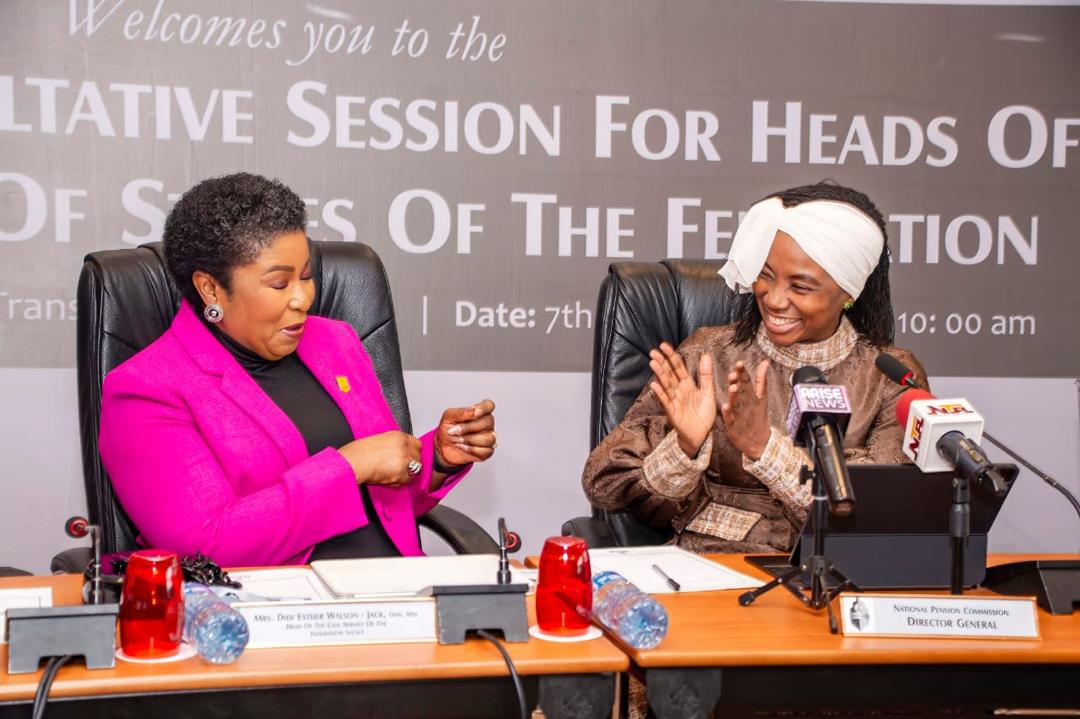
From left: Head of the Civil Service of the Federation, Didi Esther Walson-Jack and Director General of PenCom, Omolola Oloworaran, during the event.
BY NKECHI NAECHE-ESEZOBOR—National Pension Commission (PenCom) has intensified efforts to drive the nationwide implementation of the Contributory Pension Scheme (CPS) with the hosting of the maiden edition of its Bi-Annual Consultative Session for Heads of Service of states yet to fully adopt or implement the scheme.
The consultative session brought together key stakeholders to discuss strategies for strengthening pension reform implementation at the sub-national level and addressing challenges hindering full adoption across various states.
Speaking at the event, the Director General of PenCom, Omolola Oloworaran, stated that although 26 states have enacted pension reform laws, only seven states alongside the Federal Capital Territory (FCT) are currently fully implementing the Contributory Pension Scheme.
She emphasized the need for stronger commitment by state governments to ensure workers enjoy sustainable and secure retirement benefits under the CPS framework.
The event also featured the Head of the Civil Service of the Federation, Didi Esther Walson-Jack, as a special guest, underscoring the importance of collaboration between federal and state institutions in deepening pension reforms nationwide.
According to PenCom, the session served as a platform for meaningful engagement, knowledge sharing and collaboration among stakeholders, while also providing practical guidance and support to states yet to fully implement the scheme.
Discussions during the meeting focused on the benefits of pension reforms, operational challenges affecting implementation, and measures required to accelerate compliance at the state level.
The initiative forms part of PenCom’s broader commitment to promoting a sustainable pension system and expanding the reach of pension reforms across Nigeria.
The post PenCom Pushes States to Fully Implement Contributory Pension Scheme appeared first on Business Today NG.







The Federal High Court in Abuja on Tuesday fixed Nov. 24 for hearing in a suit filed by the Chartered Institute of Forensics and Certified Fraud Investigators of Nigeria (CIFCFIN) against the Institute of Chartered Accountants of Nigeria (ICAN).
CIFCFIN is challenging the power of ICAN to train and issue qualifying certificates to forensic professionals.
The matter, which is before Justice Joyce Abdulmalik, was initially scheduled for mention on Tuesday but the case was adjourned to enable parties appear properly before the court.
The News Agency of Nigeria (NAN) reports that CIFCFIN, through its counsel, Shaibu Aruwa, a Senior Advocate of Nigeria (SAN), sued ICAN as the sole defendant in the suit marked FHC/ABJ/CS/1559/2026.
CIFCFIN argued that ICAN cannot offer a “Certification Programme culminating in the award of Certified Forensic Accountant of Nigeria (CFAN).”
It submitted that this was in line with the combined interpretation of Sections 2(a) – (i),3(1)(a) and 4(a) – (c), 6(2), 12(2), 13, (1) () and (g), 17(1l) (a) and (b) and 22 of the Chartered Institute of Forensics and Certified Fraud Investigators of Nigeria (Establishment) Act No. 45, 2022,


Mohammed Arafat, the Head of Legal and Corporate Services of CIFCFIN, maintained in a supporting affidavit that ICAN’s invitation to applicants for a seven-day professional certification programme culminating in the award of Certified Forensic Accountant of Nigeria (CFAN), is outside its mandate and could confuse the general public.
The plaintiff alleged that ICAN had invited applicants in the fields of knowledge of chartered accountants, compliance managers, bankers, investment analysts, auditors, and anti-corruption agencies staff and other institutions to register for the programme.
CIFCFIN, therefore, prayed the court for an order setting aside and nullifying the award of the qualification or the CFAN certificate, or any other qualification or certificate in the field and practice of forensics in Nigeria by ICAN.
It urged the court to make an order for the defendant to withdraw, retract or cease any publication, gazette notice, or public representation asserting that it has power to certify or license.
CIFCFIN also sought an order of perpetual injunction restraining ICAN, its council, etc, from issuing, advertising or recognising CFAN qualification, designation, licence or certification or any title or award identical or similar to those created under the provisions of its Act.
It further sought a declaration that “by the combined provisions of Sections 2(a) -(i), 3(1)(a) and 4(a)- (c), 6(2), 12(2), 13, (1)(0) and (g), 17(1)(a) and (b) and 22 of the Chartered Institute of Forensics and Certified Fraud Investigators of Nigeria (Establishment) Act No. 45. 2022, the defendant cannot offer ‘Certification Programme’ culminating in the award of CFAN.”
(NAN)
Discover more from Premium Times Nigeria
Subscribe to get the latest posts sent to your email.
-

 Business3 days ago
Lingzhi Global, NACOFTAN Announce 2026 Coffee Festival in Cross River
-
Events3 days ago
Peace Walk: WOPPI Urges Plateau Citizens to Invest in Peace Every Day
-
 Health3 days ago
Nigerian hospitals collaborate to perform tele-robotic surgery
-
News5 hours ago
Plateau Killings: Rotjimwa Yilyok Urges Security Agencies to Intensify Action