Business
FG approves two additional satellites as Nigeria pushes deeper into space economy

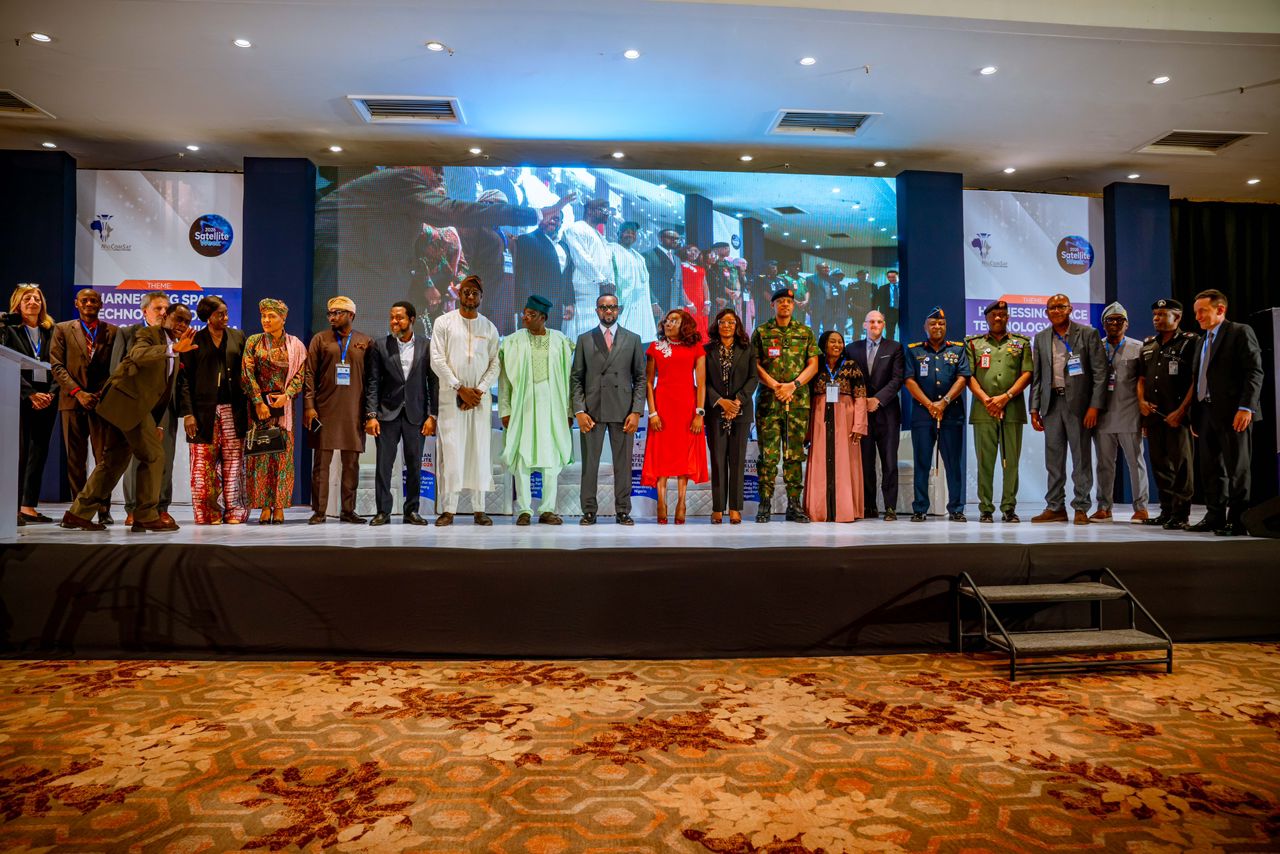
President Bola Tinubu has approved two additional communication satellites, NIGCOMSAT 2A and 2B, for Nigeria’s space programme, the Managing Director of Nigerian Communications Satellite Limited (NIGCOMSAT), Jane Nkechi Egerton-Idehen, announced on Monday.
She disclosed this during her welcoming address at the opening of the 2026 Nigerian Satellite Week in Abuja, themed “Harnessing Space Technology for an Extraordinary Nigeria.”
“This approval by President Bola Ahmed Tinubu is a clear demonstration of Nigeria’s recognition of space as a driver of national development and sovereignty,” Mrs Egerton-Idehen said.
Reflecting on the agency’s journey, Mrs Egerton-Idehen said NIGCOMSAT has grown from a single-satellite operator into a multi-service provider offering broadband, broadcasting, and connectivity services across Nigeria and parts of Africa.

“Twenty years ago, Nigeria declared its readiness to participate and shape one of the most consequential industries of this century. That declaration was not abstract; it was a commitment to build capacity, institutions, and credibility in the global space economy,” she said.
The MD also spoke about NIGCOMSAT’s strengthened global and regional presence, adding that the agency recently secured a Low Earth Orbit connectivity partnership with Eutelsat and initiated cooperation with the Kenya Space Agency. It now holds the Vice Chairmanship of the Global Satellite Operators Association, giving Nigeria influence in international satellite policy and spectrum governance.

Empowering innovators

Mrs Egerton-Idehen highlighted initiatives aimed at nurturing the next generation of space-focused companies. She said the NIGCOMSAT Accelerator Programme, launched this year, will become a permanent feature to support startups working in satellite applications and digital connectivity.
Complementing the accelerator programme is Project 774, designed to extend satellite-enabled connectivity to all local government areas across Nigeria, supporting healthcare, education, and economic activity in underserved communities.
“Today, the work of building Nigeria’s space future is being done here, by the institutions, innovators, investors, policymakers, and stakeholders gathered in this room,” Mrs Egerton-Idehen noted.
Kennedy Osemwegie, representing the Chief of Army Staff, said satellites now support intelligence gathering, surveillance, communications, and disaster response.
He added that collaboration between the military, government agencies, and private sector actors has enhanced Nigeria’s capacity for satellite-enabled operations, which are critical for addressing terrorism, insurgency, and cross-border crimes.
On his part, the Executive Vice Chairman of the Nigerian Communications Commission (NCC), Aminu Maida, emphasised the role of satellites in expanding Nigeria’s digital infrastructure. Satellite technology, he said, is central to improving connectivity, service quality, and access across sectors, including education, healthcare, and emergency response.
He stressed the need for collaboration between the government, the private sector, and innovators to develop practical solutions that strengthen Nigeria’s space and digital ecosystem.
Speaking on the first day’s theme, “The Space Race: The Convergence of Technology, Government, and Opportunities,” the Minister of Communications, Innovation and Digital Economy, Bosun Tijjani, reaffirmed the government’s commitment to expanding satellite infrastructure and praised President Tinubu’s approval of the new satellites.

“When a community gains the opportunity to connect, it transforms how businesses operate and how people live. Satellite technology allows us to extend connectivity to places where other infrastructure cannot reach. It also provides resilience, innovation, and strengthens our digital economy,” the minister said.
He added that fostering innovation through research, partnerships, and startup engagement is essential to developing solutions for agriculture, education, commerce, and security.
READ ALSO: Nigerias Space Council meets, discusses funding, ambition
Mr Tijjani emphasised that Nigeria’s space leadership carries a continental responsibility.
“Nigeria’s leadership in satellite technology is not just for Nigeria. It is for Africa. We must build talent that understands both the technology and its applications. We must create room for businesses to grow in this space. And we must collaborate more across the continent,” he added.
The event brought together policymakers, government agencies, technology innovators, investors, academics, and other experts, providing a platform for dialogue, partnerships, and practical solutions to advance Nigeria’s space and digital economy.


BY IUR REPORTER—The Federal Government has approved the disbursement of ₦32.8 billion through the Basic Healthcare Provision Fund (BHCPF) implementing gateways as part of efforts to strengthen healthcare delivery and expand access to quality primary healthcare services across Nigeria.
The funding is expected to consolidate recent gains in population health outcomes and disease control while ensuring that more Nigerians, regardless of their location or socio-economic status, have access to essential healthcare services.
The approval was one of the key resolutions reached at the 15th Ministerial Oversight Committee (MOC) meeting on the National Health Sector Renewal Investment Initiative, the Basic Healthcare Provision Fund, the Sector-Wide Approach (SWAp), and Government and Donor-Funded Programmes and Initiatives.
The meeting was co-chaired by the Coordinating Minister of Health and Social Welfare, Professor Muhammad Ali Pate, and the Minister of State for Health and Social Welfare, Dr. Iziaq Adekunle Salako.
During the meeting, the committee reviewed key performance indicators, financial reports, programme implementation milestones, and emerging priorities requiring policy attention. Members also identified strategic measures to address implementation bottlenecks and agreed on timelines for delivering priority interventions ahead of the next quarterly review.
The committee reaffirmed its commitment to strengthening collaboration among government institutions and development partners to reinforce Nigeria’s health system and accelerate the delivery of impactful healthcare interventions nationwide.
The latest funding injection underscores the Federal Government’s continued efforts to improve healthcare financing, increase access to quality primary healthcare services, and build a more resilient health system capable of meeting the needs of Nigerians.
The post FG Injects ₦32.8bn into Basic Healthcare Fund appeared first on Business Today NG.

The Nigerian Civil Aviation Authority (NCAA) has imposed a ₦6 million fine on Saudi Airlines for what it described as consumer-protection-related violations.
Michael Achimugu, Director of Public Affairs and Consumer Protection at the NCAA, disclosed this on Friday.
Mr Achimugu stated that the sanction became necessary after the airline failed to resolve several outstanding consumer issues, despite repeated interventions by the regulator and an extended period granted for compliance.
According to him, the NCAA had previously stepped in to support the airline in managing a situation at the Nnamdi Azikiwe International Airport in Abuja a few months ago that could have escalated into violence.
He noted that the authority had also given Saudi Airlines additional time to address pending complaints and comply with the regulator’s determinations, but the airline failed to meet its obligations.
“The Nigeria Civil Aviation Authority has sanctioned Saudi Airlines to the tune of ₦6 million for consumer protection-related infractions,” Mr Achimugu said.
He explained that the enforcement action was taken to ensure compliance with Part 19 of the Nigeria Civil Aviation Regulations (Nig. CARs) 2023, which outlines the rights of air passengers and the responsibilities of airlines operating in the country.
The NCAA expressed hope that the sanction would encourage the airline to improve its operations in Nigeria and strengthen its commitment to passenger welfare.
Mr Achimugu emphasised that passengers travelling to and from Nigeria deserve to be treated fairly and with respect by all airlines operating in the country.
READ ALSO: NCAA Championships: Ogazi shatters records, Ajayi strikes gold as Nigerians shine in Eugene
He added that while the authority would continue to support Saudi Airlines and other carriers to operate efficiently, it would not hesitate to enforce regulatory standards where necessary to protect consumers.
Saudi Airlines had yet to respond to the NCAA’s sanctions as of the time of filing this report.
-

 News4 days ago
I’m Jealous Wike is in PDP – APC Chairman, Nentawe Yilwatda admits
-

 Business3 days ago
Cement maker Lafarge Africa renamed HBM Nigeria Plc
-
Business4 days ago
Africa records hydropower growth but Nigeria still suffers power shortages — Report
-
Health4 days ago
Kano shuts two unlicensed health training institutions