News
Presidential election: Tinubu’s strategy not to lose desperate, extreme – Sam Amadi






News
EuroMatch NPFL: The Whistle That Won Both Sides — Ibuot Nsisong Linus Earns Rare Praise After Kwara United-Ranchers Bees Thriller


Kwara United claimed the three points, but centre referee Ibuot Nsisong Linus emerged as another major talking point from Sunday’s EuroMatch Nigeria Premier Football League (NPFL) encounter after earning commendation from both sides following the hosts’ entertaining 2-1 comeback victory over Ranchers Bees in Ilorin.
Linus, from Akwa Ibom State, handled the EuroMatch NPFL Matchday Seven fixture at the Kwara State Stadium, working alongside assistant referees Ikponmwonsa Imuetinyan and Morrison Otuwho, with Abdulmalik Abdulganiyu serving as fourth official.
Ranchers Bees carried the advantage into half-time, but Kwara United responded after the break to turn the contest around and secure another important EuroMatch NPFL victory. The visitors were eventually reduced to 10 men following Faisal Sani’s dismissal for a second yellow card.
Despite the intensity surrounding the comeback and sending-off, the encounter ended peacefully, with coaches from both clubs commending Linus and his officiating team after the final whistle.
One supporter, Ismaila, was equally impressed by the referee’s management of the EuroMatch NPFL contest.
“I loved what I saw today—free-flowing football from both sides. The officiating was outstanding, and we pray to see more performances like this,” he said.
“Fans come to enjoy good football, regardless of who wins. When the game flows well and we do not see bias in the officiating, everybody can go home peacefully. You have to give credit to this referee; he deserves commendation.”
Linus has been building his reputation through Nigeria’s refereeing development structure. He was previously identified among the country’s Young Talent referees for a FIFA Member Association course before progressing to EuroMatch NPFL assignments.
Sunday’s performance offered another opportunity for the emerging official to demonstrate his ability in Nigeria’s top flight.
Effective security and medical arrangements also contributed to a successful matchday, while both teams, officials and supporters departed the stadium without any reported incident.
For the EuroMatch NPFL, it was the kind of afternoon that strengthens confidence in the competition: an exciting comeback, competitive football, disciplined benches and an officiating team praised by winners and losers alike.
Kwara United took the points, but Linus took the applause — a notable Matchday Seven moment for the EuroMatch NPFL.
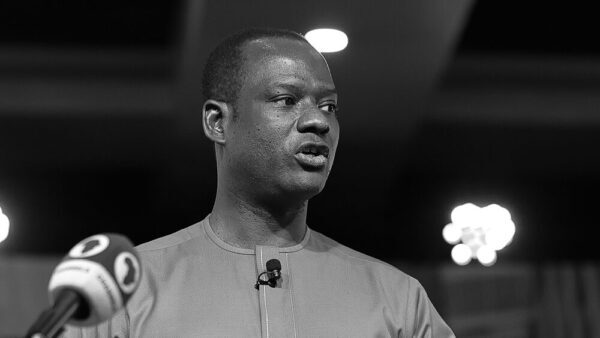
The Federal Government has rejected calls for the return of petrol subsidy, warning that subsidising fuel could cost the country more than N20 trillion annually and ultimately make petrol more expensive.
The Minister of Finance and Coordinating Minister of the Economy, Taiwo Oyedele, disclosed this on Thursday during a press briefing in Abuja on rising petrol prices and the subsidy debate.
Mr Oyedele said Nigeria consumes about 50 million litres of petrol daily, meaning that returning petrol to its pre-2023 reform price would cost more than N20 trillion every year.
He said even a proposal to sell petrol at N500 per litre would cost the government more than N16 trillion annually, before accounting for increased consumption and smuggling.
“Amounts of that size are nearly everything the Federation Account shared among all three tiers of government in 2025,” Mr Oyedele said.
He warned that funding such a subsidy would come at the expense of other government responsibilities, including salaries, pensions, schools, hospitals and security.


The minister’s comment comes amid renewed calls for the reintroduction of fuel subsidy, with the issue increasingly featuring in political debates ahead of the 2027 general elections.
‘Subsidy could push petrol to N2,000 per litre’
According to the minister, a return to subsidy could weaken government revenues, trigger a sovereign credit downgrade, increase borrowing costs and put pressure on foreign reserves and the naira.
The government estimates that the exchange rate could approach N3,000 to the dollar within months if subsidy is restored.
Mr Oyedele said this could push the price of so-called subsidised petrol to at least ₦2,000 per litre, significantly above the current average of about ₦1,400.
“A subsidy does not lower the cost of fuel. It only changes how it is paid, and when,” he said.
He argued that crude oil, freight and refining inputs are largely priced in dollars, meaning that forcing down the naira price of petrol would effectively require the government to subsidise foreign exchange.
‘Production subsidy’ is consumption subsidy
The minister also rejected descriptions of a proposed subsidy for locally refined petrol as a “production subsidy”.
He said a genuine production subsidy would support producers who could not compete at market prices, whereas the proposal being discussed would amount to providing discounted crude that would eventually be passed on to consumers at the pump.
“This is different, it is a discount on crude, passed through to the pump. That is a consumption subsidy by another route, with the same bill attached,” he said.
Mr Oyedele said subsidised fuel would also increase the price differential between Nigeria and neighbouring countries, potentially encouraging smuggling and effectively making Nigerian taxpayers subsidise motorists in other countries.
N15.8trn saved from subsidy removal
The minister defended the 2023 removal of petrol subsidy, saying it had released N15.8 trillion to the Federation Account between June 2023 and December 2025.
Of that amount, N10.4 trillion went to states and local governments, he said.
Mr Oyedele said 27 states could not reliably pay salaries in May 2023, but that none was in that position at the time of the briefing.
At the federal level, he said about two-thirds of the subsidy savings, combined with additional independent revenue and borrowing, had been used for spending that directly benefited Nigerians through higher wages, infrastructure, electricity subsidy and social transfers.
The remaining funds, he said, were used to stabilise the economy, particularly as the cost of servicing debt increased due to higher interest rates introduced to tackle inflation.
Government rejects blanket subsidy
Mr Oyedele said the government had instead used tax and duty waivers, local refining, naira-for-crude arrangements, exchange-rate stabilisation and CNG deployment to moderate fuel costs.
He said the government had granted a full waiver of taxes and duties on petrol worth more than N3.3 trillion for the year to 30 September 2026.
He added that the government would continue to consider targeted relief rather than a blanket subsidy.
Among the new measures are a 30-day discount on petrol sold at NNPC stations, a proposed N1,350 ceiling on the ex-gantry or landing cost of petrol, additional cash transfers, subsidised credit and faster CNG deployment.
READ ALSO: NNPCL: Accounting for fuel subsidy, By Uddin Ifeanyi
The government is also considering an excess profit tax on energy operators, with proceeds earmarked for measures to cushion vulnerable consumers.
Mr Oyedele said the government would not reverse the subsidy reform, arguing that doing so would expose Nigeria to the same cycle of fuel scarcity, smuggling, currency weakness and fiscal pressure experienced in the past.
“Our task is not to reverse a necessary reform designed to set our country on the path towards sustained prosperity,” he said. “It is to make sure its gains reach more Nigerians, more quickly and in more tangible ways.”
Discover more from Premium Times Nigeria
Subscribe to get the latest posts sent to your email.
-

 News4 days ago
2027: El-Rufai’s detention could hurt APC, generate sympathy – SEDSAC director, other analysts express views
-
News3 days ago
Lucid Motors’ EV output falls to lowest level in almost 2 years
-
Business4 days ago
NAIPE 11th Annual Conference Moves to 12 Noon as 28 Stakeholders Back Event
-
News3 days ago
Mirror Particle is building a ‘world model’ of human behavior