Health
Resident doctors threaten nationwide strike over OAUTHC doctors’ industrial action


The Nigerian Association of Resident Doctors (NARD) has threatened to embark on a nationwide solidarity strike if the ongoing industrial dispute at the Obafemi Awolowo University Teaching Hospitals Complex (OAUTHC) is not resolved.
In a statement on Thursday, the health body expressed support for resident doctors who commenced an indefinite strike last week.
The association, said the industrial action by the Association of Resident Doctors, OAUTHC (ARD OAUTHC), which began on 22 June, followed months of unresolved welfare and workplace concerns that management allegedly failed to address.
NARD described the crisis as avoidable, blaming it on what it called the hospital management’s failure to respond to repeated complaints despite earlier interventions by the national body.
Previous intervention ignored
According to the association, it had written to the Federal Ministry of Health and Social Welfare on 16 March, drawing attention to the deteriorating relationship between OAUTHC management and resident doctors.

The association said it requested a stakeholders’ meeting involving the ministry, hospital management, ARD OAUTHC and NARD to address issues including salary arrears, accommodation disputes, restrictions affecting the association’s secretariat and other administrative concerns.
It said despite subsequent follow-up efforts, including another intervention in June, the issues were not treated with the urgency required.
NARD accused the hospital management of adopting a “combative” and “dismissive” approach that deepened mistrust and eventually led to the indefinite strike.
Welfare concerns
The association said the doctors’ grievances centred on several welfare and workplace issues, including the refusal to provide comprehensive meal coverage for doctors on call, the transfer of identity card costs to employees, unresolved accommodation challenges and the non-payment of some allowances.
Other concerns include the imposition of bench fees on resident doctors from accredited private teaching hospitals undertaking clinical rotations at OAUTHC, as well as what NARD described as a pattern of intimidation and victimisation of resident doctors.
The association also alleged that the hospital management’s response during the strike ultimatum did not accurately reflect discussions held with the doctors, leading members of ARD OAUTHC to reject the response and proceed with the industrial action.
Nationwide action
NARD said the dispute was discussed during its May Ordinary General Meeting in Kano, where delegates raised concerns over the welfare of resident doctors and gave its National Officers’ Committee 21 days to engage relevant stakeholders.
The association said it was unacceptable that the matter was allowed to degenerate into an indefinite strike despite the warning.
They warned that the dispute now threatens patient care, emergency services, residency training and the overall stability of the teaching hospital.
NARD called on the Federal Ministry of Health and Social Welfare to urgently convene a high-level meeting involving all parties to resolve the dispute.
It also urged the ministry to direct the hospital management to address outstanding welfare issues, stop any form of intimidation or victimisation of resident doctors, protect members participating in lawful union activities and establish a monitored framework for implementing any agreements reached.
The association warned that if the dispute remains unresolved within a reasonable time, it would be compelled to declare a nationwide solidarity strike in support of the OAUTHC resident doctors.
Ultimatum
The latest dispute comes as NARD is already locked in a broader industrial dispute with the federal government over unresolved welfare, remuneration and training-related issues affecting resident doctors across the country.
READ ALSO: NMA warns of wider health crisis as LASUTH doctors’ strike enters second day
Earlier this month, the association declared a nationwide industrial dispute and issued the federal government a 21-day ultimatum to address demands including the release of the 2026 Medical Residency Training Fund (MRTF), payment of outstanding salary and promotion arrears, correction of allowance discrepancies, improved welfare for house officers and stronger measures to protect doctors from assaults in hospitals.
The ultimatum, which is now approaching its expiration, followed resolutions reached at the association’s Ordinary General Meeting (OGM) in Kano, where delegates also raised concerns over unresolved welfare issues at several hospitals, including OAUTHC.
At the meeting, NARD specifically warned about the alleged intimidation of resident doctors at the Ile-Ife-based teaching hospital and gave its National Officers’ Committee 21 days to engage relevant stakeholders before considering further action.
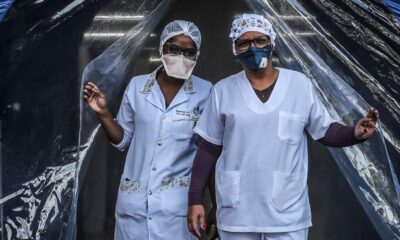





The National Primary Health Care Development Agency (NPHCDA) says about 93 per cent of children affected by recent diphtheria outbreaks in Nigeria had not received the full recommended vaccine doses.
The agency’s Executive Director, Muyi Aina, disclosed this on Thursday during its quarterly media briefing in Abuja.
Mr Aina said an analysis of cases recorded during the outbreaks showed that most affected children were either unvaccinated or had received fewer than the three recommended doses.
“We looked at data from all the cases that we have had, and in the different outbreaks that are happening, over 90 per cent, I think 93 per cent of the children had not received the full complement of vaccines that they should receive,” he said.
He said some affected children had either received no vaccine or only one of the three recommended doses.
Mr Aina attributed the situation partly to misinformation and false rumours affecting vaccine uptake in some communities.

“The vaccines are available. We have advocated, and we have interventions to get communities to access these vaccines,” he said.
“But when people allow misinformation and false rumours to influence their behaviour, they don’t access the vaccines.”
Mr Aina said reducing vaccine-preventable diseases remained a critical priority of the agency’s immunisation programme.
Other vaccination programmes
Mr Aina said more than 18.3 million girls had received the human papillomavirus (HPV) vaccine, and efforts are ongoing to expand coverage among eligible girls.
“For the human papillomavirus vaccine, over 18.3 million of our girls have now been vaccinated,” he said.
He added that the measles-rubella vaccine had reached more than 102 million children aged nine months to 14 years.
According to him, 882,000 children in Kebbi, Bayelsa, Ondo and Bauchi states had received at least the first dose of the malaria vaccine.
Mr Aina said the agency was also recording gradual improvement in routine immunisation coverage and reducing the number of zero-dose children through targeted interventions.
READ ALSO: NPHCDA records 45 million quarterly PHC visits, links 773,000 pregnant women to care
“We are reducing our number of zero-dose children through several interventions, including the identification, enumeration and vaccination of children, and through targeted interventions to reach underserved communities,” he said.
He urged caregivers, community leaders and teachers to support vaccination efforts to protect children against preventable diseases.
“I think this should be a wake-up call for all of us who are caregivers, for those of us that are community leaders and teachers, that we need to again focus on making sure that we get all of the vaccines that we need,” Mr Aina said.
He added that efforts are underway to expand the Basic Health Care Provision Fund to more facilities, increasing coverage from 8,300 to 15,000.
(NAN)
Discover more from Premium Times Nigeria
Subscribe to get the latest posts sent to your email.

Malnutrition admissions at 10 health facilities supported by the International Committee of the Red Cross (ICRC) in north-eastern Nigeria rose 18 per cent in the first nine months of 2026.
The facilities recorded nearly 20,000 admissions between January and September, up from about 17,000 in the same period of 2025, the ICRC said in a statement on Thursday.
The figures cover six health centres and four hospitals. Young children, pregnant women and breastfeeding mothers were among those most affected.
Mubi in Adamawa State saw the sharpest rise, from about 4,600 admissions in the first nine months of 2025 to approximately 5,700 this year, an increase of nearly 24 per cent.
The latest numbers follow earlier ICRC warnings about rising demand for nutritional treatment in conflict-affected areas.
In October 2024, the organisation reported a 24 per cent increase in severe acute malnutrition admissions between the third quarters of 2023 and 2024, from 6,824 to 8,470.
Admissions of children under five with severe acute malnutrition and medical complications also rose from 1,212 to 1,691 in the same period.
These figures cover different reporting periods and patient categories and cannot establish a continuous three-year trend.
They do, however, show repeated increases in demand for nutritional treatment.
Mothers struggle
At the Mubi Stabilisation Centre, Zulaihatu Mohammed brought her six-month-old daughter, Huseina, one of her twins, for nutritional support.
“When I gave birth to them, this one was tiny,” she told the ICRC. “I came today for the routine collection of children’s food. She is not feeling well. Since I gave birth to her, she has been unwell.”
Armed violence, climate shocks and economic pressures have disrupted livelihoods and limited access to food.
According to the ICRC’s video report, farmer Saminu Ijaduwa cultivates a small plot near his home because explosive devices have made more distant fields dangerous.
“Due to the conflict, going one kilometre out of town to farm could be highly risky. You might not return!” he said in the ICRC report.
Restrictions on farming and disrupted markets have made it harder for families to produce or buy enough food, particularly affecting young children and pregnant and breastfeeding women.
Humanitarian response
In a March 2026 report, the ICRC said more than 36,000 people received treatment for severe acute malnutrition at its supported facilities in Borno, Adamawa and Yobe states during 2025.
The total included more than 16,000 children under five and more than 19,000 pregnant and breastfeeding women.
The organisation also provided cash assistance to more than 17,000 vulnerable families during the 2025 lean season.
Those annual treatment figures are not directly comparable with the new nine-month admission totals.
The ICRC said it is working with the Nigerian Red Cross Society to support 15 primary healthcare centres and four hospitals and to assist more than 200 communities with malnutrition treatment and food-security programmes.
Interventions include supplying farmers with seeds adapted to drought and flooding, promoting crop diversification and teaching mothers to prepare nutritious meals from local ingredients.
One such mixture of sorghum, millet, soybeans, groundnuts and moringa, known as Tom Brown, has helped more than 13,000 young children recover from moderate acute malnutrition, according to the ICRC. Mothers are also taught how to prepare it at home.
READ ALSO: Over 87,000 children treated for malnutrition in Katsina in eight months – MSF
Wider food insecurity
The rise in admissions comes as the Food and Agriculture Organisation (FAO) and the World Food Programme (WFP) identify Nigeria among the world’s hunger hotspots of highest concern in their June to November 2026 outlook.
Citing United Nations analysis, the ICRC said more than 34 million people in Nigeria were expected to face insufficient access to food in 2026, the highest figure in six years.
In the North-east, prolonged conflict continues to restrict access to farmland and undermine household livelihoods, according to the ICRC.
Discover more from Premium Times Nigeria
Subscribe to get the latest posts sent to your email.
-

 News4 days ago
Meta releases its first frontier model, Muse Wonder
-
Health3 days ago
AMR: Livestock uses more antibiotics than human health sector
-
News3 days ago
The Stage Is Set, Nairobi Is Ready! Africa’s Business and Sports Power Players Converge for YORA Summit 2026
-
News3 days ago
MTN, Airtel take 90% of Nigeria’s 15m new subscribers as Glo shifts ground – Technology Times