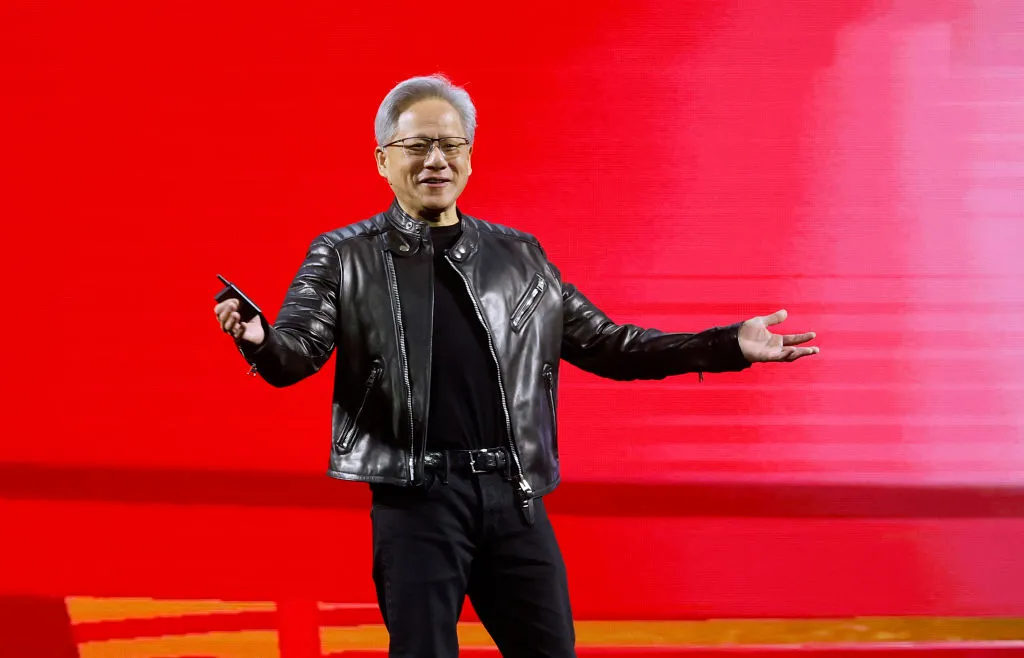
When it comes to the specter of AI’s labor-displacing potential, Jensen Huang thinks that the American worker has nothing to fear. During a conversation Monday night with MSNBC’s Becky Quick hosted by the Milken Institute — an economic policy think tank, the jovial Nvidia CEO said that AI was an industrial-scale generator of jobs, not the harbinger of mass unemployment that so-called “AI doomers” have often accused it of being.
A number of different topics were broached during the talk, but a central theme that kept coming back was the ongoing economic anxiety surrounding the AI industry and whether it was something Americans should be legitimately worried about. At one point Quick noted: “This is happening so quickly. Is there a bigger dislocation than we’ve seen in the past that leads to greater inequality? And what do we do about that?”
Throughout the night, Huang struck an optimistic note. “AI creates jobs,” Huang asserted during the discussion, adding that “AI is [the] United States’ best opportunity to re-industrialize” itself. Huang noted that the AI industry is powered by a new breed of industrial factories—the kinds producing the hardware that acts as critical infrastructure for the AI business. (Huang’s company notably sells a lot of that hardware.) Those factories necessarily need workers, as does the rest of the blossoming AI industry.
Just because a specific task is automated, that doesn’t mean that a person’s entire job is going to be replaced, Huang reasoned. People who believe this “misunderstand that the purpose of a job and the task of a job are related” but not ultimately the same thing, he said. In other words, Huang’s argument is that even when AI takes over a discrete task within a role, the broader function that employee serves in an organization is likely to remain.
Relatedly, Huang was critical of people who allege AI will dominate humanity or that it will wipe out huge sectors of the economy. “My greatest concern is that we scare…people—all the people that we’re telling these science fiction stories to, to the point where AI is so unpopular in the United States, or people are so afraid of it, that they don’t actually engage it,” he said.
Ironically, much of the “doomer” rhetoric has been generated by the AI industry itself, and critics maintain that such hyperbole has been used as a marketing gimmick designed to gin up buzz and excitement for products that aren’t anywhere near the capabilities that such rhetoric suggests.
It remains to be seen what kind of long-term impact AI will have on the overall economy. That said, reputable financial and academic organizations have suggested that as much as 15% percent of jobs in the U.S. will be eliminated over the next several years as a result of AI.
Techcrunch event
San Francisco, CA | October 13-15, 2026
When you purchase through links in our articles, we may earn a small commission. This doesn’t affect our editorial independence.
There was excitement, joy, and celebration as Little Miss Bassa emerged winner of the prestigious Little Miss Plateau Pageant, Miss Morina Jathniel Emmanuel outperforming contestants representing various local government areas across Plateau State.
The grand finale, held at the Sarau Event Center, attracted families, supporters, pageant organizers, and dignitaries who gathered to witness the colourful event and celebrate the achievements of the young contestants.
The pageant went beyond beauty, showcasing intelligence, confidence, creativity, leadership potential, and cultural heritage. Contestants impressed the audience with remarkable performances, elegance, and strong representation of the traditions and values of their respective communities.
The event featured vibrant cultural displays, music, and entertaining performances that reflected the rich heritage and diversity of Plateau State, creating a memorable atmosphere throughout the occasion.
Organizers described the Little Miss Plateau Pageant as more than a competition, emphasizing its role as a platform dedicated to nurturing young girls into confident, responsible, and culturally aware ambassadors. According to them, the initiative continues to promote values such as education, leadership, self-confidence, unity, and personal development among children from different backgrounds.
The emergence of Little Miss Bassa as the overall winner was greeted with loud applause and excitement from supporters, marking a proud and historic moment for the Bassa community.
Her exceptional performance, confidence, and outstanding display throughout the competition earned her admiration from judges and guests, ultimately securing her the coveted crown.
Among those contesting for the presidential ticket of the ADC, Atiku stands tall as the most experienced. Atiku’s quest to be president of Nigeria started in 1993, with the Social Democratic Party (SDP).
The SDP primaries was won by the late Moshood Abiola who took Baba Gana Kingibe as his running mate.
Atiku Abubakar
However, Atiku was said to have stepped down from the race under pressure from Shehu Musa Yar’adua.
At the dawn of democracy in 1999, Atiku was chosen by Olusegun Obasanjo as his running mate. However, after falling out with Obasanjo at the end of their tenure, in 2007 he defected and contested for the presidency on the platform of the Action Congress (AC). He was defeated by the late Umaru Musa Yar’adua of the PDP.
The former Vice President returned to the Peoples Democratic Party, in 2011 and challenged the former President Goodluck Jonathan for the PDP ticket. Atiku lost the party’s primary election to Jonathan. In 2015, Atiku led some PDP governors to the newly formed All Progressives Congress (APC) and challenged the late President Muhammadu Buhari and others for the presidential ticket, but lost the contest.
In 2019, Atiku returned to the PDP, won the primary, but lost the main election to the then President Muhammadu Buhari. In 2023, Atiku was also the PDP’s candidate, but lost to the incumbent President Bola Ahmed Tinubu.
In a widely publicised interview on television, Atiku recently disclosed that the 2027 election will be his last, fueling speculation that he will do everything humanly possible to clinch the ticket of the party.
(2) Rotimi Amaechi
Rotimi Amaechi, one of the top contenders for the ticket of the ADC, is a former Speaker of the Rivers State and a governor in the same Rivers. In 2023, after the tenure of the late President Muhammadu Buhari, Amaechi contested for the presidential ticket of the APC with President Tinubu and lost.
Ahead of the coming election in 2027, Amaechi joined forces with the opposition coalition in the ADC and is now battling with others to clinch the presidential ticket.
Rotimi Amaechi
As the battle for the ticket hots up, Amaechi was recently quoted in an interview with Trust TV, as saying that he did not purchase the nomination form of the ADC to step down or become a vice presidential candidate to anyone.
After his screening last week, Amaechi told journalists that he is a bonafide member of the ADC and will only accept the outcome of any consensus where he is part of and involved.
(3) Muhammed Hayatu-Deen
Muhammed Hayatu-Deen is another presidential aspirant that has been making waves ahead of the ADC presidential primary.
In 2023, Hayatu-Deen was one of the top presidential aspirants for the ticket of the party. He lost to Atiku.
Ahead of the primaries, Hayatu-Deen has urged delegates and stakeholders to use the primary to demonstrate the party’s readiness to offer Nigerians what he described as a credible alternative to failed governance and “recycled politics.”
Muhammed Hayatu-Deen
Speaking in Abuja at the weekend, Hayatu-Deen described the forthcoming primary election as a defining moment not only for the party but also for Nigeria’s political future ahead of the 2027 general elections.
He said. “Monday is not merely about selecting a candidate. Monday is about determining whether the ADC is truly serious about rescuing Nigeria and offering Nigerians a credible alternative to the failed politics they have endured for too long.”
Positioning himself as a unifying candidate capable of bridging regional, religious and generational divides, Hayatu-Deen argued that his candidacy represents a departure from established political figures.
“I am not on the carousel of the same old faces that Nigerians have seen for decades,” he stated. “I carry no political baggage. I owe no godfathers. What I bring is experience, credibility, integrity, calm leadership, and a practical recovery plan for Nigeria.”
The aspirant highlighted insecurity, unemployment, displacement and economic decline across North Central states, including Benue State, Plateau State, Niger State, Nasarawa State and Kogi State, describing persistent attacks on farming communities as both an economic and humanitarian crisis.
“A nation cannot prosper when the region that feeds it is bleeding,” he said.
The winner of the anticipated ADC presidential primary is expected to lead the party into the January 2027 presidential election and mount a challenge against incumbent President Bola Ahmed Tinubu of the APC and probably Mr Peter Obi of the Nigerian Democratic Congress (NDC).