Business
Eno leads pre-delivery inspection of Ibom Air’s third Airbus A220-300 aircraft in Canada

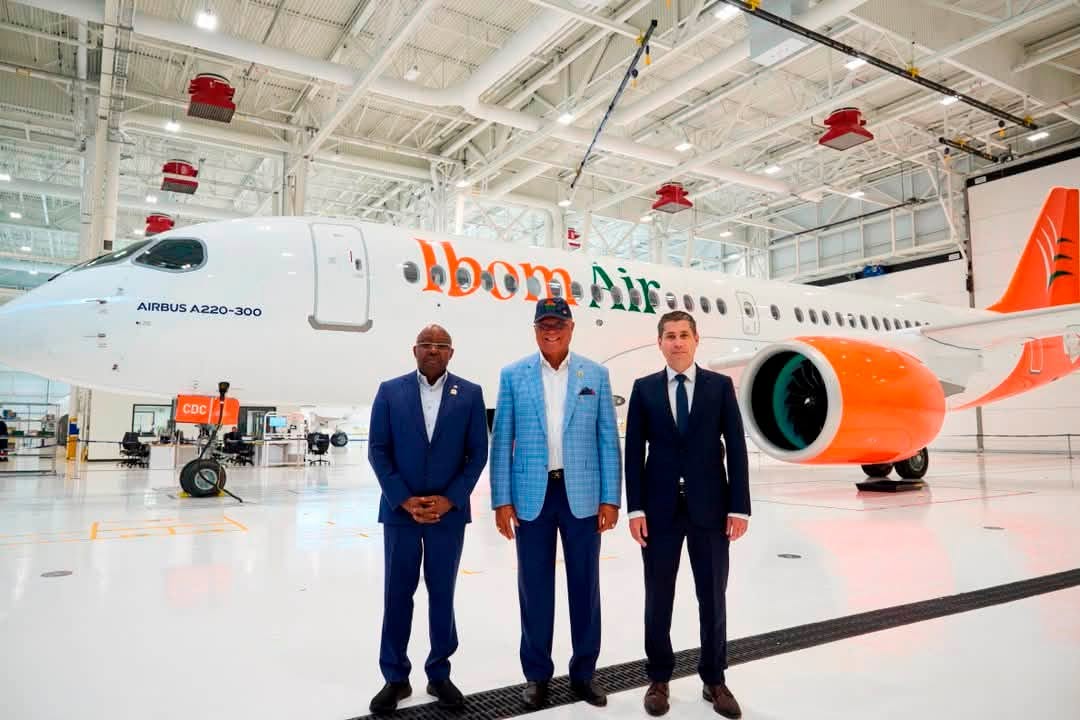

The Governor of Akwa Ibom State, Umo Eno, has led a delegation of State Executives and members of the Ibom Air’s management team to a pre-delivery inspection of the airline’s third Airbus A220-300 aircraft at the Airbus production facility in Mirabel, Canada, ahead of its formal delivery and reception in Akwa Ibom.
This is contained in a press statement issued by Aniekan Essienette, the group manager, marketing and communication, Ibom Airlines Limited, on Friday in Uyo, Akwa Ibom State.
According to the statement, the inspection marks another significant milestone in Ibom Air’s fleet modernisation and growth strategy and is part of the acceptance process before the aircraft enters commercial service.
The aircraft is Ibom Air’s third Airbus A220-300 and the second A220 to be received under the airline’s firm order for 10 Airbus A220 aircraft placed in 2021. Its addition marks a further step in Ibom Air’s commitment to expanding capacity, strengthening connectivity, and operating one of Africa’s most modern fleets.
The delegation was received by Guillaume Chevasson, head of the A220 Programme and chief executive officer of Airbus Canada, during the inspection, which formed part of the formal acceptance process ahead of the aircraft’s delivery.

Speaking on the significance of the event, the Chief Executive Officer of Ibom Air, George Uriesi, said, “This pre-delivery inspection represents an important milestone in our fleet expansion programme and brings us one step closer to welcoming this aircraft to Nigeria.
“As demand for air travel continues to grow across our markets, we remain focused on investing in modern aircraft that deliver superior operational efficiency, reliability, safety, and passenger comfort.
“The Airbus A220 continues to be the ideal aircraft for our network strategy, and we look forward to deploying this latest addition into our network in furtherance of our growth objectives.”
Eno speaks of govt’s commitment to Ibom Air’s growth
Commenting on the development, Governor Eno, said, “The inspection of this aircraft reflects the state government’s commitment to the continued growth of Ibom Air as a strategic asset for Akwa Ibom State. This investment aligns with the ARISE Agenda and our vision of establishing Akwa Ibom as a leading aviation hub, supported by world-class infrastructure and a modern airline.
“We look forward to formally receiving this aircraft in Akwa Ibom State and to the economic opportunities that enhanced connectivity will create for trade, tourism, investment, and regional development.”
Speaking on the partnership with Ibom Air, Mr Chevasson said they were honoured by Ibom Air’s trust in Airbus and the A220 family.
“The A220 is the ideal aircraft for the airline’s fleet modernisation, thanks to its exceptional operational flexibility, fuel efficiency, passenger comfort, and performance across domestic and regional networks, and we look forward to supporting Ibom Air’s continued growth for many years to come,” he said.
The aircraft also incorporates features that further support Ibom Air’s commitment to continuous improvement in operational capability, efficiency, and customer experience.
Upon completion of the delivery processes, the aircraft will be ferried to Nigeria, where it will be officially received into the Ibom Air fleet in Akwa Ibom before commencing commercial operations.
Discover more from Premium Times Nigeria
Subscribe to get the latest posts sent to your email.





Minister of Aviation and Aerospace Development Festus Keyamo has approved the design of a proposed monorail to link Ikeja Railway Station in Lagos to Murtala Muhammed International Airport (MMIA) in the state.
The project is expected to connect the airport to the Lagos Red Line rail network, providing passengers and other airport users with an alternative to road transport.
Mr Keyamo announced the approval on Tuesday after a meeting with the managing director of the Federal Airports Authority of Nigeria (FAAN), the permanent secretary of the Federal Ministry of Aviation and engineering teams from the ministry and FAAN.
In a post on X, the minister said the proposed line will have five stations, running from Ikeja Railway Station to the international airport’s Terminal 1, which is currently undergoing reconstruction.
He listed the proposed stations/stops as Ikeja Station, Domestic Airport Station, Beesam Station, Toll Gate Station and MMIA Airport Station.
“The monorail is an integral part of the reconstruction of the nation’s major gateway at the MMIA in Lagos,” Mr Keyamo said.

The design approval follows earlier announcements by the Federal Government about plans to extend rail services from Ikeja to the airport’s domestic and international terminals.
In June, PREMIUM TIMES reported that the government was working with the Lagos State Government to extend the existing rail network to the airport and to expand connectivity.
Recently, Olubunmi Onabanjo-KukuFAAN’she managing directAN, said talks on financing the planned airport rail lint had reached an advanced stage.
Speaking at the World Aviation Festival in Lisbon, Portugal, on 18 October, Ms Onabanjo-Kuku stated that efforts were ongoing to finalise the project’s financing structure.
The planned link is expected to connect the airport’s three terminals to the Red Line as part of its wider modernisation programme.
The proposed rail connection forms part of broader efforts to upgrade facilities at the Lagos airport and improve passenger movement.
Terminal 1 of the international airport is undergoing reconstruction, while other infrastructure upgrades are intended to boost airport operations and the passenger experience.
The airport serves as a major gateway for international travel to and from Nigeria, making access to its terminals crucial for passengers and other users.
Discover more from Premium Times Nigeria
Subscribe to get the latest posts sent to your email.
-

 News2 days ago
Euromatch NPFL: Matchday 9 results
-
News3 days ago
NUCAP: Nigeria targets 20 million people with 3,700 telecom towers – Technology Times
-
News4 days ago
Nigeria needs stronger collaboration ‘to shape internet governance’ – Technology Times
-
News3 days ago
Meta removes language that raised scraping and AI training concerns