Connect with us

News

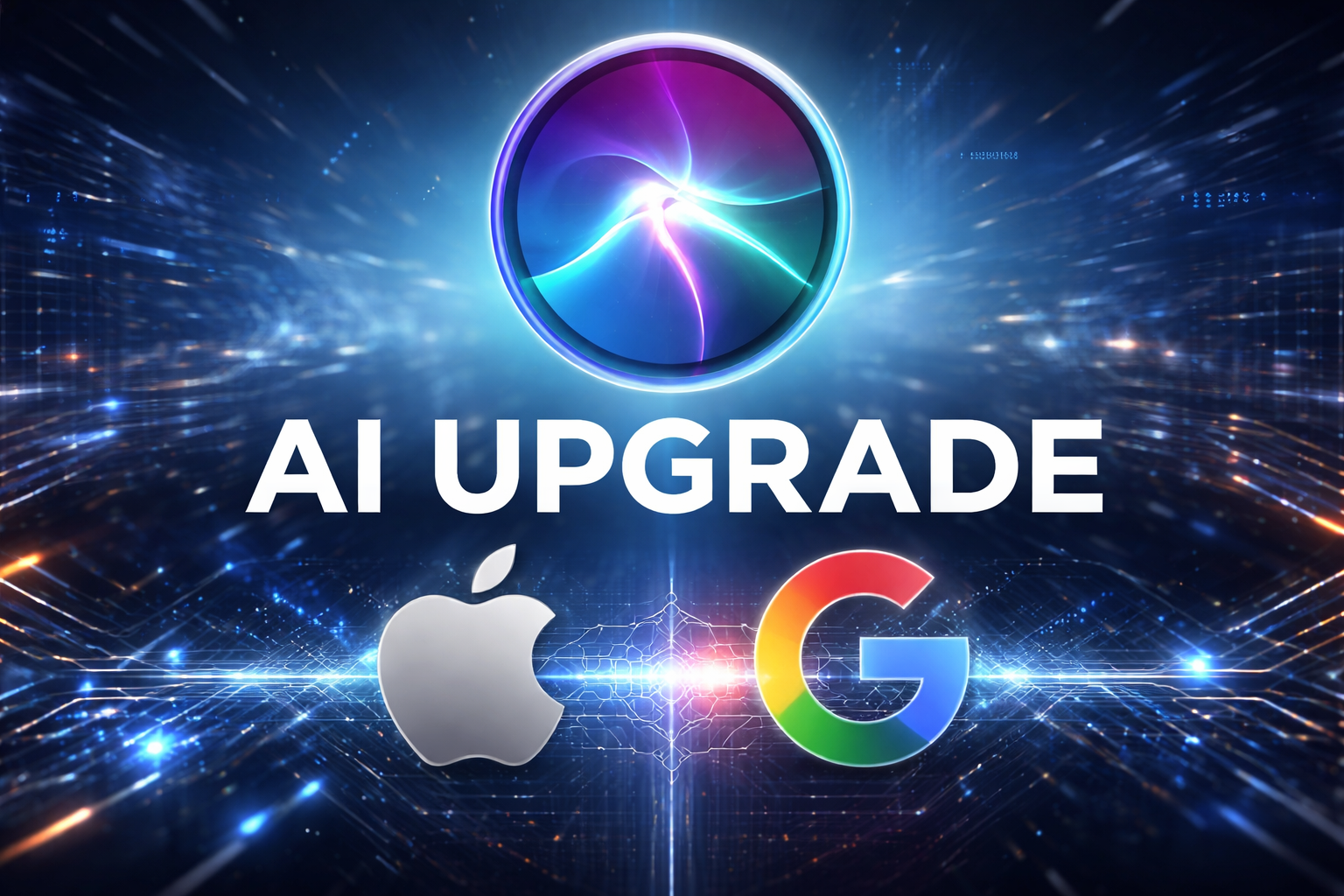
Apple Taps Google AI to Transform Siri in Major Upgrade

lamaqgodoz

Published

on

ChatGPT Image

In a surprising turn of events that signals a shift in the tech industry’s AI landscape, Apple has announced a multi-year partnership with rival Google to power its next-generation Siri voice assistant using Google’s powerful Gemini artificial intelligence models.

The deal — confirmed by both companies in a joint statement this week — means Apple will use Google’s Gemini models and cloud infrastructure as the foundation for the future of Apple Intelligence, including a more personalised and capable version of Siri expected later in 2026.

Why This Matters

Siri, Apple’s built-in digital assistant, has long lagged behind competitors such as Google Assistant and Amazon’s Alexa in handling complex, conversational tasks. The integration of Gemini represents Apple’s most significant AI investment yet and is intended to finally bring Siri up to par with the latest generative AI capabilities.

Apple said it chose Google after a “careful evaluation” of several AI technologies, concluding that Gemini currently offers the most capable foundation for its needs. While Apple previously engaged with OpenAI’s ChatGPT and explored other models, Google’s solution emerged as its primary choice.

What’s Next for Siri

The upgraded Siri — which could debut with iOS 26.4 as soon as this spring — is expected to bring a range of new capabilities, including:

  • Enhanced factual world knowledge and conversational responses
  • Improved personalization based on user context
  • Deeper integration with apps and on-screen actions
  • Expanded support for everyday tasks such as scheduling, travel planning and content creation

This marks a departure from Siri’s traditional focus on basic voice commands, positioning it instead as a more proactive and intelligent assistant.

Balancing Power and Privacy

Despite outsourcing the core AI foundation to Google, Apple emphasises that user privacy remains a priority. The company says that most AI functions will continue to run on-device or through its Private Cloud Compute system, ensuring user data isn’t freely shared with Google’s infrastructure.

Industry Impact

The partnership boosts Google’s presence across Apple’s massive global device ecosystem — more than two billion active devices — and highlights how even industry giants are willing to collaborate in the rapidly evolving AI race.

However, the move also raises questions about the balance of power in AI, given the deepening ties between two competitors traditionally known for rivalry. Experts say it could reshape future cooperation and competition — especially with other AI leaders like OpenAI.

Continue Reading
Click to comment

Leave a Reply

Your email address will not be published. Required fields are marked *

News

NIGERIA HAS LOST ITS WOMEN’S FOOTBALL ADVANTAGE — AND AFRICA IS CATCHING UP FAST

info

Published

on

By

IMG 20260814 WA0000.jpg

For more than three decades, Nigeria’s Super Falcons were the standard of African women’s football.

Ten Women’s Africa Cup of Nations titles. Every FIFA Women’s World Cup from the beginning of the competition. Generations of players who dominated the continent.

Read Also: 14th Women AFCON: Swart’s heroics foil Super Falcons’ search for World Cup ticket

But that era has now reached a disturbing turning point.

For the first time in the history of the FIFA Women’s World Cup, Nigeria will not be at the tournament.

South Africa’s 2–1 victory over the Super Falcons in Casablanca on Thursday ended Nigeria’s final route to the 2027 World Cup.

But perhaps this should not be viewed simply as a failure of the Super Falcons.

Perhaps it is the clearest evidence yet that the rest of Africa has finally caught up.

Look at Malawi.

The Scorchers were appearing at the WAFCON for the first time in 2026. They did not come merely to make up the numbers. They reached the semi-finals and secured Malawi’s historic first-ever Women’s World Cup qualification.

Look at Morocco.

The country has invested heavily in women’s football, and AS FAR has become a continental force, winning the CAF Women’s Champions League in 2025 and earning the right to represent Africa at FIFA’s inaugural Women’s Champions Cup.

Look at South Africa.

Banyana Banyana have transformed themselves from challengers into African champions and have now defeated Nigeria when a World Cup place was on the line.

And across the continent, CAF says women’s football is being strengthened through coaching education, better administration, grassroots development, refereeing and more structured domestic leagues.

This is the part Nigerians must understand.

Africa did not wait for Nigeria to remain dominant.

Other countries started building.

For years, Nigeria had an enormous advantage because many of our best players grew up playing together for long periods, particularly through the domestic system and national-team pathways.

The Super Falcons of previous generations were not simply eleven talented Nigerians assembled for a tournament.

They were products of a football culture that continuously produced players.

Today, that advantage is much smaller.

And there is another uncomfortable reality: Nigerian players are increasingly finding opportunities in women’s leagues outside Nigeria, while African leagues are becoming more organised and competitive.

CAF’s Women’s Champions League has also created a continental platform with meaningful financial rewards; participating clubs received at least $150,000 in the 2024 edition, while the winners received $600,000.

So perhaps the question is no longer:

“Why did the Super Falcons fail?”

The bigger question is:

“Why did Nigeria stop developing faster than the countries chasing us?”

We should support the Falcons.

We should respect the players.

We should recognise their achievements.

But we must also recognise what this moment represents.

Nigeria has won ten WAFCON titles. That history is extraordinary.

But history cannot qualify a team for the next World Cup.

Systems do.

Leagues do.

Academies do.

Coaching structures do.

Investment does.

Player development does.

And if Nigeria does not rebuild those foundations, the Super Falcons’ absence from Brazil may not remain a once-in-history event.

THE SUPER FALCONS HAVE NOT SUDDENLY BECOME A BAD TEAM. AFRICA HAS SIMPLY STOPPED WAITING FOR NIGERIA.

The real alarm is not that Nigeria lost to South Africa.

The real alarm is that the countries Nigeria used to look down on are now building football systems capable of defeating Nigeria when it matters most.

This should not be a blame game.

It should be a wake-up call.

NIGERIA DID NOT LOSE WOMEN’S FOOTBALL IN ONE MATCH. WE MAY HAVE BEEN LOSING THE ADVANTAGE FOR YEARS.

Continue Reading

Business

Sovereign Trust, Guinea Insurance, 5 Others Join Verified List in Final Recapitalization Clearance

info

Published

on

By

BY NKECHI NAECHE-ESEZOBOR—Sovereign Trust Insurance Plc and Guinea Insurance Plc are among seven additional underwriting firms officially cleared and verified by the National Insurance Commission (NAICOM) as compliant with the Minimum Capital Requirements stipulated under the Nigerian Insurance Industry Reform Act (NIIRA) 2025.

This final batch of approvals formally completes the nation’s insurance recapitalization exercise, bringing the total roster of fully capitalized operators in Nigeria to 48 insurance companies and two reinsurance companies.

See details below:

List of Additional Insurance Companies that Complied with the MCR Prescribed by NIIRA 2025

The post Sovereign Trust, Guinea Insurance, 5 Others Join Verified List in Final Recapitalization Clearance appeared first on Business Today NG.

Continue Reading

Trending