Business
NCC Urges Judges to Strengthen Digital Law Knowledge


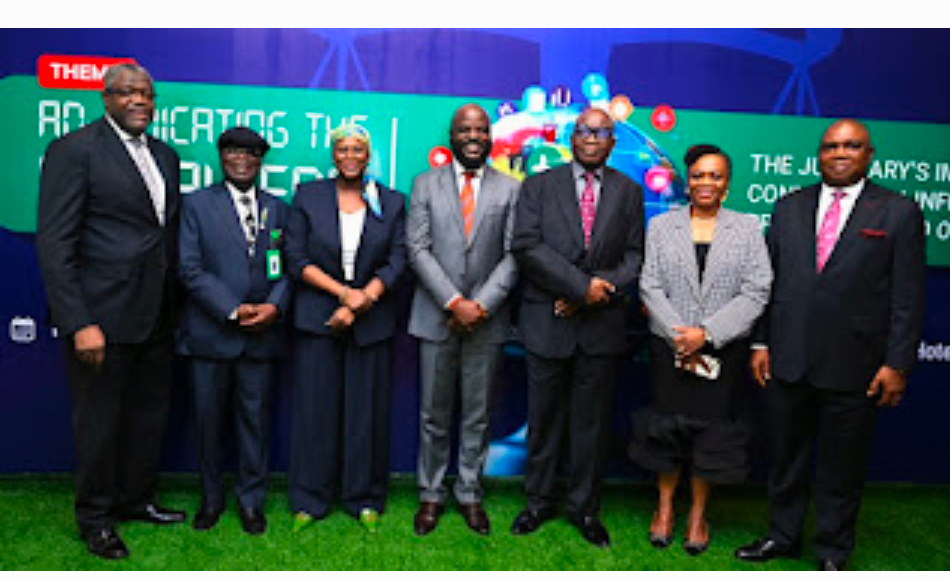
L -R: Hon Justice Habeeb A.O Abiru, Justice of the Supreme Court; Hon. Justice Babatunde A. Adejumo, Administrator, National Judicial Institute; Barr. Rimini Makama, Executive Commissioner Stakeholder Management, Nigerian Communications Commission, NCC; Chief Idris Olorunnimbe, Chairman Governing Board NCC; Hon. Justice Ibrahim M.M Saulawa, Justice of the Supreme Court, representing the Chief Justice of Nigeria; Mrs Chizua Whyte, Head Legal and Regulatory Services, NCC and Hon Justice Obande Festus Ogbuinya, Justice of the Supreme Court, during NCC’s 2026 Workshop for Judges on Legal Issues in Telecommunications on the 14th May 2026 at Sheraton Hotel, Ikeja Lagos.
BY NKECHI NAECHE-ESEZOBOR-Nigeria’s communications regulator,Nigerian Communications Commission,(NCC), has emphasised the need for judges to better understand telecommunications and digital security matters as the country increases its reliance on technology-driven systems.
At a judicial workshop in Lagos, Aminu Maida, represented by Rimini Makama, said telecom infrastructure now plays a vital role in Nigeria’s economy, security, and public services.
He explained that these systems have become critical national assets that support financial operations, public safety, governance, and citizen communication.
Maida noted that the rapid expansion of digital platforms has created new legal issues involving cybersecurity, online abuse, digital identity, consumer rights, and artificial intelligence.
He added that growing incidents of telecom vandalism, cyberattacks, and infrastructure disputes require judges to develop stronger knowledge of telecommunications laws and regulations.
The workshop was organised by the National Judicial Institute in partnership with the Nigerian Communications Commission.
The event focused on the judiciary’s role in connectivity, online safety, and the protection of digital infrastructure in a rapidly evolving technological environment.
Speaking at the programme, Kudirat Kekere-Ekun said courts must adapt to increasing cases involving cybercrime, data governance, privacy concerns, and online misconduct.
She stressed that technology-related disputes can no longer be treated as minor issues because governance, commerce, education, and financial transactions now depend heavily on digital connectivity.
Kekere-Ekun also stated that judicial decisions are important in shaping Nigeria’s digital legal framework, especially as the country seeks stronger broadband expansion, digital inclusion, and protection of its telecom ecosystem.
The post NCC Urges Judges to Strengthen Digital Law Knowledge appeared first on Business Today NG.


The Federal Airports Authority of Nigeria (FAAN) has begun earning revenue from the Murtala Muhammed Airport Terminal Two (MMA2) in Lagos following a settlement between the Federal Government and Bi-Courtney Aviation Services Limited over a dispute that lasted nearly two decades.
The Minister of Aviation and Aerospace Development, Festus Keyamo, disclosed this on Tuesday during the formalisation of the settlement involving the Federal Government, FAAN, Bi-Courtney and Stabilini Visinoni Limited.
“FAAN had not earned a kobo from MMA2 for the last 20 years because of disputes. Today, FAAN begins to earn its money from MMA2,” Mr Keyamo said.
The agreement provides for the resumption of concession fee payments to FAAN and the reciprocal waiver of specified historical financial and other claims by the parties.
Mr Keyamo said the Federal Executive Council (FEC) approved the framework for the negotiated settlement on 30 April 2026, following discussions aimed at resolving the long-running dispute.
What the settlement changes
Under the revised agreement, Bi-Courtney has agreed to waive its outstanding claims against the Federal Government, while the government and FAAN will relinquish specified historical claims against the concessionaire, including accumulated concession fees and related payments arising before the agreement.


The minister said the arrangement was intended to resolve past disagreements and establish clearer contractual obligations for the parties going forward.
The settlement also addresses a dispute over the General Aviation Terminal (GAT), commonly known as the Old Domestic Airport.
According to Mr Keyamo, the revised agreement recognises the terminal as the property of the Federal Government, to be operated by FAAN.
The minister said the government had agreed to allow Bi-Courtney to expand its apron and accommodate regional flights within Africa at MMA2, subject to the terminal’s capacity.
The agreement also restores rights and provides for separate lease arrangements covering a four-star hotel and conference centre near the airport. The facilities have remained unfinished for years.
Mr Keyamo said the government would retain regulatory oversight over security, access, emergencies and maintenance standards, while the parties would work together to implement the revised arrangements.
Background to the dispute
In April, PREMIUM TIMES had reported that the Federal Government had reached a settlement with Bi-Courtney to resolve the long-running dispute over MMA2 after years of litigation and disagreements over the airport concession.
Mr Keyamo at the time said the Federal Executive Council (FEC) had approved the negotiated settlement, which included concessions by both parties, revised operational arrangements and plans to restore government revenue from the terminal.
The dispute originated from a concession agreement signed on 24 April 2003 involving the Federal Government, Bi-Courtney and Stabilini Visinoni Limited for the design, construction, operation and eventual transfer of the domestic terminal.
The agreement initially covered 12 years from 7 May 2007 but was subsequently extended to 36 years.
Disagreements over contractual obligations, financial claims and the scope of the concession led to multiple court cases across successive administrations.
Bi-Courtney maintained that it had been denied benefits under the concession, while FAAN asserted its own financial entitlements and responsibility to protect public airport assets.
READ ALSO: FAAN steps up airport surveillance as Nigeria confirms Ebola case in Abuja
The dispute also involved the ownership of the General Aviation Terminal and financial claims connected to the Asset Management Corporation of Nigeria.
Mr Keyamo said the latest settlement followed negotiations between the government and the chairman of the Bi-Courtney Group, Wale Babalakin, with legal, commercial and technical teams involved in the process.
He added that the agreement would give Bi-Courtney greater certainty to invest in the terminal while allowing the government to resume revenue collection and plan airport development under the revised framework.
He urged FAAN and Bi-Courtney to ensure that the settlement resulted in completed facilities, reliable services and improved airport operations.
“The travelling public should see the result in functioning facilities and dependable service. That is how the value of this settlement will be measured,” he said.
Discover more from Premium Times Nigeria
Subscribe to get the latest posts sent to your email.
-

 News3 days ago
Euromatch NPFL: Matchday 9 results
-
News4 days ago
NUCAP: Nigeria targets 20 million people with 3,700 telecom towers – Technology Times
-
News3 days ago
No agenda, no rush, no leaving San Francisco: Benchmark’s partners on investing in a frenzied market
-
News2 days ago
Amazon to fund 12 small nuclear reactors at former Indiana coal plant