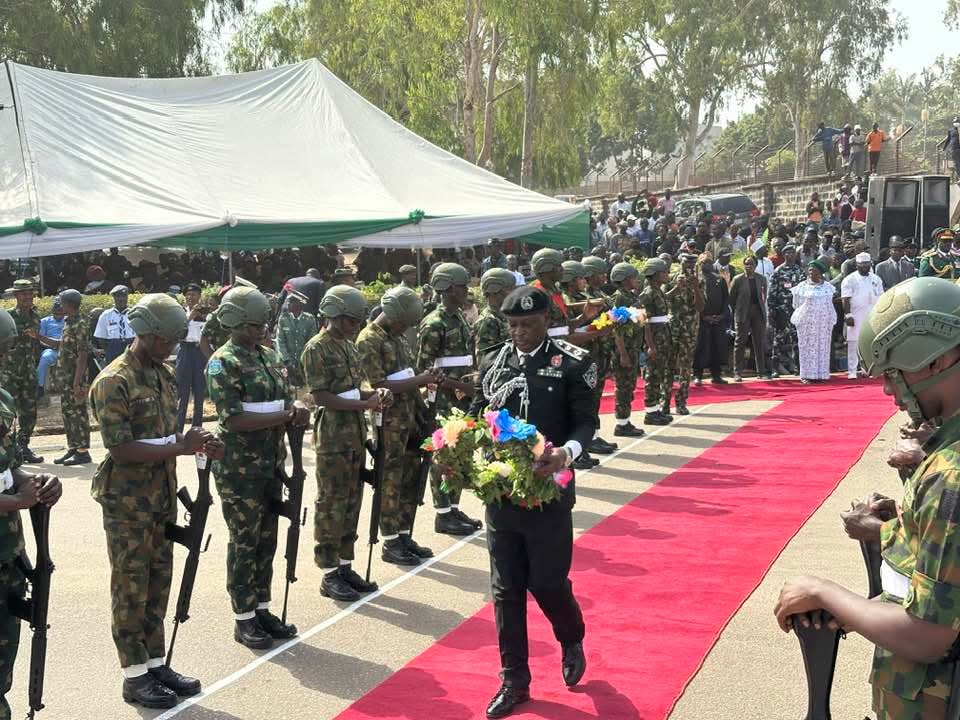
The Plateau State Government on Thursday, January 15, 2026, joined the rest of the country to commemorate the 2026 Armed Forces Remembrance Day with a solemn ceremony held at the J.D. Gowon Secretariat, Jos.
Armed Forces Remembrance Day, observed annually on January 15, honours officers and men of the Nigerian Armed Forces who paid the supreme price in defence of Nigeria’s unity, peace and territorial integrity, as well as those wounded or permanently incapacitated in the line of duty.
The ceremony featured interdenominational prayers for fallen heroes and lasting peace in the country, followed by the laying of wreaths, a 21-gun salute, the sounding of the Last Post and a minute of silence in honour of departed servicemen and women. Activities later culminated in a luncheon at the Headquarters of 3 Division, Nigerian Army, Maxwell Khobe Cantonment, Jos.
Speaking at the luncheon held at the Rhino Officers Mess, Governor Caleb Manasseh Mutfwang, represented by the Deputy Governor, Mrs. Ngo Josephine Piyo, described the occasion as a solemn tribute to the courage, sacrifice and resilience of Nigeria’s armed forces.
The governor said Plateau State remained proud of its long-standing tradition of military service and acknowledged the critical role played by the armed forces in maintaining peace and security. He reaffirmed the state government’s commitment to supporting the military through sustained collaboration, provision of necessary resources and strengthened civil-military relations.
Governor Mutfwang also emphasised the need to care for veterans and their families, noting that the sacrifices of soldiers extend beyond the battlefield to their loved ones. He called for continued support in areas such as healthcare, education and employment for retired personnel.
Earlier, in his welcome address, the General Officer Commanding (GOC) 3 Division and Commander, Operation Enduring Peace, Major General Folunsho Oyinlola, described Armed Forces Remembrance Day as a moral obligation to honour fallen heroes and appreciate serving personnel.
He noted that the day serves as a reminder that peace is neither passive nor free, but sustained through sacrifice, professionalism and commitment. According to him, Operation Enduring Peace reflects the resolve of the armed forces to protect communities, safeguard stability and prevent conflict.
Major General Oyinlola paid tribute to veterans and families of fallen soldiers, assuring them that their sacrifices would never be forgotten. He also commended the men and women under his command for their discipline, courage and dedication to duty amid evolving security challenges.
Also speaking, the Chairman of the Nigerian Legion, Plateau State, Colonel Adams Donzhi (rtd.), expressed appreciation to the Plateau State Government for its continued support to the Legion and veterans. He called for sustained care for widows, orphans and families of fallen heroes, urging all sectors of society to contribute to their welfare.
The ceremony concluded with prayers for peace, unity and prosperity in Nigeria, alongside renewed calls for collective support for the nation’s armed forces and veterans.
The Presidency has vowed that the democratic choice of Nigerians will no longer be overturned by any authority, and that the sacrifices made during the June 12 struggle must continue to guide the country’s democratic journey.
Politics Nigeria reports that the Special Adviser to the President on Information and Strategy, Bayo Onanuga, stated this on Thursday at the national premiere of MKO, a documentary on the life and political struggle of the late Chief Moshood Kashimawo Olawale Abiola.
The premiere, held at the Wole Soyinka Centre for Culture and Creative Arts, Lagos, formed part of activities marking Nigeria’s 66th Independence Anniversary.
President Bola Tinubu attended the event alongside his wife, First Lady Oluremi Tinubu, with senior government officials, lawmakers, governors and other dignitaries also present.
The documentary, produced by US-based filmmaker Ose Oyamendan, chronicles the events surrounding the June 12, 1993 presidential election, its annulment by the military government and Abiola’s subsequent struggle to reclaim what he regarded as his electoral mandate.
It also documents Abiola’s arrest in 1994 after declaring his mandate and his death in detention in 1998.
Leading a minute’s silence for Nigerians who died during the pro-democracy struggle, Onanuga said the sacrifices of those who resisted military rule must not be erased from the country’s history.
He listed several prominent figures associated with the struggle, including Anthony Enahoro, Adekunle Ajasin, Abraham Adesanya, Gani Fawehinmi, Beko Ransome-Kuti, Alfred Rewane, Frank Kokori, Ndubuisi Kanu, Dan Suleiman, Chima Ubani, Bola Ige, Cornelius Adebayo, Ayo Adebanjo and Balarabe Musa.
The presidential aide also honoured journalists and media organisations that continued to document the struggle despite arrests, kidnappings, seizures of publications and other forms of repression.
“We remember the lawyers who defended detainees, the students who staged countless protests on the streets and on their campuses, the workers, especially members of NUPENG, who withdrew their labour, the academics who gave the struggle a voice, and the Nigerians in the diaspora who mobilised international support for the sanctity of our democracy,” Onanuga said.
He recalled that many Nigerians were imprisoned without trial, driven into exile or lost their livelihoods and properties because of their opposition to military rule.
According to him, the restoration of democratic rule came at a heavy cost, adding that the June 12 struggle should serve as a reminder of the responsibility to protect the people’s mandate.
“The democracy we enjoy today was built upon the courage and sacrifices of the people we have identified. We owe them more than remembrance. We owe them a duty to ensure that no authority ever again overturns the freely expressed will of Nigerians,” he said.
Onanuga added that Abiola had been officially acknowledged as the winner of the June 12, 1993 presidential election, describing the documentary as a tribute to him and the wider pro-democracy movement.
Minister of Art, Culture, Tourism and the Creative Economy, Hannatu Musa Musawa, said the documentary was produced to preserve the history of the June 12 struggle for future generations.
“This documentary is in honour of the heroes of June 12, the men and women who gave their lives for the mandate of June 12, 1993 and for the democracy Nigeria enjoys today,” Musawa said.
She said the events surrounding the election, regarded as one of Nigeria’s freest and fairest elections, needed to be properly documented so younger Nigerians could understand the sacrifices that preceded the country’s current democratic system.
Musawa urged citizens to protect democracy and prevent the truncation of the people’s will.
Bayo Onanuga; President Bola Tinubu
The premiere was attended by Senate President Godswill Akpabio; Speaker of the House of Representatives Tajudeen Abbas; Kwara State Governor and Chairman of the Nigeria Governors’ Forum, AbdulRahman AbdulRazaq; Lagos State Governor Babajide Sanwo-Olu; Ogun State Governor Dapo Abiodun; Plateau State Governor Caleb Mutfwang; and Chief of Staff to the President, Femi Gbajabiamila.
Also present were Minister of Industry, Trade and Investment Jumoke Oduwole; Minister of Water Resources and Sanitation Joseph Utsev; former Ogun State Governor Olusegun Osoba; members of the National Assembly and other dignitaries.
Oyamendan, the documentary producer, thanked Tinubu and other individuals and organisations that supported the project, recalling that he interviewed the president when Tinubu was a senator in 1992.
JOS, PLATEAU STATE — Student creativity and digital storytelling took centre stage in Jos as the 2nd edition of the European Union–National Film Institute (EU-NFI) Students Film Festival came to a colourful close on September 29, 2026.
The two-day festival, organised by the National Film Institute (NFI) in partnership with the European Union (EU), brought together emerging filmmakers, film students, industry professionals and stakeholders for screenings, masterclasses and competitive showcases aimed at developing the next generation of Nigerian filmmakers.
The event provided students with an opportunity to showcase their creative abilities while exploring the role of film and digital storytelling in documenting Nigerian experiences, culture and contemporary realities.
EU Ambassador Applauds Students’ Creativity
Speaking at the festival finale, the EU Ambassador to Nigeria and ECOWAS, H.E. Gautier Mignot, described the students’ creative output as impressive and expressed optimism about the future of Nigeria’s film industry.
Mignot highlighted the important role of the National Film Institute in Nigeria’s creative ecosystem, noting that initiatives such as the students’ film festival align with the European Union’s priorities in youth empowerment, education, culture and strengthening EU-Nigeria relations.
He also commended the leadership of the Institute, particularly the Rector, for his commitment to the students and for fostering a relationship built around creativity, mentorship and learning.
Ali Nuhu: Festival Is More Than Competition
The Managing Director of the Nigerian Film Corporation (NFC), Dr. Ali Nuhu, described the festival as more than a platform for competition.
According to him, the initiative provides young Nigerians with an opportunity to develop their skills and become cultural ambassadors who can use film to tell stories that reflect Nigeria’s identity and diversity.
He called for sustained investment in skills development, education and learning opportunities for young people seeking careers in the creative industry.
NFI Announces Winners
The Rector of the National Film Institute, Prof. Pomak Frank Tengya, expressed the Institute’s readiness to continue supporting young filmmakers and assured participants that the institution would host the 2027 edition of the festival.
He subsequently announced the winners in the various competition categories.
Each of the top prize winners received ₦100,000.
The winners include:
Best Sound: Rev Kola — Osakpolo Arthur
Best Documentary: Carrying a Legacy — Badung Chuhwak
Best Animation: Coming Home — Habibi Risku
Best Cinematography: Dusk Till Dawn — Longtong Tamg’an
Best Director: They Call Me Mother — Esther Oyninyechi Nnamani
Best Short Film: They Call Me Mother — Esther Oyninyechi Nnamani
Esther Oyninyechi Nnamani emerged as one of the biggest winners of the festival, taking home awards for both Best Director and Best Short Film.
Nurturing the Next Generation
The festival further demonstrated the potential of film education and practical creative opportunities in nurturing young talents and strengthening Nigeria’s growing creative economy.
With students taking centre stage as writers, directors, cinematographers, animators and storytellers, the EU-NFI Students Film Festival provided a platform for emerging filmmakers to gain exposure, learn from industry professionals and connect with fellow creatives.
As the National Film Institute looks ahead to the 2027 edition, the festival continues to position Jos as an important centre for film education, creativity and digital storytelling in Nigeria.
Jos Events | Connecting Jos. Promoting Events. Supporting Local Businesses.