News
NPFL 2025/2026: How Kun Khalifat FC Escaped Relegation With Second-Stanza Magic, Smart Recruitment

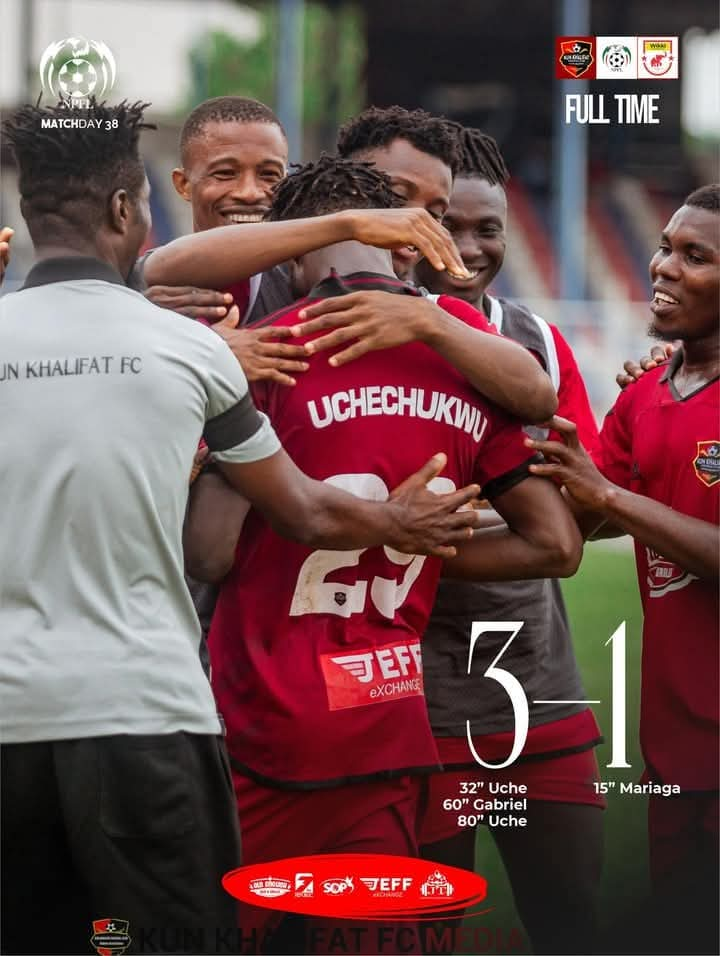

In a league season where survival often depends on experience, money, and consistency, few stories capture the spirit of resilience better than the dramatic escape of Kun Khalifat FC in the 2025/2026 Nigeria Premier Football League campaign.
At one point in the season, relegation looked almost inevitable for the Owerri-based side. Results were poor, confidence was low, and many observers believed KKFC lacked the squad depth needed to survive the brutality of the NPFL.
But football has a way of rewarding courage, smart planning, and bold decisions.
What followed in the second stanza of the season was nothing short of extraordinary.
The Turning Point That Changed Everything
The biggest gamble came during the mid-season transfer window when KKFC owner Micheal Ahamefula made a decision many supporters initially questioned.
Rather than hold on emotionally to key players, he sanctioned the sale of three important squad members to Barau FC:
Ebuka Nwokorie
Henry Ezeonye
Uche Moses
The transfer reportedly brought in about ₦15 million in sign-on fees.
For many struggling NPFL clubs, that money could easily disappear into operational expenses. But Ahamefula had a different vision.
Instead of panicking in the market for expensive stars, he returned to the football streets of Owerri , searching for hungry, overlooked, and ambitious talents desperate for an opportunity. That decision ultimately saved KKFC’s season.
The Street Recruitment Strategy That Worked
From local football circles and lesser-known setups emerged a new wave of players who transformed Kun Khalifat FC’s campaign:
Uchechukwu Onuoha
Chijoke Ejiogu
James Ekebuike
Ebuka James
Mmesoma Nnorom
What looked like low-profile recruitment soon became one of the smartest rebuilding projects of the NPFL season.
The new arrivals brought hunger, energy, fearlessness, and tactical balance to a side fighting for survival.
Uchechukwu Onuoha Became the Symbol of Survival
No player represented KKFC’s great escape more than striker Uchechukwu Onuoha.
Signed during the second half of the season, the forward exploded into form at exactly the right moment.
Onuoha scored eight goals in the second stanza alone, becoming the attacking spark that reignited KKFC’s survival hopes.
His movement, finishing, and ability to score under pressure gave the club belief during the most difficult weeks of the campaign.
Every survival story needs a hero.
For KKFC, that hero was Onuoha.
The Supporting Cast That Delivered Under Pressure
While Onuoha grabbed the headlines, survival was also built on collective effort.
James Ekebuike contributed crucial goals after joining mid-season, adding attacking depth and relieving pressure from the frontline. His four-goal contribution proved vital in tight fixtures.
Creative midfielder Mmesoma Nnorom provided key assists and attacking intelligence, helping KKFC become more dangerous in transition during the closing stages of the season.
At the back, veteran goalkeeper Chijoke Ejiogu brought leadership, composure, and experience. In several must-win encounters, his saves preserved valuable points that eventually kept the club afloat.
These were not superstar signings.
They were simply players who arrived with purpose.
The Five-Game Run That Saved Their NPFL Status
When the pressure became unbearable, KKFC produced their best football of the season.
The club went unbeaten in their final five matches, picking up an astonishing 13 points from a possible 15.
That remarkable run completely altered the relegation picture.
At a stage where every mistake could have sent them down, Kun Khalifat FC suddenly became one of the most difficult teams to beat in the league.
The confidence returned. The goals arrived. The belief spread through the squad.
And by the end of the campaign, the same club many had already written off completed one of the most impressive survival escapes of the NPFL season.
Micheal Ahamefula’s Midas Touch
Football survival is often discussed in tactical terms, but KKFC’s escape also became a lesson in football management and investment.
Micheal Ahamefula understood something many club owners fail to recognize — smart recruitment can outweigh expensive recruitment.
He sold assets at the right time, reinvested wisely, trusted grassroots scouting, and rebuilt a competitive squad without reckless spending.
That strategy changed the destiny of the club.
Now, the reward may extend beyond survival itself.
Bigger Clubs Are Already Circling
The performances of KKFC’s second-stanza recruits have reportedly attracted attention across the Nigerian football scene.
As many as nine Kun Khalifat FC players are now being monitored by bigger clubs ahead of the upcoming transfer window.
Ironically, the same survival battle that nearly destroyed the club could soon become a financial breakthrough.
If KKFC successfully cash in on these emerging talents, owner Micheal Ahamefula may once again smile to the bank — proving that proper football investment is not always about spending more, but spending wisely.
More Than Survival
Kun Khalifat FC’s 2025/2026 campaign will not simply be remembered as a relegation escape story.
It was a season that demonstrated the power of scouting, courage, calculated risks, and belief in grassroots talent.
While bigger clubs chased expensive solutions, KKFC went back to the streets of Owerri and found players hungry enough to save a football club.
In the end, that hunger became their greatest weapon.






The National Chairman of the All Progressives Congress, APC, Nentawe Yilwatda, has left open the possibility of Godswill Akpabio returning as Senate President in 2027.
Yilwatda said the decision on whether Akpabio would return as Senate President rests with the Senate and not the APC.
He spoke during an interview on Channels Television's Politics Today on Monday night.
Asked whether Akpabio would return as Senate President in 2027, Yilwatda said, "You know that the Senate will determine it. Let's wait for the election first. I don't have anybody in mind. The Senate will determine who they want to make Senate President. We, as a party, will only just bring the Majority Leader."
On the political dispute between former Imo State Governor Rochas Okorocha and incumbent Governor Hope Uzodinma, the APC chairman said the party would allow the court to determine the matter.
Asked about the dispute, he said, "We will allow the court to settle it, but behind the scenes, we are doing management of the case.
"The report I have of all the political parties, you don't have one tenth of it. I have my intelligence around everybody. I filter data from all.
"There is no political party that does not have a research unit, and the research unit goes as low as scavenging for data."
APC Chairman speaks on Akpabio’s chances of returning as Senate President in 2027

Access Holdings is considering exiting at least one market outside its base in Nigeria to comply with a Central Bank of Nigeria (CBN) rule requiring lenders to limit investment in foreign subsidiaries to no more than one-tenth of shareholders’ funds.
The banking group mentioned one business in which it plans to offload its stake to meet the requirement, Bloomberg reported on Monday, citing Chairman Aigboje Aig-Imoukhuede.
“If a subsidiary cannot meet its cost of capital and the strategic objectives for which it is set up, you should be ready to take a decision to exit,” Mr Aig-Imoukhuede was quoted as saying at an African Financial Industry Summit in Luanda, Angola, last week.
“Do we have one or two troublesome subsidiaries? I can think of one.”
Investment in subsidiaries for Nigeria’s biggest bank by assets stood at N446.6 billion at the end of September, equivalent to 19.3 per cent of its equity, according to Access Holdings’ 9M 2026 Investor Presentation.
That was roughly double the 10 per cent ceiling permitted by the Banks and Other Financial Institutions Act (BOFIA) 2020.


Only in cases of regulatory approval for a higher threshold from the CBN are lenders allowed to exceed that limit, the Act says.
The banking industry watchdog has given Access Holdings 12 months to address the issue.
The potential exit is part of the financial institution’s move to review its international operations to comply with the directive.
In June, Access Bank’s chief executive, Roosevelt Ogbonna, said the lender would reduce its shareholding in some of its foreign subsidiaries to achieve compliance.
According to Innocent Ike, CEO of Access Holdings, the lender will explore three strategies towards that end.
The options include recalling surplus capital from overseas subsidiaries, offloading minority stakes and restructuring some businesses, he said.
He added that the group has already completed one capital repatriation exercise involving its six targeted subsidiaries, and is engaging regulators in five countries to facilitate the return of excess capital to Nigeria.
Access Holdings plans to meet the regulatory requirement ahead of the March 2027 deadline, Mr Ike stated.
READ ALSO: Access Holdings’ nine-month profit jumps 6% to N474.2 billion
“We gave ourselves up till January next year, and I think we’re completing this ahead of schedule,” said Mr Aig-Imoukhuede.
The Access Holdings’ chairman said the group’s international portfolio remains fundamentally strong despite plans to sell interests in some international subsidiaries.
He noted that the group would continue to review the performance of its subsidiaries to ensure they generate sustainable returns and remain aligned with the strategic objectives for which they were established.
“You have to do dynamic portfolio management. Every year, you’re looking for ways to improve,” he said.
Access Bank sold its 97 per cent stake in its loss-making Ivorian subsidiary to Cameroon’s Afriland First Group SA for $1 million in January 2014, after the CBN restricted parent-bank capital for foreign subsidiaries.
Discover more from Premium Times Nigeria
Subscribe to get the latest posts sent to your email.
-

 News11 hours ago
Troops Arrest Suspected Gunrunner, Neutralise Two Terrorists in Plateau
-
News4 days ago
The New York Times reportedly in talks to buy Letterboxd for $330 million
-
News1 day ago
Makinde Visits COCIN Headquarters in Jos, Urges Christians to Shape Nigeria’s Political Future
-
News4 days ago
Nigeria Get Second Chance as CAF Reportedly Considers Flying Eagles for 2027 U-20 AFCON