
News
Nigeria’s Intron adds 57 languages to AI speech platform


Nigeria’s AI startup Intron expands it’s speech platform to 57 languages
Intron, a Nigerian artificial intelligence startup has expanded its speech recognition platform, Sahara, to support 57 languages, adding 24 new ones as it scales operations across healthcare, legal, financial services, and telecommunications.
The upgraded Sahara v2, includes 23 African languages and supports more than 500 African accents. Newly added languages include Hausa, Swahili, Yoruba, Igbo, isiZulu, Kinyarwanda, Twi, isiXhosa, Amharic, and Wolof, among others. The company said language selection was driven by commercial demand.
Intron also introduces the world’s first bilingual Swahili-English automatic speech recognition model designed to handle code-switching, alongside new text-to-speech features and offline deployment options for enterprise users.
The development comes amid growing interest in voice technology across Africa, where most of the continent’s estimated 2,000 languages are primarily spoken rather than written. Industry projections show the global speech recognition market could reach $81.59 billion by 2032.
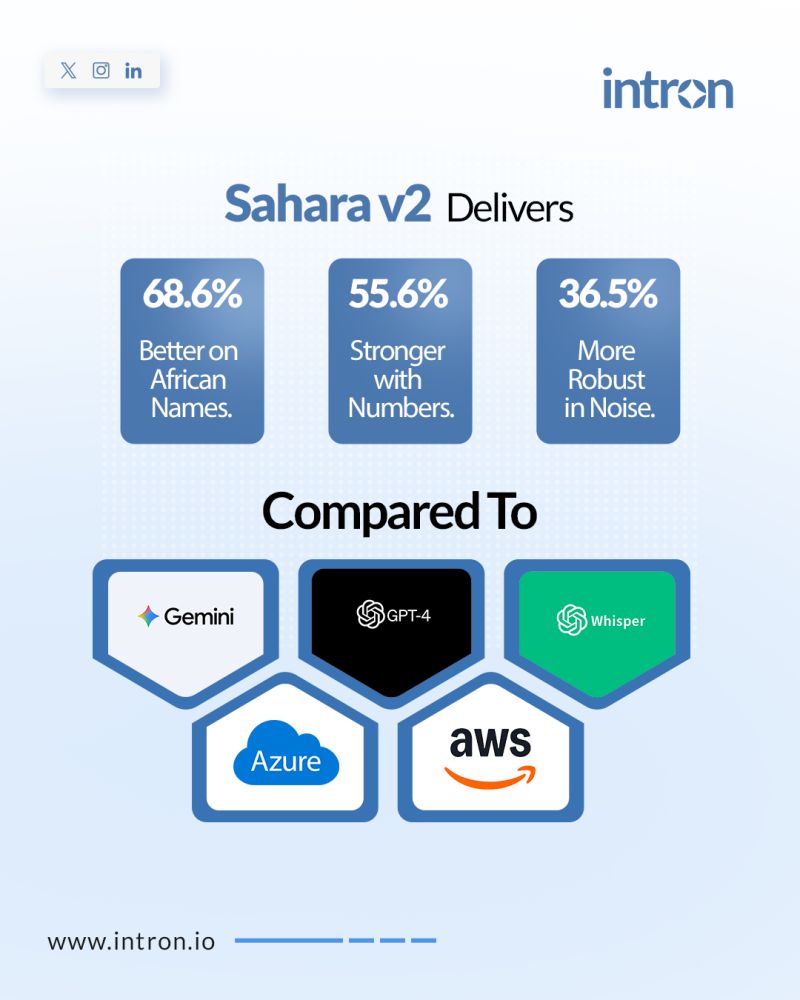
According to Intron, Sahara was trained with locally sourced voice data to better capture African accents, dialects, and speech patterns. The company’s internal benchmarks using African voice datasets showed the platform outperformed global systems such as Gemini, GPT-4, Whisper, ElevenLabs, and Azure by up to 64% in recognising African names, organisations, and locations.

It also reported 35% better performance with numbers, 20% stronger accuracy in noisy or multi-speaker environments, and 25% higher cross-domain accuracy across key sectors.
“We curated datasets of African voices and made them publicly testable so global models can be evaluated on African speech,” said Tobi Olatunji, founder and chief executive officer of Intron.
Founded in 2020 by Olatunji and Olakunle Asekun, the company initially built clinical documentation tools before expanding into broader voice infrastructure. Sahara now powers speech-to-text, text-to-speech, and voice authentication systems for enterprise and government clients.
Intron said it currently records consistent usage in at least six African countries, including Nigeria, Kenya, South Africa, Ghana, Rwanda, and Uganda.
Its clients include the Ogun State Judiciary and Audere, which uses the platform to transcribe WhatsApp voice messages across multiple accents.
Sahara v2 was built using more than 14 million audio clips, representing over 50,000 hours of speech from more than 40,000 speakers across 30 African countries. The company said much of its early medical speech data had to be created internally due to a lack of existing datasets.
The bilingual Swahili-English model was developed in partnership with Penda Health to address real-time language switching common in clinical settings. Intron said additional bilingual models for languages such as Yoruba, Hausa, Zulu, and Kinyarwanda are in development.
The company also launched a Hausa text-to-speech model aimed at powering multilingual voice applications for call centres, healthcare services, and financial platforms.
While Sahara is primarily cloud-based, Intron has introduced offline deployment through a partnership with Nvidia, enabling the system to run on edge devices in low-connectivity environments.
Intron said it complies with local data protection regulations and allows clients to choose between local and cloud data storage.
The company plans to raise $3 million later in 2026 to expand language coverage and further develop bilingual and sector-specific models.
The Publicity Secretary of the African Democratic Congress, ADC, in Kwara State, Abubakar Kabir Basambo, has resigned from the party, accusing some of its leaders of hypocrisy, dishonesty and double standards.
Basambo announced his decision in a resignation letter dated October 23, 2026, addressed to the state party chairman through the Magaji Are 1 ward chairman and the chairman of Ilorin East Local Government Area.
He said his decision followed careful consideration of the party’s direction in the state ahead of the 2027 general elections.
In the letter, Basambo criticised some party leaders and members of the state executive committee, accusing them of failing to practise the values they publicly claim to uphold.
“This decision was not taken lightly. After deep reflection, I can no longer cope with the direction the party is going in the state.
“There is so much hypocrisy, lies, and double standards amongst some party leaders and State Excos who parade themselves as loyal leaders,” he stated.
The former spokesman also criticised the party’s governorship candidate, Zakari Mohammed, alleging that his arrogance, alongside the conduct of some members, had contributed to his decision to leave.
He warned that the alleged behaviour of some party leaders could prevent the ADC from growing if it was not addressed.
“If this situation does not change, it will surely bring the party down. This party cannot grow with hungry and hypocritical people parading themselves as leaders,” he wrote.
Despite his departure, Basambo said he had no regrets about leaving the party, describing the decision as the end of his political journey with the ADC.
He also expressed disappointment that he would no longer be working with his political leader, Abubakar Kannike, whom he said he had grown to respect over the past year.
Basambo described Kannike as a man of honour and sincerity, adding that his regard for him would remain unchanged despite his resignation.
He also wished the state chairman, secretary and woman leader success in their respective positions.
While thanking those who supported him during his time in the party, he said he had no apology to offer to those who disliked him.
Basambo further clarified his meeting with the governorship candidate of the Peoples Democratic Party, PDP, Bolakale Kawu, insisting that it was not intended to work against the ADC.
“For the purpose of clarity and to exonerate myself from any anti-party allegation, my meeting with Mallam Bolakale Kawu was purely an act of brotherhood and that of a committed member trying to canvas for the party,” he stated.
He added that some ADC leaders had also been involved in similar activities privately.
News
From Super-Sub to World Cup Superstar! Kanyinsola Yusuf Wins FIFA Player of the Match as Flamingos Stun North Korea 3-1


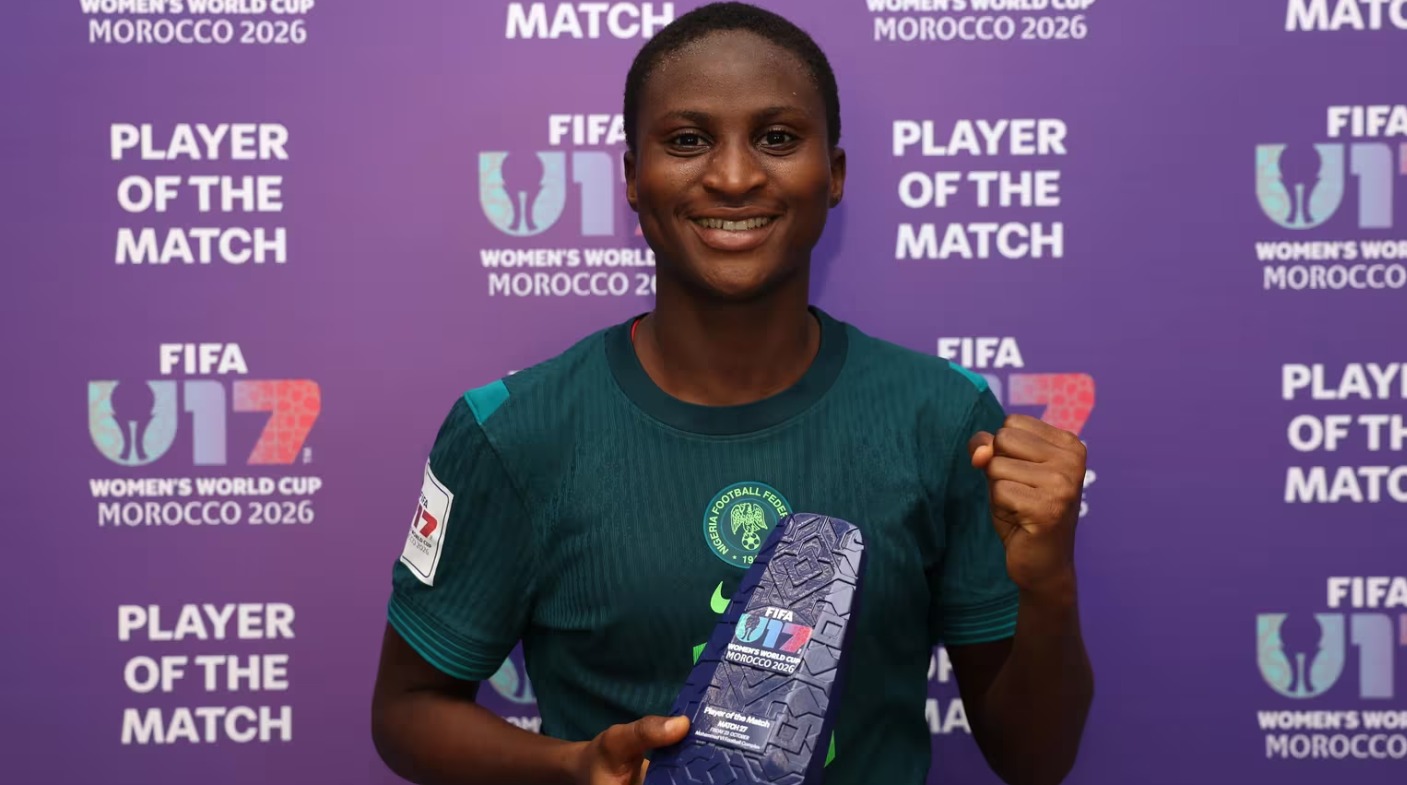
Nigeria’s teenage sensation Kanyinsola Yusuf has emerged as one of the standout performers at the 2026 FIFA U-17 Women’s World Cup in Morocco after winning the Player of the Match award in the Flamingos’ sensational 3-1 victory over defending champions North Korea on Friday.
The prestigious individual recognition crowned an unforgettable afternoon for Yusuf, whose second-half goal helped Nigeria dismantle the tournament favourites and secure a place in the Round of 16.
Yusuf struck in the 56th minute to give Nigeria a commanding three-goal advantage, completing a remarkable attacking display against opponents who had scored 12 goals in their opening two group matches.
Oluwakemi Adegbuyi had opened the scoring in the 15th minute before Oluebube Umejiaku doubled Nigeria’s lead in the 38th minute, leaving the defending champions stunned at half-time.
North Korea pulled a goal back through Yu Jong Hyang’s 82nd-minute penalty, but the Flamingos held firm to record a famous victory.
For Yusuf, the individual honour represents another significant moment in a rapidly developing World Cup campaign.
The youngster had already made an impact in Nigeria’s opening 2-1 defeat to Poland, coming off the bench and helping spark a late fightback, before playing her part in the team’s recovery.
Her emergence adds another exciting dimension to coach Akeem Busari’s squad, which has transformed its fortunes after beginning the tournament with defeat.
Nigeria followed that setback with a 2-0 victory over Puerto Rico before producing Friday’s stunning performance against the reigning champions.
Yusuf’s award also means Nigerian players have claimed the Player of the Match prize in consecutive victories, following Adegbuyi’s recognition against Puerto Rico.
With the Flamingos now through to the knockout stage, Yusuf’s growing influence could prove crucial as Nigeria chase a historic first title.
From an impact substitute against Poland to a match-winning star against North Korea, Yusuf is rapidly making her name on the world stage.
-

 News14 hours ago
Obi, Kwankwaso to hold Middle Belt Youth, Village Hall Meeting in Jos
-
News4 days ago
Mamdani says feds have abdicated on AI, urges New Yorkers to push back
-
News3 days ago
Meta’s Muse hits 10M U.S. downloads in 40 days, a milestone reached by only 11 other apps
-
Business3 days ago
How Your Side Hustle Income Ends Up in Your RSA


