Nigeria risks falling behind in the rapidly evolving global digital economy if it repeats the long telecoms policy delays that followed its last major telecommunications framework, the Federal Government has warned, as it pushes for faster and more adaptive reforms in the era of artificial intelligence (AI) and emerging technologies.
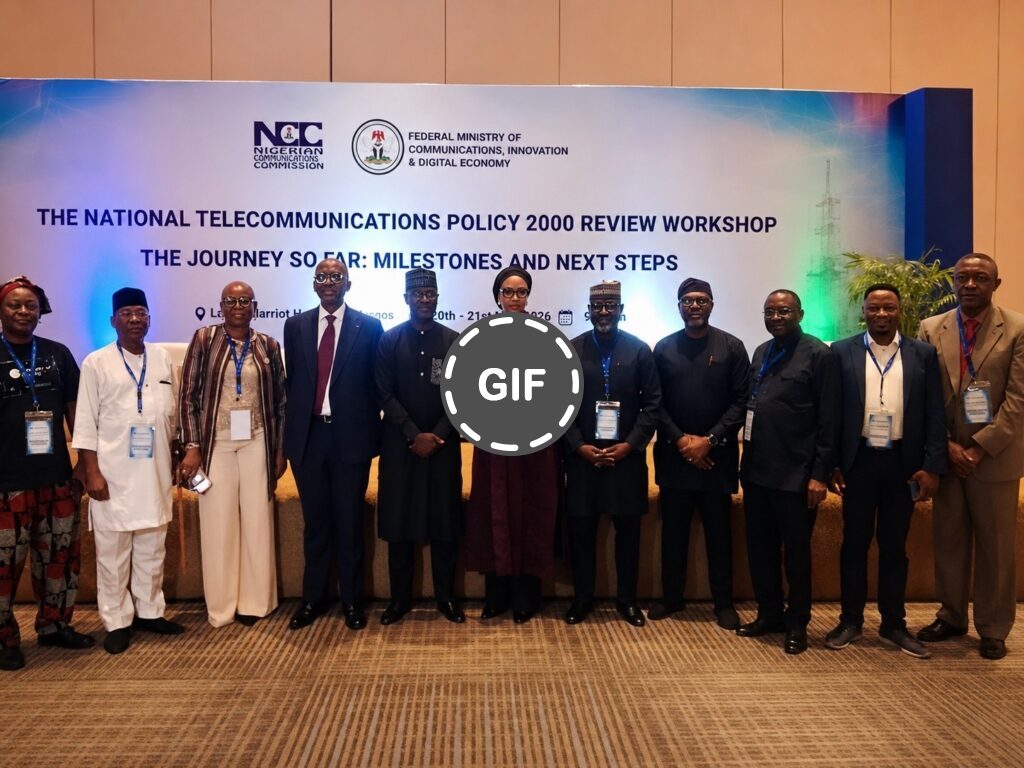
Speaking on Wednesday at the two-day National Telecommunications Policy 2000 Review Workshop organised by the Nigerian Communications Commission (NCC) in Lagos , Hadiza Bala Usman, Special Adviser to the President on Policy and Coordination, says Nigeria cannot afford another prolonged gap in updating critical telecoms policy frameworks at a time when technology is advancing at unprecedented speed.
“Nigeria cannot wait two more decades before undertaking the next phase of this review,” she says, stressing that the country must build a more responsive policy system capable of keeping pace with rapid shifts driven by AI, broadband expansion, cybersecurity demands and digital transformation.
“A policy that was fit for purpose in the year 2000 cannot simply be assumed to remain relevant in 2026,” she says.
Next phase of Nigeria’s telecoms policy drive
The workshop, themed “The Journey So Far: Milestones and Next Steps,” marks a major review of Nigeria’s National Telecommunications Policy introduced in 2000, which opened the sector to private investment and competition after years of state dominance.
According to Bala Usman, telecommunications has evolved far beyond voice connectivity to become the backbone of modern economic and social systems, powering finance, e-commerce, education, healthcare, identity management, public services and national security.
“Telecommunications is no longer a standalone sector. It is an enabling platform for almost every other sector of Nigeria,” she says.
Nigeria’s Telecoms Policy reset: What the 2026 review signals for next phase of digital growth
She warns that outdated or fragmented policy structures risk weakening implementation, creating regulatory uncertainty and slowing investment at a time when Nigeria is seeking to deepen digital access and strengthen economic resilience.
“A policy that was fit for purpose in the year 2000 cannot simply be assumed to remain relevant in 2026,” she says.
Her intervention reflects growing concern within government circles that the accelerating pace of technological change, particularly with the rise of AI-driven systems, requires a shift away from long-cycle policy reviews toward more continuous and adaptive governance models.
At the same event, Dr. Aminu Maida, Executive Vice Chairman of NCC, says the telecoms sector has evolved from providing basic connectivity into what he describes as “productivity infrastructure for the entire economy.”
He recalls that when the 2000 telecoms policy was introduced, Nigeria had fewer than 500,000 active telephone lines serving a population of more than 120 million people, reflecting a tightly controlled and underdeveloped sector at the time.
The policy, he says, successfully liberalised the market, attracted private investment and laid the foundation for the independent regulatory framework that later drove Nigeria’s telecom expansion.
However, Maida says the industry has now entered a new phase shaped by artificial intelligence, satellite broadband, the Internet of Things (IoT), digital sovereignty and mounting cybersecurity challenges.
“The market has outgrown the assumptions of that era,” he says.
He warns that the next phase of telecoms policy must balance traditional regulatory principles such as competition and consumer protection with emerging priorities including infrastructure resilience, innovation and digital inclusion.
“The sector is no longer just a sector. It is the productivity infrastructure for the entire economy,” he says.
The NCC chief also underscores a shift in regulatory philosophy, describing modern telecoms oversight as “ecosystem stewardship” rather than traditional sector regulation.
Maida also highlights the broader economic implications of telecoms reform, noting that digitalisation across sectors such as agriculture, education and public services could significantly boost Nigeria’s economy.
He cites projections showing that deeper digital adoption could add as much as two percentage points to Nigeria’s GDP, create about two million jobs and generate nearly ₦2 trillion in economic value.
The NCC chief also underscores a shift in regulatory philosophy, describing modern telecoms oversight as “ecosystem stewardship” rather than traditional sector regulation.
“Today’s regulation must support infrastructure, financial services, cybersecurity, identity systems, e-governance, data governance, consumer trust, innovation and critical infrastructure protection,” he says.
Ernest Ndukwe, former Executive Vice Chairman of the NCC and current chairman of MTN Nigeria, also used the platform to reflect on Nigeria’s telecoms evolution and the need for continued regulatory refinement.
He says the Nigerian Communications Act may require updates after more than two decades to reflect current market realities and technological developments.
“I have a feeling that the NCA might need a little bit of tweaking also after so many years,” he says.
Ndukwe recalls the sector’s transformation from an era of limited fixed lines and minimal mobile penetration into one of Africa’s largest telecoms markets, driven largely by liberalisation and regulatory reforms.
He, however, stresses the importance of regulatory independence, transparency and stakeholder consultation in sustaining sector growth and investor confidence.
Across the workshop, stakeholders agree that Nigeria’s next telecoms policy must go beyond expanding connectivity to addressing broader concerns such as cybersecurity, digital trust, broadband affordability, infrastructure protection and effective policy implementation.
Bala Usman says future reforms must be anchored on clear institutional responsibilities, measurable outcomes and stronger coordination across government agencies to ensure policies translate into tangible impact.
“What problem are we trying to solve? What future are we trying to build?” she says.









 News4 days ago