News
How I killed my wife with axe, cut off daughter’s hand –Plateau bricklayer


News
Perfect 10s, Statement Wins And New Stars: SHOWTIME Bowl Series XV Explodes Into Life In Blockbuster Week One


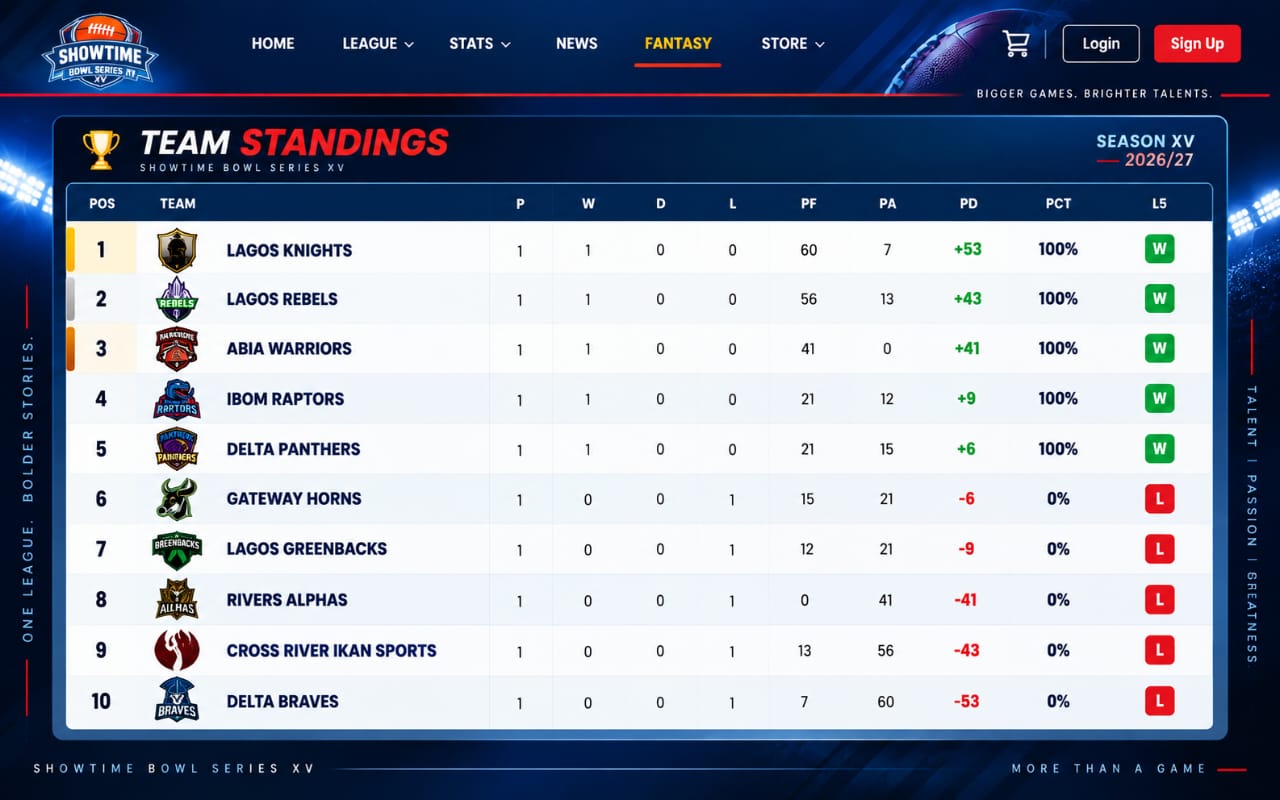
The opening week of SHOWTIME Bowl Series XV delivered exactly the kind of beginning the new season needed, combining huge victories, individual brilliance and a competitive battle that offered an early glimpse of the stories likely to shape another fascinating campaign at Showtime Arena.
With Lagos Knights opening their title defence in devastating fashion, Lagos Rebels producing a 56-point offensive showcase and Ibom Raptors emerging from a much tighter contest, Week One was not simply about collecting victories. It was also about players beginning to build their identities, teams establishing early standards and SHOWTIME’s expanding statistics and player-rating system giving supporters another way to understand who truly influenced each game.
Defending champions Lagos Knights produced the biggest victory of the week, defeating Delta Braves 60-7 in an emphatic start to their campaign. The Knights, who captured their first SHOWTIME Bowl championship last season, immediately demonstrated that the celebrations have not reduced their appetite for success.
At the centre of the performance was Kayode Mafe. The Season XIV MVP started the new campaign with another commanding display and was rewarded with a perfect 10.0 rating. Mafe repeatedly unlocked the Delta defence, connecting with several receivers for touchdowns as the Knights built a commanding advantage.
But perhaps one of the most significant developments for Lagos was the performance of Anyaorah Lotanna, who also received a 10.0 rating. Lotanna repeatedly connected with Mafe for touchdowns, giving the champions another major attacking weapon and showing why individual player tracking could become one of the most compelling features of Series XV.
Fatai Praise, rated 7.7, was another strong performer for the Knights, while Delta Braves will have plenty to assess after a difficult opening assignment. The 60-7 result gives Lagos an explosive beginning, but with the season still young, it is only the first chapter of their title defence.
If the Knights delivered the biggest score, Lagos Rebels were not far behind.
The Rebels overwhelmed Cross River Ikan Sports 56-13, with two more players joining the Week One perfect-rating club. Fawaz Azeez and Sulaimon Alhameen both received 10.0 ratings, reflecting their influence on an attacking performance that repeatedly stretched the Cross River defence.
Alhameen orchestrated much of the damage from quarterback, while Fawaz emerged as a devastating scoring target. The combination repeatedly produced touchdowns and quickly turned the contest in Lagos Rebels’ favour.
There was quality around them too. Divine Eric recorded an 8.4 rating, Mofeoluwa Akinrinmade finished with 8.3, Ruth Chilaka earned 7.7 and Onyinye Udueze registered 7.5, demonstrating the number of contributors behind the Rebels’ opening victory.
Cross River Ikan Sports may have suffered defeat, but Abayomi Agbayewa’s 7.4 rating provided one of the positives from their opening appearance. The challenge now will be turning individual bright moments into greater consistency as Series XV develops.
The week’s closest contest came between Ibom Raptors and Lagos Greenbacks, and it provided a very different test.
Ibom Raptors emerged with a 21-12 victory, although the play-by-play data supplied from the SHOWTIME match page records scoring sequences reaching 21-14, meaning the published final score and detailed match log appear to contain a discrepancy that may require clarification. The official result graphic lists the game as 21-12.
What is not in doubt is that this was a much more competitive encounter than the week’s two major blowouts.
Taiwo Oluwalanu, the Raptors quarterback, received the team’s highest rating at 7.5, while Aisha Raji Oluwatosin earned 7.0 and Moyosore Adolphus 6.6. Lagos Greenbacks defender Precious George recorded 7.6, the highest displayed rating across the Greenbacks, after making her presence felt defensively, including several pass break-ups. Emmanuel Ojirinnaka also recorded a strong 7.0 rating.
Taken together, the three results produced an intriguing opening picture: Lagos Knights and Lagos Rebels supplied the fireworks, while Ibom Raptors showed they can navigate a considerably tighter contest.
But perhaps the most exciting part of Week One was the emergence of the perfect 10.
Kayode Mafe. Anyaorah Lotanna. Fawaz Azeez. Sulaimon Alhameen.
Four players, across two different teams, beginning Series XV with the maximum displayed rating.
That gives SHOWTIME something increasingly valuable as the league grows: identifiable stars backed by visible performance data. Supporters are no longer limited to knowing who won and lost. They can follow player ratings, positions, match events and individual performances, creating debates around who was outstanding, who is improving and who could become the next major name in Nigerian flag football.
It also matters commercially. Sponsors looking at SHOWTIME are not simply seeing teams playing matches; they are seeing athletes with individual identities, measurable performances and stories that can be followed throughout a season. Every touchdown, interception, rating and breakout performance creates another opportunity to market the athletes and deepen the connection between players, supporters and brands.
That is why Series XV could become an important season for the league. SHOWTIME has already built a dedicated home for the competition at Showtime Arena, while its digital platform now gives supporters access to results, statistics, player ratings, play-by-play information, standings and other parts of the competition from beyond the venue.
Week One demonstrated what can happen when those pieces come together.
There were 137 combined points across the three official final scores, two enormous statement victories, one hard-fought contest and four perfect individual ratings. More importantly, there are already personalities and performances for supporters to follow into Week Two.
For the Knights, the question is whether Mafe and company can maintain the ruthless standards of their championship season. For the Rebels, their 56-point opening performance has provided an early indication of their attacking potential. For the Raptors, an opening victory provides something valuable to build upon. Delta Braves, Cross River Ikan Sports and Lagos Greenbacks now have an opportunity to respond.
One week cannot define a season, but it can certainly introduce it.
SHOWTIME Bowl Series XV has introduced itself with points, personalities and perfect 10s — and if Week One is the opening act, there is already plenty to watch when the action returns to Showtime Arena.

GCR Ratings has upgraded Fidelity Bank Plc‘s national-scale long-term issuer rating to A Plus (NG) from A (NG), while affirming its short-term issuer rating at A1 (NG). The outlook remains stable.
The upgrade reflects Fidelity Bank’s significantly strengthened capital position following the addition of NGN227.0 billion to its total core capital. GCR also recognised the bank’s strong domestic market position, stable funding base and healthy liquidity profile.
Fidelity Bank’s competitive position remains a key rating strength, supported by its strong domestic franchise and nearly four decades of operating experience. With total assets of NGN10.5 trillion and an estimated 8.0 per cent share of the banking industry’s gross loans as of December 2025, the bank ranks as Nigeria’s sixth-largest bank.
The bank also plans to leverage its international banking licence to enter three additional African markets over the medium term. The expansion is expected to diversify its country exposure and further strengthen its competitiveness among rated peers.
Fidelity Bank raised NGN227.0 billion in additional equity capital in 2025, enabling it to fully comply with the revised capital requirement for its licence category. The capital was officially recognised as the core capital in 2026.
Consequently, the bank’s GCR core capital ratio increased substantially to 29.4 per cent at the end of March 2026, from 17.2 per cent in December 2025. Its stage three loan loss reserve coverage also remained strong at more than 100.0 per cent.


GCR expects the bank’s core capital ratio to remain above 20.0 per cent over the outlook period, supported by good earnings retention. The rating agency also noted that Fidelity Bank’s exposure to the oil and gas sector is diversified across the upstream, downstream and services segments. Foreign currency exposure is further moderated through natural hedging.
Fidelity Bank’s funding profile remains positive, underpinned by a large and stable deposit base. Customer deposits grew by 16.1 per cent as of December 2025 and by a further 7.1 per cent as of March 2026, reaching NGN7.4 trillion.
Customer deposits accounted for 89.5 per cent of the bank’s total funding base in March 2026. Approximately 90 per cent of these deposits were held in relatively inexpensive current and savings accounts, providing a strong foundation for sustainable funding.
READ ALSO: Fidelity Bank gets extension to publish H1 2026 audited results
The bank also maintained a robust liquidity position, supported by a substantial portfolio of liquid assets. Its liquid assets-to-customer deposits ratio stood at 56.9 per cent in March 2026, while liquid assets covered wholesale funding by 4.8 times.
The stable outlook reflects GCR’s expectation that Fidelity Bank will maintain a strong financial profile, with its core capital ratio remaining above 20.0 per cent, supported by stable funding, strong liquidity and resilient asset quality indicators.
Discover more from Premium Times Nigeria
Subscribe to get the latest posts sent to your email.
-

 Business2 days ago
Lingzhi Global, NACOFTAN Announce 2026 Coffee Festival in Cross River
-
Events2 days ago
Peace Walk: WOPPI Urges Plateau Citizens to Invest in Peace Every Day
-
Business4 days ago
Tinubu reacts as Nigeria wins arbitration against Sunrise Power
-
News4 days ago
Why I refused to join APC – Seriake Dickson