
News
Yelp’s updated AI assistant can answer questions and book a restaurant or service in one conversation

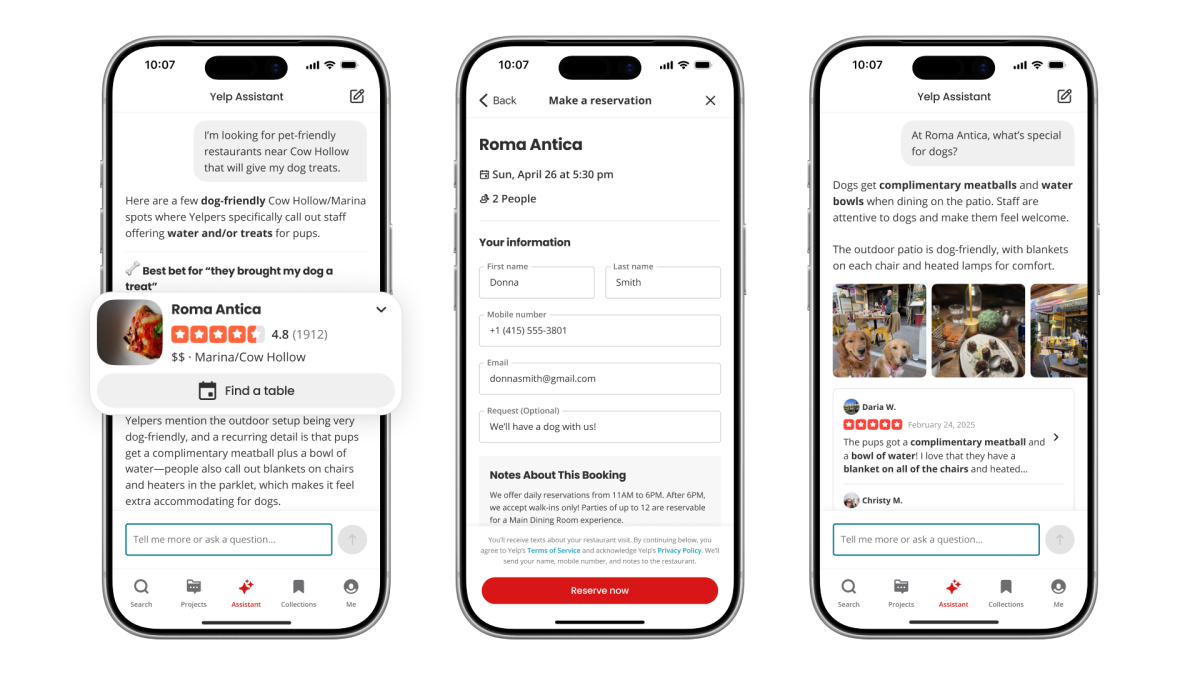
For years, existing consumer platforms have tried to keep users within their app by offering more services. After the rise of the AI chatbot, the trend is to have people use the assistant for both queries and actions without leaving the conversational flow. With its latest update, Yelp is letting people ask questions, get restaurant reservations, order food delivery, and book service professionals, all through its updated AI assistant.
The company debuted the AI assistant in 2024 to help people search for different services based on their problem. It is now using the platform data paired with an AI assistant to let users do more tasks.
In a demo seen by TechCrunch, the company’s SVP of product, Akhil Kuduvalli Ramesh, searched for hiking places to go with a dog without a leash; looked for takeout places along the way, with an option to place an order on Doordash; looked for restaurant recommendations for a weekend plan, with an option to check out availability and book a table; and queried about painting a friends’ new Victorian house without leaving the chat.
“We would really like consumers to reconceive Yelp as a place where they can ask questions and get answers, not just that, but also complete the action. That’s Yelp reconceiving from a review platform to an answers and action platform,” he told TechCrunch over a call. “Some of the investments we’re making will be in that lane.”
Users can select a specific page for a restaurant or service when they tap on it, or ask more questions about the business. Yelp said that as the knowledge is grounded in details of the business on the platform, the business’s website, and user reviews, there is a scant chance of getting wrong answers.
The company is hosting the assistant in a new tab in the app, which is now placed in the center of the bottom navigation bar, so users are likely to visit it more often. The assistant will be available on iOS and Android at launch and will work with eligible business pages, including restaurants, retail shops, and attractions. The company said that the desktop version and rollout across all kinds of businesses are slated for later in the year.
Apart from fetching information, Yelp also announced integration with external providers to complete an action, like place an order or appointment. Users can now order food through DoorDash and Grubhub, book fitness or beauty appointments through Vagaro, a doctor’s appointment through ZocDoc, and a car repair through Repairpal. Plus, it also offers a Calendly integration for other kinds of businesses that allow appointment booking.
Techcrunch event
San Francisco, CA
|
October 13-15, 2026

Notably, all these actions will lead you to a specific provider’s app or page, meaning this is not “agentic” in nature, where the entire transaction is completed within the chat window. Kuduvalli mentioned that while the redirections are the way Yelp is set up now, it might not “remain that way” in the future.
However, it’s hard to say how agentic pipelines might work with other services for cases when the user doesn’t specify whether they want to order food through DoorDash or Grubhub.
Besides the new AI assistant, Yelp is rolling out a few quality-of-life updates to the app. Last year, it launched the ability for people to scan a menu and see what dishes look like through photos other users posted. Now, users can look at those dishes within the app as they are scanning a menu.

What’s more, Yelp said that users will be able to search the media gallery of a business using natural language queries instead of keywords. Plus, the company will offer an AI-powered tagging and grouping feature for before and after photos to business owners to avoid manual work.
News
IASC PatrickLingo Super League 2026: Jendol Set to Sell Zudachi a Defeat as Construction Giants Threaten to Demolish Superstores; Remed Prepare Bitter Medicine for Daily Manna!

The Island AllStars PatrickLingo Super League 2026 returns with a mouthwatering Matchweek 4 on Saturday, October 24, as Jendol Superstores prepare to shut down Zudachi Construction’s championship project, while Remed Healthcare hope to prescribe bitter medicine to Daily Manna Global at the Lagos Business School Sports Arena.
The opening encounter at 8:30 a.m. promises fireworks as Remed Healthcare attempt to cure their inconsistent form against a Daily Manna side desperately searching for its first victory.
Remed began their campaign with a painful 4–2 defeat to Zudachi before administering a 1–0 treatment to Wellborn Hotels. Having enjoyed their Matchweek 3 rest day, the healthcare boys return refreshed and ready to write another winning prescription.
But Daily Manna are not coming to the hospital for treatment. The bakery boys are arriving with freshly baked football surprises!
After losing their opener to Wellborn, Daily Manna shared points with Jendol before serving Zudachi a hot stoppage-time equaliser through Sky-P’s penalty in a thrilling 2–2 draw.
However, the biggest fireworks are reserved for the 10:30 a.m. top-of-the-table blockbuster between Jendol Superstores and Zudachi Construction.
Jendol have become the hottest supermarket in town after checking Wellborn Hotels out with a stunning 3–1 victory, inspired by Chibuike’s brilliant brace.
Now, the supermarket boys want to stock their shelves with another three points and put Zudachi’s championship ambitions on clearance sale!
But Zudachi are no ordinary builders. The construction giants have laid an unbeaten foundation, collecting four points from two matches, and are determined to prevent Jendol from demolishing their position at the summit.
Meanwhile, Wellborn Hotels will enjoy their scheduled rest day, perhaps using the break to renovate their leaking defence after two consecutive defeats.
Sponsored by PatrickLingo Pharmaceuticals Limited, the competition continues to celebrate football, friendship, fitness and sportsmanship.
Will Jendol close Zudachi’s construction site, or will the builders demolish the supermarket? Can Daily Manna serve Remed a winning breakfast?
Saturday will provide the answers!

-

 News19 hours ago
Obi, Kwankwaso to hold Middle Belt Youth, Village Hall Meeting in Jos
-
News3 days ago
Meta’s Muse hits 10M U.S. downloads in 40 days, a milestone reached by only 11 other apps
-
Business3 days ago
How Your Side Hustle Income Ends Up in Your RSA
-
Business4 days ago
Mbah Rebuilds Technical College, Prepares Enugu Youths for Tech-Driven Future


