Connect with us

News

WAFCON 2026: Oshoala Wants Bigger Crowds, Charges CAF on Awareness as Super Falcons Chase Record 11th African Title in Morocco

info

Published

on

WhatsApp Image 2026 07 17 at 5.30.48 AM.jpeg

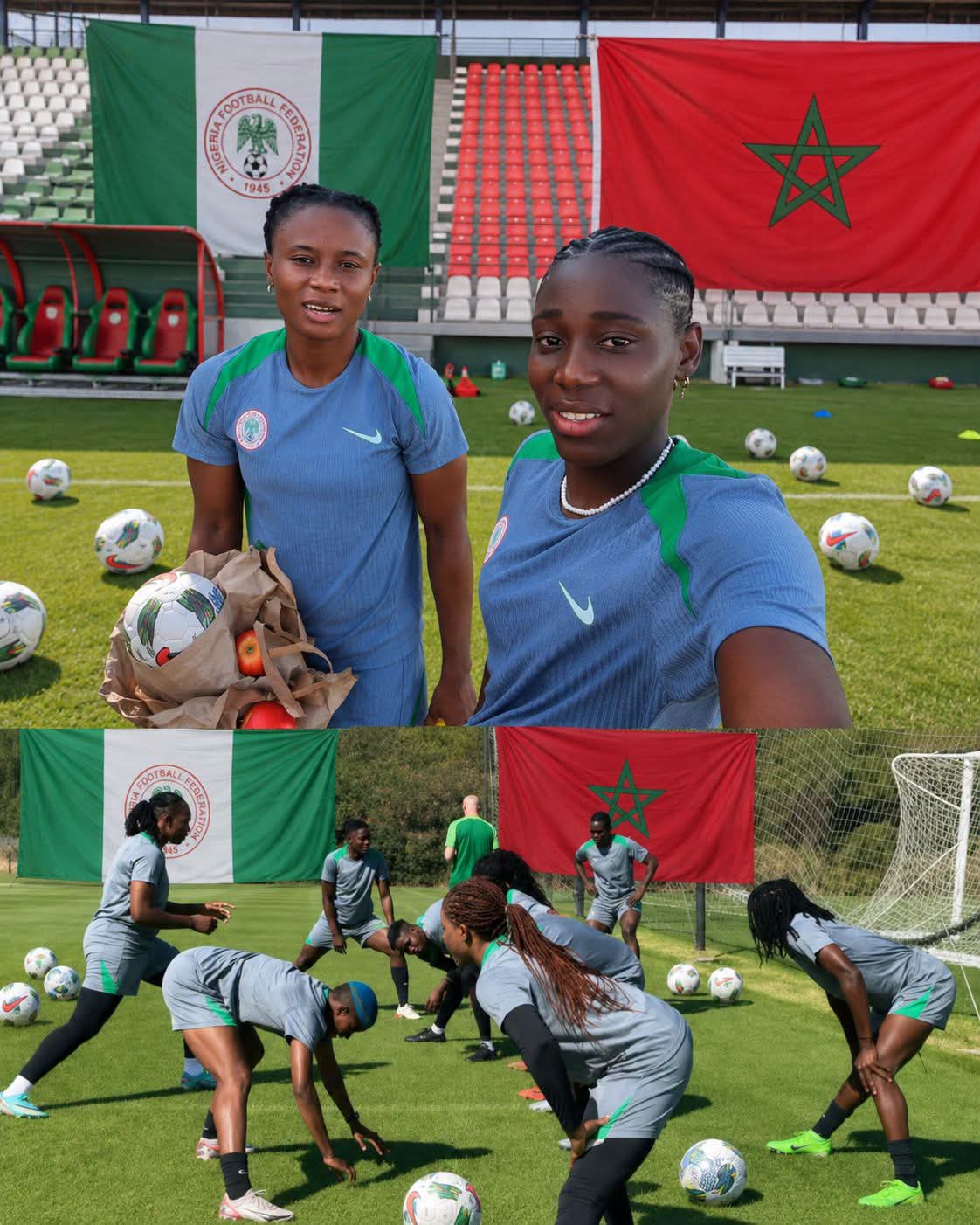
Six-time African Women’s Player of the Year Asisat Oshoala has expressed her desire to see larger crowds at the 2026 Women’s Africa Cup of Nations (WAFCON), saying stronger fan support will reflect the continued growth of women’s football across Africa.

READ ALSO: Asisat Oshoala Delivers Verdict On African Women’s Football: ‘The Best Is Still To Come’

The Super Falcons forward, who has featured in multiple WAFCON tournaments, believes this year’s championship in Morocco should demonstrate significant progress both on and off the pitch as Nigeria targets a record-extending 11th continental title.

Speaking during a CAF Media Stars Spotlight session, Oshoala described the tournament as a competition worth fighting for despite Nigeria’s long-standing dominance in African women’s football.

“I am looking forward to Nigeria winning it again. It’s something to always fight for, but I feel like each edition there has to be a form of improvement on and off the pitch,” Oshoala said.

“I really want to see more fans out there. It has to be better than the previous editions. More promotion of this tournament will help spread awareness about African women’s football.”

The 31-year-old is among the early arrivals at Nigeria’s training camp in Casablanca, where head coach Justine Madugu’s squad is preparing for the tournament, scheduled to run from July 25 to August 16 in Morocco.

Oshoala, who lifted the WAFCON trophy with Nigeria in 2014, 2016, 2018 and 2024, also reflected on her international career, highlighting how her experiences in Europe and North America have shaped her development.

“It’s been an amazing journey for me personally, having experienced all of this and played on different continents. It’s been pretty impressive, but there is always room for improvement,” she added.

The Super Falcons have been drawn in Group C alongside Malawi, Zambia and Egypt, and will begin their campaign against tournament debutants Malawi in Rabat on July 28.

In addition to competing for continental glory, Nigeria will also be aiming to secure qualification for the 2027 FIFA Women’s World Cup in Brazil.

The four semi-finalists will qualify automatically, while the best-performing quarter-finalist will advance to the inter-confederation play-offs.
Continue Reading
Click to comment

Leave a Reply

Your email address will not be published. Required fields are marked *

News

ADC rejects ICPC interim report on alleged fake PFIPC

info

Published

on

By

ADC 2.jpg

The African Democratic Congress (ADC) has rejected the interim report of the Independent Corrupt Practices and Other Related Offences Commission (ICPC) on the alleged fake Presidential Foreign Intervention Promotion Council (PFIPC), describing the report as “predictable and inadequate.”

In a press statement issued on Saturday, August 8, 2026, and signed by its National Publicity Secretary, Mallam Bolaji Abdullahi, the opposition party accused the Federal Government of being more interested in managing the political fallout from the scandal than conducting a comprehensive investigation.

The ADC said the ICPC report failed to provide satisfactory answers to how an organisation that the government now describes as fictitious was able to obtain federal office space, have civil servants deployed to it, receive official vehicles and security support, and secure a reported N1.3 billion allocation in the 2026 federal budget.

The party argued that the development could not reasonably be explained as a mere administrative error or failure of government procedures.

“What has happened is a national disgrace in the full glare of the entire world. No serious government should be satisfied with identifying one culprit for prosecution,” the ADC said.

According to the ADC, the commission’s findings appear to focus on the alleged actions of an individual rather than investigating the government officials and institutions that may have enabled the purported fake agency to operate within official structures.

“What Nigerians expected was an investigation into how a ‘fictitious agency’ managed to obtain all authorisations and institutional support required to operate as a legitimate government agency,” the statement said.

The ADC further questioned how Adeyemi could have independently secured office accommodation within the Federal Secretariat, obtained the deployment of civil servants, received official vehicles with customised number plates and accessed armed security if the organisation had no legitimate government approval.

The party said these issues raised serious questions about the effectiveness of government verification and oversight systems.

The ADC also expressed concern over reports that the ICPC had uncovered two additional fictitious organisations allegedly linked to Adeyemi.

“If an investigation into one fake government agency leads investigators to two more, then the obvious question is no longer merely how one individual perpetrated an elaborate fraud. The question is how has this administration operated that made such systemic criminality possible?” the party stated.

On the alleged forged appointment letter bearing the signature of the President’s Chief of Staff, the ADC said establishing that the document was forged did not explain how the alleged deception passed through several layers of government.

The party queried the lack of verification of the existence of PFIPC before civil servants were deployed to it. It asked for identification of those who authorised its accommodation in a federal facility and processed its dealings with other government institutions.

The N1.3 billion budgetary provision was identified by the ADC as one of the most significant issues requiring clarification.

The party said budget allocations normally involve proposals, approvals, documentation and audit trails, and therefore urged investigators to establish who proposed the allocation, who processed it, who verified the beneficiary agency and how an organisation that the Presidency says never existed was able to appear in the Appropriation Act.

The ADC also noted that the National Assembly had commenced an investigation into how PFIPC was included in the federal budget.

“To prosecute Mr. Adeyemi without answering these questions would be to punish the man who entered through the window while refusing to ask who left the doors open,” the party said.

The ADC called for the immediate publication of the full ICPC interim report and demanded that any public official whose actions or negligence enabled the alleged fictitious organisations to acquire official legitimacy should be identified and held accountable if wrongdoing is established.

The party maintained that Nigerians were not asking the government to manufacture culprits, but rather to follow the evidence wherever it leads.

“Anything short of this, this so-called investigation, will remain what it presently appears to be: an exercise designed less to discover the truth than to contain the historic embarrassment,” the party said.

Continue Reading

News

Nigeria Seeks China’s Partnership On Water-saving Agriculture, ICT

info

Published

on

By

IMG 7867.jpeg


Cutting the ribbon to officially open the “Seasonal Life & Harmonious China” Cultural Exhibition at the China Cultural Centre, Abuja, on Saturday. (NAN)
 

By Sarafina Christopher

Nigeria has sought deeper cooperation with China in water-saving agriculture, soil management and scientific research to address agricultural challenges in the northern part of the country and the Lake Chad basin.

Dr Mukhtar Muhammed, Permanent Secretary, Federal Ministry of Innovation, Science and Technology, made this known on Saturday at the “Seasonal Life and Harmonious China” Cultural Exhibition at the China Cultural Centre in Abuja.

Muhammed said Nigeria could draw lessons from China’s experience in using science and technology to improve agricultural productivity in areas affected by water scarcity and land degradation.

He said his recent technical visit to China, particularly the Yangling High-Tech Agricultural Demonstration Zone in Shaanxi Province, had demonstrated the potential of applying scientific innovation to Nigeria’s agricultural challenges.

“In Yangling, often referred to as China’s ‘Agricultural Silicon Valley’, we witnessed the seamless integration of modern technology with traditional farming.

“For example, we observed advanced water-saving irrigation systems and soil monitoring technologies that allow farmers to cultivate crops in arid conditions with minimal water wastage,” he said.

According to him, the experience was particularly relevant to Nigeria’s efforts to address land degradation and improve agricultural productivity in the northern part of the country.

“Seeing how China has successfully combated land degradation and improved agricultural productivity in the Loess Plateau is a powerful inspiration for our efforts in Northern Nigeria and the Lake Chad region,” Muhammed said.

He said the ministry would seek stronger collaboration between Nigerian and Chinese ministries of science and technology, research institutions, universities and industries.

Muhammed said the proposed cooperation would focus on practical areas including sustainable agriculture, water management, agro-processing and scientific research.

He also said Nigeria planned to expand scholarships and science, technology, engineering and mathematics (STEM) training for Nigerian scientists in Chinese universities, particularly in sustainable agriculture and water management.

The Permanent Secretary linked the proposed scientific cooperation to the growing economic relationship between both countries, particularly China’s expanded market access for African agricultural products.

He said Nigeria needed to strengthen its scientific and technological capacity to ensure that increased access to the Chinese market translated into tangible benefits for farmers and the wider economy.

“We must see this as a starting point. The policy does not just facilitate exports; it forces us to level up,” Muhammed said.

He said Nigeria would also seek Chinese technology transfer to strengthen agro-processing and move the country from exporting raw commodities to value-added products.

Muhammed also identified cassava, shea butter and cashew nuts as among the commodities that could benefit from improved processing technology for the Chinese and global markets.

Mr Yang Jianxing, Director of the China Cultural Centre in Nigeria, said China remained committed to strengthening people-to-people exchanges with Nigeria as part of efforts to deepen the bilateral partnership.

Yang said cultural cooperation provided an important platform for mutual learning between both countries, noting that the facility would continue to promote exchanges in culture, education, youth affairs, tourism and other areas.

“Cultural exchange is a vital component of China-Africa friendly cooperation.

“It serves as an important bridge for fostering mutual understanding and affinity between our peoples, as well as for promoting dialogue and mutual learning among civilisations,” he said.

He said the centre would continue to implement the outcomes of the 2024 Forum on China-Africa Cooperation (FOCAC) Beijing Summit and agreements reached by the leaders of Nigeria and China.

The director added that it would  expand programmes that bring the peoples of both countries closer.


The News Agency of Nigeria (NAN) reports that the  exhibition marked the China-Africa Year of People-to-People Exchanges and the 55th anniversary of China-Nigeria diplomatic relations.

The event featured displays on the Twenty-Four Solar Terms, traditional Chinese cuisine, intangible cultural heritage crafts and interactive cultural activities.(NAN)
Edited by Mark Longyen

Continue Reading

Trending