By Muhyideen Jimoh, News Agency of Nigeria (NAN)
Upon assuming office in May 2023, President Bola Tinubu inherited a Nigerian economy contending with a severe combination of cascading crises.
These predicaments ranged from crippling fuel subsidies and multiple exchange rates to declining revenues, rising debt-servicing costs, insecurity and weak investor confidence.
To prevent further economic collapse, the administration opted for difficult reforms, including the removal of the petrol subsidy and the unification of the foreign exchange market, arguing that delaying action would have pushed the country deeper into an economic crisis.
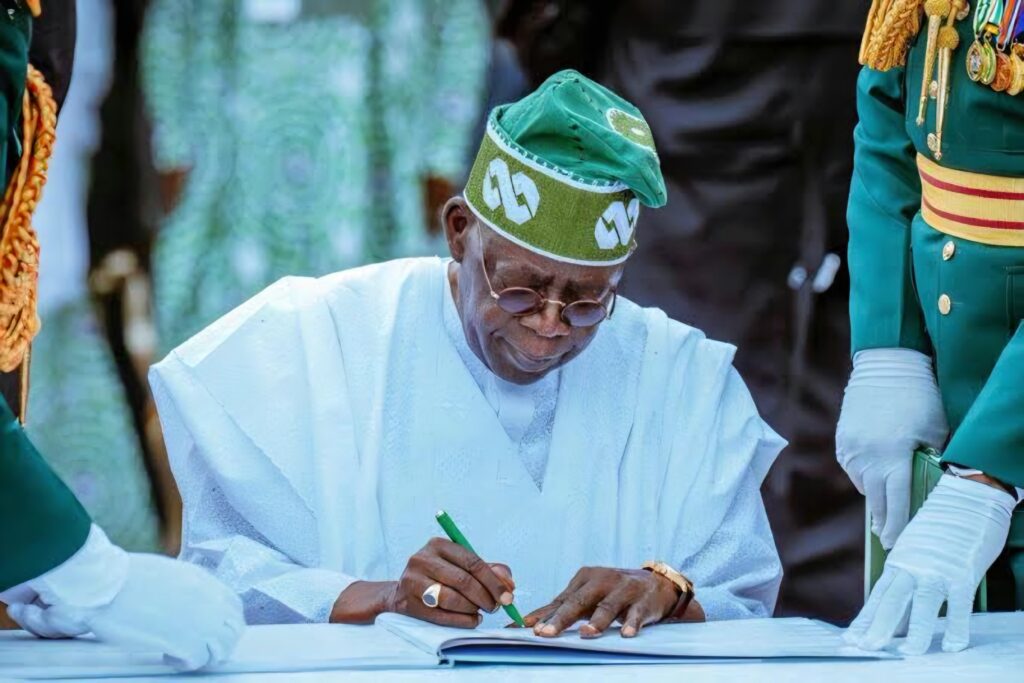
Tinubu succinctly captures it in his third anniversary address.
“At the height of the subsidy regime, Nigeria was spending as much as N18.4 billion daily to sustain petrol subsidies.
“Over N4 trillion was spent in 2022 alone, resources that could have been invested in roads, healthcare, education, housing and critical infrastructure.
“Multiple exchange rate windows and forex arbitrage created massive distortions, with Nigeria losing more than N8 trillion over three years to rent-seeking and speculative practices,” he said.
Though the reforms triggered sharp increases in living costs and tested the patience of many Nigerians, the government insists the sacrifices are beginning to yield measurable gains.
Policy analysts say one of the clearest indicators is improving competitiveness and renewed investor confidence.
The Nigerian stock market has witnessed significant growth, with market capitalisation rising from about N30 trillion in 2023 to N160 trillion in 2026.
Public finances have also improved, enabling states and local governments to access larger allocations for developmental projects and social services.
Mr Taiwo Oyedele, the Minister of Finance and Coordinating Minister of the Economy, said Nigeria was steadily moving from a phase of economic stabilisation to growth.
“We have seen moderation in inflation; we have seen the foreign exchange rate stabilise; and, in fact, steady appreciation over the past couple of years; we have also seen growth, modest growth, but increasing.
“So, we believe that we are now at a point where we are moving from stability to growth,” Oyedele said.
Across the country, observers say massive infrastructure projects are changing the landscape, with more than 2,700 kilometres of highways and major roads under construction, reconstruction or rehabilitation.
The Minister of Works, Sen. Dave Umahi, highlighted critical road projects.
He said the Federal Government was executing legacy highway projects designed to improve connectivity and boost socio-economic development across the six geopolitical zones.
The projects include the 750km Lagos-Calabar Coastal Highway, 1,068km Sokoto-Badagry Super Highway, Calabar-Abuja Superhighway, 482km Trans-Saharan Road and 439km Akwanga-Jos-Bauchi-Gombe Road.
Umahi said the Sokoto-Badagry Super Highway would be a game-changer for the economy.
“This highway will unlock economic opportunities and strengthen movement of people and goods across states,” the minister said.
Analysts say projects such as the Lagos-Calabar Coastal Highway, Abuja-Kaduna-Zaria-Kano Road and East-West Road are expected to enhance connectivity, stimulate trade and create thousands of jobs, while rail modernisation initiatives are advancing economic integration across the federation.
In the oil and gas sector, reforms have attracted fresh investments worth billions of dollars, while the nearing completion of the five-billion-dollar NLNG Train 7 project, expansion of domestic gas utilisation and increased local refining capacity are improving energy security.
In addition, the power sector, long constrained by debt, weak infrastructure and inadequate investment, is also receiving renewed attention through transmission upgrades, renewable energy initiatives and efforts to stabilise the national grid.
It is worth noting that agriculture remains central to the administration’s economic agenda.
Millions of farmers have benefited from interventions covering improved seedlings, fertiliser distribution, mechanisation, irrigation and expanded access to finance.
The Minister of Agriculture and Food Security, Sen. Abubakar Kyari, said government interventions were focused on achieving food security and reducing dependence on food imports.
“We are investing in mechanisation, irrigation, improved seedlings and access to finance because agriculture remains critical to economic diversification and national food security.
“The goal is to increase productivity, reduce food inflation and improve farmers’ incomes across the country,” Kyari said.
Analysts say the opening of new agricultural corridors is expected to boost food production, strengthen supply chains and reduce pressure on household incomes.
What’s more, stakeholders in the education sector acknowledge that notable progress has been made through the Nigerian Education Loan Fund.
Available data indicates that NELFUND has provided more than 1.5 million students access to higher education, with over N282 billion disbursed to beneficiaries.
In addition, the housing sector has also gained momentum under the Renewed Hope Housing Programme and Federal Housing Authority projects, with more than 10,000 housing units under development across 14 states and the FCT, generating over 300,000 jobs and stimulating construction activities.
In healthcare, thousands of primary healthcare centres are being revitalised, while health insurance coverage continues to expand for vulnerable Nigerians.
More so, the telecommunications sector is witnessing renewed confidence as a result of ongoing reforms.
Sector experts say the reforms resulted in expanded network coverage and deepened digital connectivity nationwide.
The aviation sector has also benefited from reforms aimed at modernising airport infrastructure, improving operational efficiency and restoring investor confidence.
The Minister of Aviation and Aerospace Development, Festus Keyamo, was upbeat.
“Our focus is to modernise airport infrastructure, strengthen safety standards, attract investment and make Nigeria a major aviation hub in Africa,” he said.
For many Nigerians, the most sensitive area remains security.
While terrorism, banditry, kidnapping and other criminal activities persist in some parts of the country, security agencies have intensified operations and recorded gains in several communities and major transport corridors.
The National Security Adviser (NSA), Nuhu Ribadu, said security agencies were recording significant successes through coordinated operations.
“While challenges remain, we are seeing improved collaboration among security agencies, better intelligence gathering and increasing pressure on criminal elements across different parts of the country,” Ribadu said.
Security experts hold the view that smart policing is pivotal to tackling Nigeria’s hydra-headed security challenges.
“Enhanced investments in intelligence, surveillance technology, logistics and inter-agency collaboration are gradually improving the state’s capacity to confront emerging threats,’’ a security analyst said.
Nonetheless, the administration acknowledges that significant challenges remain—namely inflation, unemployment, and insecurity—underscoring the need to translate macroeconomic gains into tangible improvements for Nigerians.
Yet, three years into the Renewed Hope Agenda, supporters argue that Nigeria is witnessing the early signs of a turnaround driven by economic reforms, infrastructure expansion, human capital development and renewed investor confidence.
For policy pundits, whether the gains ultimately meet public expectations may depend on how effectively the administration consolidates current progress and ensures that the dividends of reform reach ordinary Nigerians in the years ahead. (NANFeatures)
Edited by Chijioke Okoronkwo
***If used, please credit the writer and the News Agency of Nigeria.






 News3 days ago