Connect with us

News

“This Tragedy Will Not Happen Again” — Bola Tinubu Assures Plateau Victims During Jos Visit

info

Published

on

IMG 20260402 WA0158 720x380 1.jpg

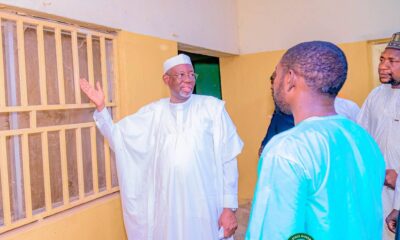
President has reassured victims of the recent attack in Jos, that such a tragedy will not occur again, pledging the Federal Government’s resolve to restore lasting peace and security.

The President gave the assurance on Thursday while addressing stakeholders during a visit to Jos, following the deadly Palm Sunday attack in Angwan Rukuba that claimed 28 lives after gunmen struck the community.

Speaking to political leaders and affected residents, Tinubu expressed deep sympathy and emphasized the government’s determination to prevent a recurrence.

“There’s nothing I can give you, whether money in millions, but to console you and promise that this experience will not repeat itself,” he said.

He further stressed the need for unity and a return to the peaceful identity Jos was once known for, noting that government efforts would focus on rebuilding trust and stability.

Tinubu also highlighted that both he and Plateau State Governor, , were elected to deliver prosperity and inclusive governance, not grief and loss.

“We were elected to bring prosperity, not to console and create widows and widowers, but to fulfill the hopes and aspirations of our people,” he stated.

Reaffirming his commitment, the President said his visit was not only to sympathize but to ensure concrete steps toward lasting peace, particularly for the younger generation.

The attack has intensified concerns over security in , with renewed calls for decisive action to end recurring violence in the region.

Continue Reading
Click to comment

Leave a Reply

Your email address will not be published. Required fields are marked *

Health

Residents decry shortage of doctors, infrastructure in Taraba hospitals

info

Published

on

By

Taraba State map.png

MTN ADVERT

Residents of Taraba have decried the shortage of qualified doctors and the infrastructure deficit in the state’s general hospitals.

Some residents told the News Agency of Nigeria (NAN) on Monday in Jalingo that the situation was affecting the quality of service delivery.

Yerima Ato, a resident of Wukari town, particularly said that there was no qualified doctor stationed at the general hospital in Wukari.

Mr Ato, who alleged that doctors were being hired from other places to provide skeletal services at the general hospitals, noted that such arrangements were gravely affecting service delivery.

“To my knowledge, doctors are being hired from the Federal Medical Centre, Jalingo, to cover up for the shortage of doctors in the general hospitals.

PT WHATSAPP CHANNEL

“There was a time I was scheduled for surgery at the general hospital, but I had to wait for the doctors to come from the FMC.

“So, the same doctors you find at the FMC that you find in the general hospitals,” he said

Speaking, Hajara Thomas said that the situation was not different in general hospitals in Takum, Ussa, Gassol, Takum, Gashaka, Bali, among other local government areas of the state.

READ ALSO: PT HEALTH WATCH: Delayed treatment of childhood cataracts can lead to irreversible vision loss – Expert

She called on the state government to recruit more doctors to enable residents to access quality services at the general hospitals and primary healthcare centres.

On his part, a health expert, John Mayo, decried the infrastructure deficit in most of the hospitals.

Mr Mayo noted that the dilapidated condition of facilities at the public hospitals in the state was not motivating to medical workers.

He, however, commended Governor Agbu Kefas for the renovation of some general hospitals in the state.

(NAN)


Continue Reading

News

How Grassroots Academies Are Powering Nigerian Sport

info

Published

on

By

WhatsApp Image 2026 06 06 at 10.31.54 PM.jpeg

Across dusty estate pitches, school fields and floodlit five-a-side cages, a quiet revolution has been reshaping Nigerian sport. Grassroots academies, once informal gatherings run on passion and little else, have grown into structured talent factories that feed clubs at home and across Europe.

The Nigeria Football Federation now treats them as serious partners in player development, and the proof is turning up on team sheets from the NPFL to the Premier League.

That rise has not gone unnoticed beyond the touchline. As more academy graduates break into top leagues, the global audience following Nigerian talent has swelled, and supporters tracking those players abroad increasingly lean on comparison and review platforms such as Betiton to size up the best betting sites covering the Premier League and European football. The interest underlines a simple point: the pipeline starts on Nigerian soil, long before any scout or online betting market takes notice.

From street pitches to structured academies

Football arrived in Nigeria during the colonial era and never let go. For decades the country produced talent the hard way, on uneven streets and bare patches of ground where ball control was a survival skill. What has changed is the scaffolding around that raw ability. Academies such as the Pepsi Football Academy, Real Sapphire and Lagos-based Mavlon FC turned street culture into something organised, with age-group teams, qualified coaching, fitness work and a clear pathway toward professional contracts. The shift has been less about discovering talent, which Nigeria has never lacked, and more about keeping it, shaping it and giving it somewhere to go.

A new academy model built on data and education

The best academies now look nothing like the kickabouts of a generation ago. Many integrate video analysis, performance data, structured mentorship and partnerships with overseas clubs, while pairing football with formal schooling so players have a future even if they never turn professional. International programmes have taken note of the depth of Nigerian talent: UK-based outfits such as FCV International Football Academy have run scholarship-backed trials in Lagos and Abuja that channel young Nigerians into European football, as reported by THISDAY. The emphasis has moved from producing raw ability to developing the complete athlete, technically, physically and mentally.

The talent the system is producing

The results are increasingly hard to ignore. Defender Benjamin Fredrick, born in 2005, is a textbook product of the modern Nigerian academy system. Discovered by the Simoiben Academy Foundation in Kaduna, he sharpened his close control on rough surfaces before a move to Brentford, where he won the club’s B-team Player of the Season award and earned a senior Nigeria call-up. He is one name among a growing list of Nigerian players plying their trade abroad, many of whom passed through a local academy before a single European scout learned their name. For every graduate who reaches the Premier League, dozens more strengthen the NPFL and the national youth teams.

The challenges still facing grassroots academies

Progress has not erased the obstacles. Funding remains tight, and infrastructure is uneven: talent-rich regions such as Kano still struggle for proper pitches, equipment and coaching support. Administration is another hurdle, with calls for clearer regulation and recognition so academies meet consistent standards. NFF President Ibrahim Musa Gusau has stressed that effective grassroots structures are vital to the country’s football future, and has pushed for a recognition process that aligns sporting development with education. Until that framework matures, much of the system will keep running on the dedication of individual coaches and founders.

Why grassroots academies matter for Nigerian sport

The stakes reach well beyond football. Strong grassroots academies give thousands of young people structure, mentorship and a route out of difficult circumstances, while feeding the talent that powers Nigerian sport on the continental and world stage. Their reach is now tracked everywhere, from professional scouting databases to comparison sites like Betiton, where fans follow the leagues these graduates join and weigh up live betting markets around them. Where betting features in that global interest, it remains strictly an adults-only activity, and responsible play matters. With a World Cup year on the horizon and a steady flow of academy graduates emerging, the foundations laid on Nigeria’s roughest pitches have rarely looked more important.

Continue Reading

Trending