News
Stakeholders Advocate Stronger Collaboration to Address Cross-Border Conflicts, Promote Inclusive Governance in Plateau Region


Stakeholders from Plateau and neighboring states have called for strengthened multi-sectoral collaboration, sustained dialogue, and practical policy reforms to curb rising cross-border conflicts and promote inclusive governance for sustainable peace across the region.
The call was made at the end of a two-day Multi-Agency and Multi-Sectoral Roundtable Discussion on Cross-Border Conflicts and Diversity Management Towards a Sustainable Peace Architecture in Plateau State, held from October 7–8, 2025, at Novel Suites, Jos.
The forum brought together representatives from security agencies, government ministries, traditional and religious institutions, civil society organizations, and international development partners to deliberate on strategies for managing border-related conflicts and fostering long-term stability.
Persistent Conflict Drivers Identified
In a communiqué read by Alhaji Ibrahim Sale Hassan, Senior National Expert Adviser, HD Nigeria, participants observed that violent conflicts in Plateau State are intricately linked to border disputes, ethno-religious tensions, and governance challenges involving neighboring states such as Bauchi, Kaduna, Nasarawa, and Taraba.
They identified key drivers of conflict to include farmer-herder clashes, land and boundary disputes, banditry, arms and human trafficking, drug trade, and the negative influence of social media. Other contributing factors noted were environmental degradation, socio-economic inequalities, and weak institutional coordination in managing border communities.
The meeting also raised concerns over the activities of transnational criminal groups and mercenaries, stressing the urgent need for stronger cross-border cooperation and effective implementation of the ECOWAS Protocol on Transhumance and Border Management.

Key Recommendations
On Cross-Border Management, stakeholders recommended:
- Continuous multi-stakeholder engagement to identify and address emerging security threats.
- Greater leadership from Deputy Governors in initiating structured frameworks for cross-border peacebuilding.
- Constitutional empowerment of traditional rulers to enhance local governance.
- Sustained dialogue and peaceful engagement in boundary demarcation areas.
- Support for the Federal Government’s establishment of forest guards to secure ungoverned spaces, following the Gashaka-Gumti model.
- Adoption of a people-centered approach to security by integrating environmental protection, healthcare, food security, and economic empowerment into peace strategies.
- Increased private sector participation in job creation, infrastructure, and border community development.
On Diversity Management, participants called for deliberate actions by leaders to promote inclusion, fairness, and equitable resource distribution. They also proposed a national rebranding campaign to foster unity and shared identity, alongside constitutional reforms that ensure justice and equity.
A gender and disability audit was further recommended to address the representation gap within the formal sector.
Acknowledgements and Next Steps
The communiqué acknowledged Humanitarian Dialogue (HD) Nigeria, in partnership with the Plateau State Peace Building Agency (PPBA) and with the support of GIZ, for facilitating the forum and sustaining dialogue on peacebuilding efforts across the state.
In his closing remarks, Dr. Ahmed Yassin, Lead Facilitator, HD Nigeria, commended the level of engagement among participants and emphasized that peacebuilding is a continuous process requiring partnership, inclusivity, and collective commitment.
“Dialogue is not a one-time event; it is a continuous process,” Dr. Yassin stated. “Violence is a shared threat, and therefore, we must work towards shared solutions. The next step is to broaden this engagement by bringing together deputy governors and stakeholders from neighboring states to jointly address these cross-border issues.”
The roundtable concluded with a reaffirmation of participants’ commitment to sustained dialogue and collaboration toward building a peaceful, inclusive, and resilient Plateau State and its neighboring regions.

News
Nigerian Teenage Stars Raheem Salaudeen, Fawas Adeleke Spark UK Scholarship Interest After Stunning Trial


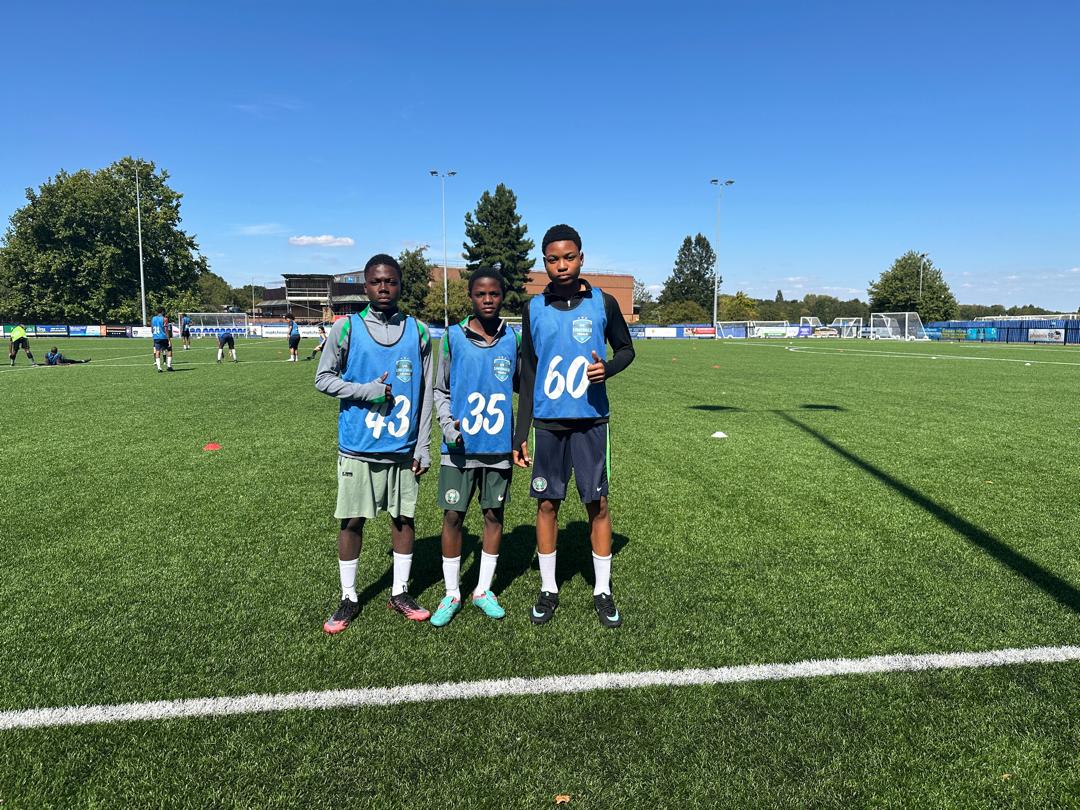
Two promising Nigerian midfielders, Raheem Moyinoluwa Salaudeen and Fawas Ayomide Adeleke, have attracted significant attention in the United Kingdom after impressing during a football trial, with both youngsters now being considered for scholarship opportunities that could combine their football development with further education.
The teenage midfielders, who are products of Buruj Sports Academy, caught the attention of the technical team with their performances during the trial, opening the door to what could become a major step forward in their young careers.
Read Also: SHOWTIME Sets Another First As Africa’s Flag Football Pioneer Unveils New Digital Home
Following their impressive showing, Anthony Williams MSC, Director of UK Football Trials, approached the players over a potential scholarship opportunity, with discussions now ongoing with their management representatives.
The proposed scholarships would give the two youngsters an opportunity to continue their football development in the United Kingdom while also pursuing further education, providing a pathway that could prove crucial to their ambitions of becoming professional footballers.
Salaudeen, born on May 13, 2010, has already built an impressive international résumé despite his young age.
The midfielder represented Nigeria at U-15 level during a two-legged international friendly against Morocco in 2024 before featuring for the country at the All African School Games in Algeria in 2025.
His performances subsequently earned him a call-up to the Nigeria U-17 set-up for a four-nation international invitation tournament in China in 2026.
Salaudeen has also gained experience beyond youth international football, having featured in Nigeria’s Nationwide League One, giving him an opportunity to compete against older and more experienced players.
Adeleke, born on April 20, 2011, has followed a similarly impressive path.
The young midfielder represented Nigeria at U-15 level against Morocco in 2024 and was also part of the Nigerian team at the African Schools Football Championship in 2025.
Like Salaudeen, Adeleke has already stepped into senior football through appearances in the Nationwide League One despite still being a teenager.
That combination of youth international experience and exposure to senior football has now helped place both players firmly on the radar in the United Kingdom.
Their latest trial has therefore become more than just another opportunity to showcase their ability.
It could potentially open the door to a new football and educational environment where they can continue developing their technical and tactical qualities while preparing academically for their future.
Both players have completed their secondary education in Nigeria and are now looking ahead to the possibility of beginning the next chapter of their lives in the United Kingdom.
For Salaudeen and Adeleke, the opportunity comes at a crucial stage in their development, with both youngsters determined to take full advantage of the interest generated by their performances.
Their journey from representing Nigeria at youth international level, to gaining valuable senior experience in the NLO, and now attracting scholarship interest in the United Kingdom, underlines the progress made by the two Buruj Sports Academy products.
With discussions over the proposed scholarships continuing, the young Nigerians now have an opportunity that could take their careers to another level.
And if they can build on the promise that attracted attention during their UK trial, Salaudeen and Adeleke could be taking their first major steps towards turning their dream of professional football into reality.
Business
AXA Mansard Health Takes World Hepatitis Day Campaign to Bariga with Free Screenings and Community Relief
-

 News3 days ago
Gagdi Appreciates Appointment as Deputy Director, Security and Intelligence of 2027 Presidential Campaign Council
-
Business2 days ago
Police Arrest of Five Suspected Telecommunication Vandals, Recovery of Truckload of Suspected Stolen Iron Rods
-
News2 days ago
SSA Adeboye: National Intermediate Games Will Give Nigeria’s Young Talents the Platform to Shine
-
News3 days ago
APC chairman collapses, dies at reconciliation meeting in Kogi