News
Plateau state Rallies for Malaria-Free Future as Prevalence Drops to 2.8%

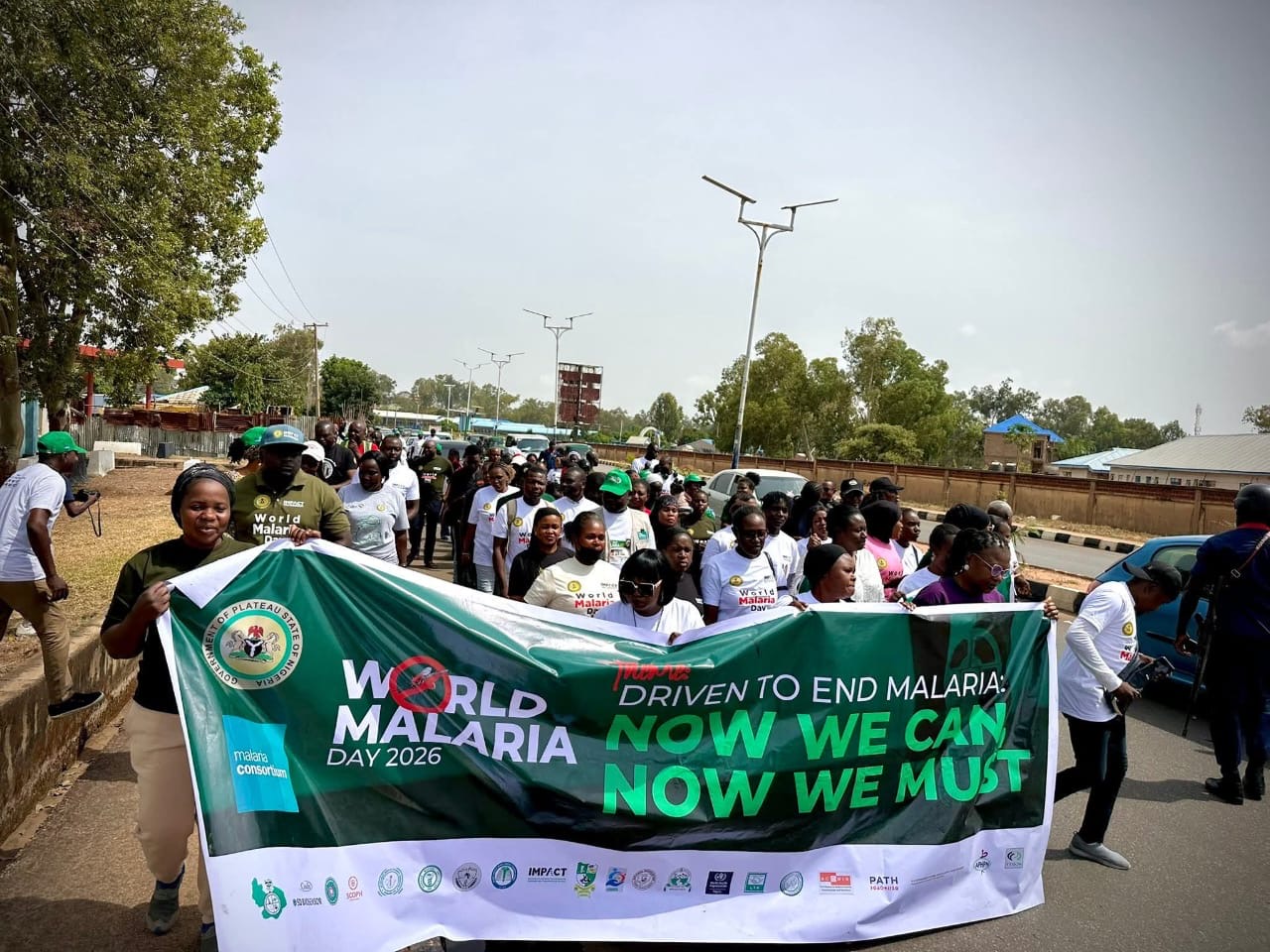
The Plateau State Government, in collaboration with the Plateau State Malaria Elimination Programme (SMEP), development partners, and key stakeholders, on Saturday marked the 2026 World Malaria Day with a renewed call for sustained action to eliminate malaria across the state and Nigeria.
The event, held at Crystal Hall, Crispan Suites in Jos, carried the theme “Driven to End Malaria: Now We Can. Now We Must,” alongside the slogan “Let’s Do It.” Activities commenced with a sensitization health walk from Air Force Roundabout to the venue, aimed at raising awareness on malaria prevention.
The commemoration attracted a wide range of participants, including healthcare workers, students of health institutions, SMEP officials, development partners, and representatives of the Plateau State Ministry of Health.
Representing the Deputy Governor, Ngo Josephine Piyo, Dr. Benjamin Garkuwa Sumi described the occasion as a moment to reflect on progress made and reinforce commitment to ending malaria, which remains a major public health concern in Nigeria.
He noted that Nigeria accounts for nearly a quarter of global malaria cases and deaths, with an estimated nine to ten fatalities recorded every hour. Despite this, he highlighted significant progress, revealing that malaria prevalence in Plateau State dropped from 18.8% in 2021 to 2.8% in 2025.

Dr. Sumi attributed the achievement to coordinated efforts by the State Ministry of Health, SMEP, and development partners. He also pointed to key milestones, including over 100% coverage during the 2024 and 2025 Seasonal Malaria Chemoprevention campaigns and a 96% success rate in the 2024 distribution of insecticide-treated nets. He added that malaria testing kits and treatment drugs are now available in over 400 health facilities across the state.
He urged residents to adopt preventive measures such as consistent use of treated mosquito nets, maintaining clean environments, early testing, and proper antenatal care.
In his remarks, the Commissioner for Health, Dr. Nicholas Baamlong, commended stakeholders for their contributions and stressed the importance of environmental sanitation in eliminating mosquito breeding sites. He expressed confidence that sustained efforts could lead to near-zero malaria prevalence in Plateau State.

Also speaking, the Programme Manager of SMEP, Nurse Kisito Ndak, described the celebration as both a milestone and a platform to assess progress and plan ahead. He credited the decline in malaria cases to interventions by partners, including the Malaria Consortium, alongside increased public awareness through media and community outreach.
In a keynote address, Dr. Elijah Otopka emphasized that malaria remains one of the deadliest mosquito-borne diseases globally, with Africa accounting for about 95% of deaths. He noted that Plateau State’s progress demonstrates the effectiveness of interventions such as treated nets, seasonal prevention, rapid testing, and improved treatment services.
He called for increased funding, stronger health systems, and continued collaboration, stressing that the tools and knowledge needed to eliminate malaria are already available.

Delivering a goodwill message on behalf of the Malaria Consortium, Dr. Mbwas Mashor highlighted that over one million children in Plateau benefit annually from preventive malaria treatment under the SMC programme. He urged sustained investment and data-driven strategies to prevent a resurgence.
Similarly, a representative of the World Health Organization, Muoghah Abere Favour, reaffirmed support for Plateau State and Nigeria, emphasizing prevention through treated nets, timely treatment, and improved environmental hygiene.

Stakeholders at the event agreed that while significant progress has been made, continued collaboration and public participation are essential to achieving a malaria-free Plateau State and Nigeria.

The Taraba State Police Command has confirmed an attack on Binnari community in Karim-Lamido Local Government Area of the state.
It said 10 people were killed by unknown gunmen.
The attack reportedly occurred in the early hours of Friday in Amar Ward, Karim II Constituency.
Police Public Relations Officer, PPRO, Victor Mshelizah, confirmed the incident to DAILY POST, stating that security personnel had been deployed to the area.
“There was an incident that happened yesterday, an attack by unknown gunmen that claimed the lives of ten people.
"We currently have men deployed there,” Mshelizah said.
The police, however, did not provide further details about the circumstances surrounding the attack.
Local sources said the assailants, suspected to have crossed from neighbouring Plateau State, stormed the community unexpectedly, killing residents, setting houses ablaze and destroying foodstuffs reportedly worth millions of naira.
The attack was said to have forced several residents to flee their homes and seek refuge in neighbouring communities, while some people were reportedly missing.
Residents also alleged that distress calls were made during the attack but that security assistance arrived too late to prevent the killings and destruction.
The incident has heightened concerns over the security situation in Karim-Lamido, with residents calling on the Taraba State government and relevant security agencies to take urgent measures to prevent further attacks.
News
Flamingos Have To Keep Fighting Because We Are Not There Yet; Team Captain Azeezat Oduntan Acknowledges

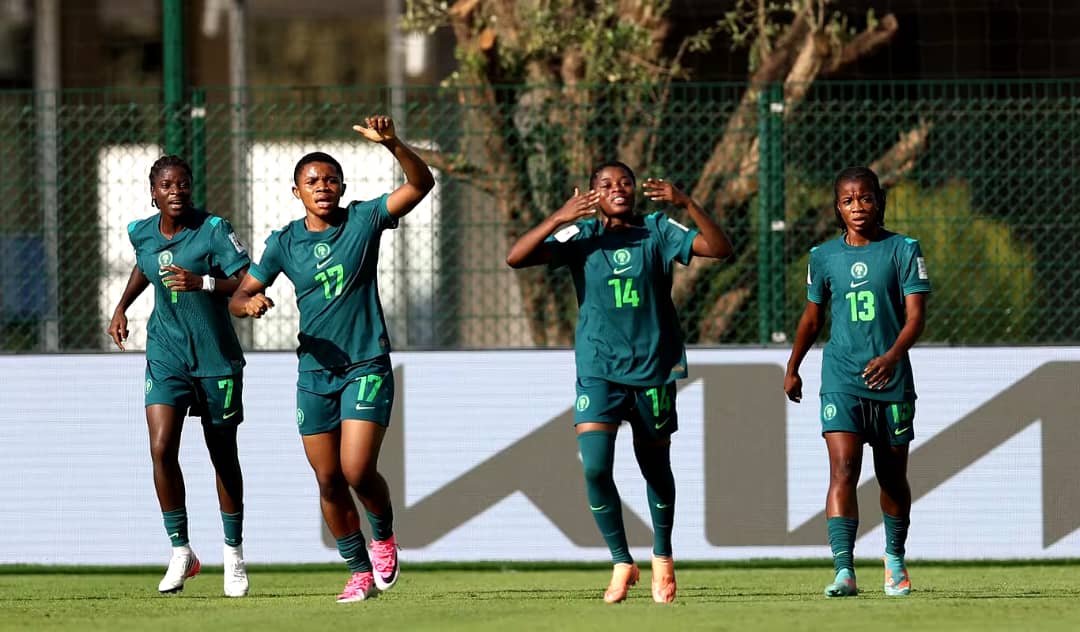
In the wake of a shock 3-1 win for Nigeria’s cadet female national team, Flamingos, over back-to-back champions, Korea DPR, at the ongoing FIFA U17 Women’s World Cup, captain of the side, Azeezat Oduntan, said they can’t relax just yet.
Sports247 reports that, rather than keep on celebrating the win that took them into the competition’s knockout stage as runners-up in their group, Sanusi said they ‘have to keep fighting’ because they ‘are not there yet.’
That surely is a reference to their first knockout fixture at the ongoing competition in Morocco, where Coach Akeem Busari’s team is now a squad to be wary of, as they edged on goal difference ahead of Poland, who defeated Nigeria 2-1 in their opening match.
While Poland eventually finished with no goal difference (following a 6-1 loss to Korea and a 6-2 win over Puerto Rico on Friday), Nigeria jumped into second spot with a plus-three goal difference (2-0 over Puerto Rico and 3-1 versus Korea).
However, while relishing how they made huge history on Friday night in Rabat, Oduntan admitted they just have to keep working hard, even as they seek to surpass the Flamingos’ set of 2022 that won bronze in India.
Expectations of a repeat now look quite realistic following Friday’s stunning win, which fifa.com captured in graphic style, while noting that Busari’s side sent a shortwave through the entire competition with their victory.
The report noted, “Nigeria pulled off a win for the ages by downing two-time defending champions DPR Korea. They opened the scoring through Oluwakemi Adegbuyi, who collected a ball down the left, muscled off a defender and finished with her right foot.
“The African side wanted more and struck for a second shortly before intermission when Oluebube Umejiaku surged through the DPR Korea half and finished past goalkeeper Kim Son-gyong.
“DPR Korea came out with a sense of urgency to start the second half, but Nigeria did well to withstand the pressure and then found a crippling third via Kanyinsola Yusuf’s exquisitely-taken free-kick. The reigning champions pulled a goal back through a late Yu Jong-hyang penalty conversion, but the day belonged to Nigeria.”
Oduntan said afterwards: “I’m super proud of my team-mates because they all came out and chose to play. We have to keep going and keep fighting. I feel excited but we are not there yet because we just qualified for the next round.”
Sports247 gathered further that Adegbuyi again slotted the ball inside Korea’s net in the 88th minute, but VAR ruled it out and, at the end of all the night of thrills, Kanyinsola Yusuf emerged as player of the match.
-

 News1 day ago
Obi, Kwankwaso to hold Middle Belt Youth, Village Hall Meeting in Jos
-
News4 days ago
Meta’s Muse hits 10M U.S. downloads in 40 days, a milestone reached by only 11 other apps
-
Business3 days ago
How Your Side Hustle Income Ends Up in Your RSA
-
News3 days ago
Blacksmith hits unicorn valuation after Sequoia leads Series C