Business
TMDK Group celebrates 25th anniversary, vows to continue building Nigeria’s Energy, agro-industrial future

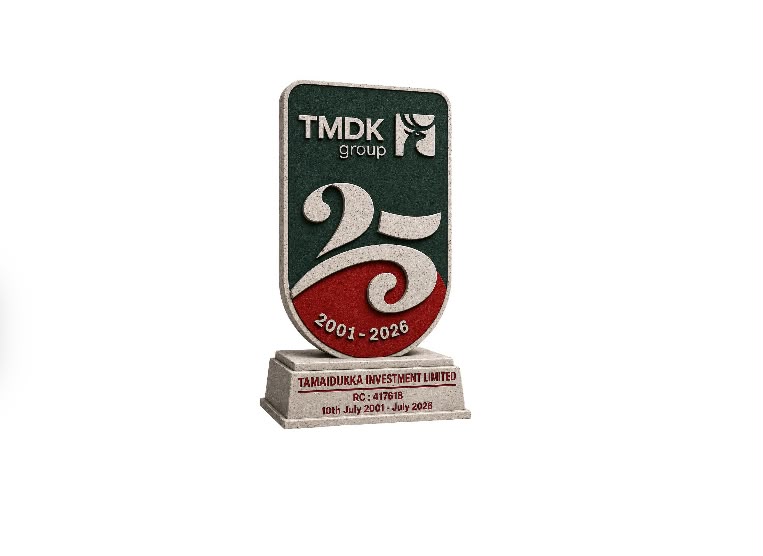

Diversified Nigerian conglomerate, TMDK Group, has marked its 25th anniversary with a renewed commitment to expanding investments in Nigeria’s energy, agriculture, manufacturing and industrial sectors.
The silver jubilee celebration brought together employees, business associates, customers, partners, financial institutions and other stakeholders who joined the Group in reflecting on its journey and celebrating a quarter-century of enterprise, resilience and investment.
Founded 25 years ago by Alhaji Amadu Sule Leda, TMDK Group has evolved from a small real estate investment company into a diversified investment group with significant interests spanning downstream petroleum, petroleum infrastructure, logistics, agro-processing and manufacturing.
The milestone, according to the company, represents not only an opportunity to celebrate its achievements but also a platform to reaffirm its commitment to investing in sectors capable of strengthening Nigeria’s productive capacity, creating employment and supporting sustainable economic development.
Speaking at the anniversary celebration, Suhailu Ismaila, Acting Managing Director of TMDK Agro Park, described the Group’s 25-year journey as one defined by resilience, strategic investment and an enduring commitment to Nigeria.

He said the company’s next phase would build on the foundation established over the past two and a half decades by pursuing investments that create long-term economic value.
“Twenty-five years is a significant milestone. It reflects years of resilience, strategic investments and commitment to national development. We are celebrating what has been achieved, but we are equally focused on what lies ahead,” he said.

Expanding Nigeria’s Energy Infrastructure
Over the past 25 years, TMDK says it has established a growing presence in Nigeria’s downstream petroleum industry through investments in petroleum storage, distribution and logistics infrastructure.
The Group’s petroleum operations are focused on strengthening the supply chain and improving the availability and efficient distribution of refined petroleum products to industrial and commercial customers.
Through its investments in storage and logistics infrastructure, TMDK has continued to contribute to the development of Nigeria’s downstream petroleum value chain at a time when efficient storage, transportation and product distribution remain critical to the country’s energy security.
The company said it intends to deepen these investments as part of its broader strategy to support Nigeria’s evolving energy needs and strengthen the resilience of the downstream petroleum supply chain.
From Agriculture to Agro-Industrial Processing
TMDK’s diversification into agriculture has also become a major component of its growth strategy.
At the TMDK Agro Park in Kaduna State, the company is developing an integrated agro-industrial food-processing platform designed to serve both human and animal consumption, while connecting agricultural production with large-scale industrial processing and value addition.
The facility processes maize, soybeans and other agricultural commodities into a range of products, including corn flour, corn grits, edible vegetable oil and animal feed. The company is also developing capacity for the production of pasta and noodles.
David Onabajo, Chief Operating Officer of the Agro Park, said the integrated nature of the facility was designed to create stronger links between farmers, processors and consumers.
According to him, the objective is to move beyond the production and sale of raw agricultural commodities by creating additional value within Nigeria.
“The Agro Park is designed to strengthen local value addition, provide reliable markets for farmers and contribute to Nigeria’s food security by reducing dependence on imported food products,” he said.
The investment is expected to support farmers by creating more reliable off-take opportunities while strengthening domestic processing capacity and expanding employment opportunities across the agricultural value chain.
Investment, Employment and Local Value Creation
The company said its diversification strategy is driven by the belief that sustainable economic growth requires investment in productive sectors capable of generating employment and creating value locally.
The Group’s operations now bring together different elements of the economy, including energy infrastructure, logistics, agriculture and industrial processing.
The anniversary therefore marks a transition from the company’s first 25 years of establishment and consolidation into what management describes as a new phase focused on expansion, innovation and deeper investment.
The Group expressed appreciation to its employees, customers, business partners, financial institutions, regulators and host communities for their contributions to its development.
Tamwakat Barde, Human Resource Manager, said TMDK would continue to prioritise responsible business practices, innovation, operational excellence and employee welfare.
She said the company recognises that its people remain central to its ability to achieve its long-term objectives.

Recognising Employees
The anniversary also provided an opportunity for TMDK to recognise employees whose contributions have supported the company’s growth.
Bilkisu Suleiman, an employee of the Group, recalled receiving the Chairman’s Award Silver Category after joining the company in January 2025.
“I started working with TMDK in January 2025, and by December 2025, I was awarded the Chairman’s Award Silver Category. This award gave me great joy because it meant the time and effort I put into the growth of the company was seen and acknowledged,” she said.
She urged management to sustain initiatives that recognise and reward employees who demonstrate commitment and excellence.
The company said employee welfare and recognition would remain important components of its corporate culture as it enters its next phase of growth.
Giving Back to Host Communities
Beyond its commercial activities, TMDK said it remains committed to supporting communities connected to its operations.
Abba Aminu, Site Operations Manager at the Agro Park, commended the management for its contributions to society through donations and the provision of food supplies during important festive periods, including Sallah, Christmas and New Year celebrations.
He said such initiatives demonstrated the company’s recognition of its responsibilities to the communities in which it operates.
READ ALSO: In Kaduna, TMDK Group is strengthening Nigerias energy, food security
Looking Ahead
The 25th anniversary comes at a critical period for Nigeria, as the country seeks to attract greater private-sector investment into energy, agriculture, manufacturing and other productive sectors to accelerate economic diversification and improve national productivity.
For TMDK Group, the anniversary is therefore both a celebration of the past and a statement of intent for the future.
The Group said it plans to build on its existing investments by pursuing projects capable of improving energy infrastructure, expanding agro-industrial processing, creating jobs and strengthening domestic value chains.
For Alhaji Amadu Sule Leda, the founder of the Group, the next chapter is anchored on a continuing belief in Nigeria’s potential and the capacity of Nigerian businesses to build globally competitive enterprises from within the country.
Onabajo described the founder as a businessman whose vision continues to shape the Group’s direction.
“Our CEO is a visionary who believes in Nigeria. He is a resilient Nigerian patriot who believes in the Nigerian enterprise,” he said.
As TMDK Group begins its next 25 years, the company says its ambition remains firmly rooted in investment, enterprise and national development — with a strategy centred on building productive assets, creating employment and contributing to the transformation of Nigeria’s energy and agro-industrial landscape.
Discover more from Premium Times Nigeria
Subscribe to get the latest posts sent to your email.

The Federal Airports Authority of Nigeria (FAAN) has begun earning revenue from the Murtala Muhammed Airport Terminal Two (MMA2) in Lagos following a settlement between the Federal Government and Bi-Courtney Aviation Services Limited over a dispute that lasted nearly two decades.
The Minister of Aviation and Aerospace Development, Festus Keyamo, disclosed this on Tuesday during the formalisation of the settlement involving the Federal Government, FAAN, Bi-Courtney and Stabilini Visinoni Limited.
“FAAN had not earned a kobo from MMA2 for the last 20 years because of disputes. Today, FAAN begins to earn its money from MMA2,” Mr Keyamo said.
The agreement provides for the resumption of concession fee payments to FAAN and the reciprocal waiver of specified historical financial and other claims by the parties.
Mr Keyamo said the Federal Executive Council (FEC) approved the framework for the negotiated settlement on 30 April 2026, following discussions aimed at resolving the long-running dispute.
What the settlement changes
Under the revised agreement, Bi-Courtney has agreed to waive its outstanding claims against the Federal Government, while the government and FAAN will relinquish specified historical claims against the concessionaire, including accumulated concession fees and related payments arising before the agreement.

The minister said the arrangement was intended to resolve past disagreements and establish clearer contractual obligations for the parties going forward.
The settlement also addresses a dispute over the General Aviation Terminal (GAT), commonly known as the Old Domestic Airport.
According to Mr Keyamo, the revised agreement recognises the terminal as the property of the Federal Government, to be operated by FAAN.
The minister said the government had agreed to allow Bi-Courtney to expand its apron and accommodate regional flights within Africa at MMA2, subject to the terminal’s capacity.
The agreement also restores rights and provides for separate lease arrangements covering a four-star hotel and conference centre near the airport. The facilities have remained unfinished for years.
Mr Keyamo said the government would retain regulatory oversight over security, access, emergencies and maintenance standards, while the parties would work together to implement the revised arrangements.
Background to the dispute
In April, PREMIUM TIMES had reported that the Federal Government had reached a settlement with Bi-Courtney to resolve the long-running dispute over MMA2 after years of litigation and disagreements over the airport concession.
Mr Keyamo at the time said the Federal Executive Council (FEC) had approved the negotiated settlement, which included concessions by both parties, revised operational arrangements and plans to restore government revenue from the terminal.
The dispute originated from a concession agreement signed on 24 April 2003 involving the Federal Government, Bi-Courtney and Stabilini Visinoni Limited for the design, construction, operation and eventual transfer of the domestic terminal.
The agreement initially covered 12 years from 7 May 2007 but was subsequently extended to 36 years.
Disagreements over contractual obligations, financial claims and the scope of the concession led to multiple court cases across successive administrations.
Bi-Courtney maintained that it had been denied benefits under the concession, while FAAN asserted its own financial entitlements and responsibility to protect public airport assets.
READ ALSO: FAAN steps up airport surveillance as Nigeria confirms Ebola case in Abuja
The dispute also involved the ownership of the General Aviation Terminal and financial claims connected to the Asset Management Corporation of Nigeria.
Mr Keyamo said the latest settlement followed negotiations between the government and the chairman of the Bi-Courtney Group, Wale Babalakin, with legal, commercial and technical teams involved in the process.
He added that the agreement would give Bi-Courtney greater certainty to invest in the terminal while allowing the government to resume revenue collection and plan airport development under the revised framework.
He urged FAAN and Bi-Courtney to ensure that the settlement resulted in completed facilities, reliable services and improved airport operations.
“The travelling public should see the result in functioning facilities and dependable service. That is how the value of this settlement will be measured,” he said.
Discover more from Premium Times Nigeria
Subscribe to get the latest posts sent to your email.
-

 News3 days ago
Euromatch NPFL: Matchday 9 results
-
News4 days ago
NUCAP: Nigeria targets 20 million people with 3,700 telecom towers – Technology Times
-
News3 days ago
Meta removes language that raised scraping and AI training concerns
-
News3 days ago
No agenda, no rush, no leaving San Francisco: Benchmark’s partners on investing in a frenzied market