Connect with us

News

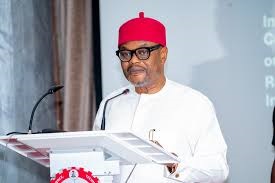
ICPC Launches Manhunt for Ex-Minister Uche Nnaji Over Alleged Certificate Forgery

info

Published

on

Uche Nnaji

The Independent Corrupt Practices and Other Related Offences Commission (ICPC) has reportedly intensified efforts to locate and interrogate former Minister of Innovation, Science and Technology, Uche Nnaji, over allegations of certificate forgery.

According to sources familiar with the investigation, the anti-graft agency has been probing claims that Nnaji submitted falsified academic and National Youth Service Corps (NYSC) certificates during his ministerial screening in 2023.

The investigation, which reportedly stems from a two-year inquiry, alleges that the former minister presented a forged University of Nigeria, Nsukka (UNN) degree certificate and an NYSC discharge certificate to the presidency and the Senate during his confirmation process.

ICPC insiders say the commission has now escalated its search after multiple attempts to invite Nnaji for questioning were allegedly ignored. The invitations were reportedly sent through phone calls, email, and messaging platforms.

One source said the commission is considering declaring him wanted if he continues to evade questioning.

Investigators also claim that the University of Nigeria, Nsukka, responded to official inquiries confirming that while Nnaji was admitted in 1981, he did not graduate and was not issued a degree certificate. The NYSC is also said to have disowned the discharge certificate in question.

The case gained public attention following reports that triggered his resignation from office after the allegations became public. Calls have since intensified for his prosecution over alleged violations of Nigerian criminal laws relating to forgery and false representation.

Nnaji’s spokesperson has not responded to repeated requests for comment on the latest development.

The ICPC says investigations are ongoing as it continues efforts to establish the full circumstances surrounding the allegations.

Continue Reading
Click to comment

Leave a Reply

Your email address will not be published. Required fields are marked *

News

Honest Ahanor’s Move To Crystal Palace, On Loan From Chelsea, Raises Eyebrows In Italy

info

Published

on

By

735ced9b 812c 4468 81f9 3e9ab8de1163.jpeg

A lot of eyebrows are already rising high in Italy, following the exit of Nigerian-born defender, Honest Ahanor from Atalanta to Chelsea of England, who immediately loaned him to their fellow-London-based English Premier League rivals, Crystal Palace.
Sports247 reports that, while the move is being celebrated as a personal achievement for Ahanor, critics of Italian football have rated it yet another setback for their country’s dwindling fortunes, as highlighted in three straight FIFA World Cup misses.
Ahanor joins two other Nigerian-born players of Italian origin – Destiny Udogie at Tottenham Hotspur and Michael Kayode at Brentford – in the EPL, but his exit after just one season at Atalanta has left Italian football buffs raising dust about a mass exodus of talent.
Growing apprehension in Italy about exits of their most promising talentts, both native born and many of other ancentral oigins, has been highlighted by an erudite writer, Antonio Moschella, who noted that the lure of pounds in England has become too tempting to ignore.
Moschella opined further in an article via Tribal Football, “Some players seem destined for the Premier League. That’s the case for Ahanor, whose name is English and whose Nigerian family has historical ties to Britain, due to longstanding colonial connections.
“The move of the 2008-born player from Atalanta to Chelsea, however, is just the latest confirmation of a trend that resembles a diaspora of young Italian talents. In fact, the defender is set to become the 13th Italian player in the Premier League.
“In the 2026/27 Premier League season, there are already 12 Italian players, including the new summer arrivals. Italians who will take the field in England this year are Donnarumma, Calafiori, Savona, Chiesa, Tonali, Udogie, Kayode, Gnonto, Palestra, Ruggeri, Di Gregorio and Leoni.
“It’s clear that the prevailing trend is now to leave the Mediterranean and cross the Channel. This trend, a sad reflection of Serie A and its domestic product as a whole, is mainly due to the extremely high salaries offered by Premier League clubs. But that’s not the only reason.
“The appeal of the Premier League, which for at least a decade has been the most exciting in terms of style and intensity, is undeniable. Ahanor’s move from the relatively provincial reality of Bergamo to a London that pulls the strings of European football is certainly a sign of growth.”
On the other hand, The Eagles are celebrating, as a post on their X handle @PalaceReport read: “Crystal Palace agree deal to sign Honest Ahanor on loan from Chelsea, the eagle has landed. Verbal agreement done as Honest Ahanor joins Chelsea from Atalanta for £40m and then joins Palace on loan.”

Continue Reading

Business

Nigeria’s economy grows 4.43% in Q2 2026 — NBS

info

Published

on

By

National Bureau of Statistics.jpg

MTN ADVERT

Nigeria’s economy grew by 4.43 per cent year-on-year in real terms in the second quarter of 2026, according to the National Bureau of Statistics (NBS).

The latest growth rate is higher than the 4.23 per cent recorded in the corresponding quarter of 2025 and represents an improvement from the 3.89 per cent recorded in the first quarter of 2026.

The NBS disclosed this in its Gross Domestic Product Report for the second quarter of 2026, released on Monday.

The latest figure indicates that economic activity continued to expand during the quarter, extending a gradual recovery recorded over the past year.

Nigeria’s economy grew by 3.87 per cent in real terms in 2025, compared with 3.38 per cent in 2024, according to the NBS data.

PT WHATSAPP CHANNEL

The latest quarterly performance was also the strongest growth recorded since the third quarter of 2024, when the economy expanded by 3.86 per cent, based on the NBS quarterly series.

In nominal terms, the country’s GDP stood at ₦119.29 trillion in the second quarter of 2026, while real GDP was estimated at ₦53.47 trillion.

The improvement came as both the oil and non-oil sectors recorded stronger growth compared with the preceding quarter, although the contribution of the non-oil economy remained overwhelmingly dominant.

Services remain dominant

The services sector remained the largest contributor to Nigeria’s real GDP during the quarter, accounting for 56.62 per cent of total output.

It also recorded real growth of 4.60 per cent, up from 3.94 per cent in the corresponding quarter of 2025.

Agriculture contributed 26.15 per cent to real GDP and grew by 4.39 per cent, a significant improvement from the 2.82 per cent recorded in the second quarter of 2025.

The improvement in agriculture is notable, as the sector remains an important source of employment and income for millions of Nigerians, even as farmers continue to contend with insecurity, high input costs, climate-related pressures, and infrastructure constraints.

The industrial sector, however, recorded slower growth.

Industry grew by 3.96 per cent in the second quarter, compared with 7.46 per cent in the corresponding period of 2025. It accounted for 17.23 per cent of real GDP during the quarter.

The slowdown means that the stronger headline GDP figure was not reflected uniformly across all major sectors of the economy.

Oil production rises

Meanwhile, the oil sector recorded a stronger performance during the quarter, aided by higher crude oil production.

Nigeria’s average daily oil production rose to 1.72 million barrels per day (bpd) in the second quarter, from 1.55 million bpd in the first quarter of 2026.

Production was also higher than the 1.68 million bpd recorded in the second quarter of 2025.

The increase in production coincided with stronger growth in the oil sector.

The sector grew by 7.31 per cent year-on-year in real terms, compared with 2.57 per cent in the first quarter of 2026. On a quarter-on-quarter basis, oil-sector growth stood at 10.91 per cent.

Despite the improvement, oil remained a relatively small part of Nigeria’s overall economic output.

The sector contributed 4.16 per cent to real GDP in the second quarter, up from 4.05 per cent in the corresponding quarter of 2025 and 3.92 per cent in the first quarter of 2026.

By contrast, the non-oil sector accounted for 95.84 per cent of real GDP.

The non-oil sector grew by 4.31 per cent in real terms during the quarter, compared with 3.64 per cent in the second quarter of 2025 and 3.94 per cent in the first quarter of 2026.

According to the NBS, agriculture, information and communication, real estate, trade, financial and insurance services, manufacturing and construction were among the activities that supported non-oil growth during the quarter.

Growth improves but remains moderate

The latest GDP figures suggest that Nigeria’s economy is gaining momentum, but the pace of expansion remains moderate relative to the country’s development needs.

President Bola Tinubu’s administration has repeatedly set a target of achieving 7 per cent annual economic growth by 2027. The 4.43 per cent quarterly growth, therefore, remains below the pace required to reach that broader target if sustained annual growth is the benchmark.

The economy has nevertheless recorded a gradual improvement since the contraction and weak growth rates that characterised earlier years.

The annual growth rate rose from 0.95 per cent in 2021 to 4.32 per cent in 2022, before moderating to 3.04 per cent in 2023. It then increased to 3.38 per cent in 2024 and 3.87 per cent in 2025, according to the NBS data.

The latest figures, therefore, point to a continued, although still gradual, strengthening of economic activity.

READ ALSO: Three-year scorecard of the Federal Ministry of Marine and Blue Economy

However, stronger GDP growth does not necessarily mean that households are immediately experiencing improved living standards.

GDP measures the value of goods and services produced in the economy and does not, on its own, show how income is distributed or whether households can afford basic goods and services.

For Nigerians, the impact of the latest expansion will ultimately depend on whether stronger economic activity translates into more jobs, higher incomes, increased investment and lower production and living costs.

The continued dominance of services and the improved performance of agriculture also highlight the growing importance of the non-oil economy to Nigeria’s growth story.

At the same time, the slowdown in industrial growth shows that challenges related to electricity, financing, infrastructure, logistics, and production costs continue to weigh on the productive sectors.

The latest NBS figures provide further evidence that the Nigerian economy is expanding faster than a year ago.

The bigger test, however, will be whether that growth can be sustained and broadened across productive sectors and translate into tangible improvements in Nigerians’ economic well-being.


Discover more from Premium Times Nigeria

Subscribe to get the latest posts sent to your email.

Continue Reading

Trending