News
CDS Unveils Operation Enduring Peace, Replaces Operation Safe Haven in Plateau

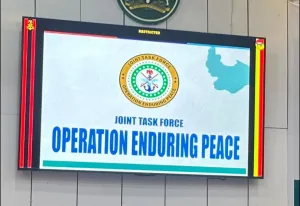
The Chief of Defence Staff (CDS), General Christopher Gwabin Musa, on Friday officially launched Operation Enduring Peace as the new identity of the Joint Task Force in Plateau State, bringing to a close the long-running Operation Safe Haven.
The unveiling took place at the Nigerian Army’s 3 Division Headquarters in Jos, where General Musa described the change as a strategic shift aimed at strengthening military effectiveness and restoring lasting peace across Plateau and adjoining states of Kaduna, Benue, and Nasarawa.
“Today, we gather to mark a significant and strategic transition in our ongoing commitment towards restoring sustainable peace, security, and stability,” Musa declared. “It is with great honour that I formally deactivate Operation Safe Haven and operationalize its successor: Operation Enduring Peace.”

He acknowledged the successes of Operation Safe Haven in addressing communal conflicts, banditry, and stabilizing communities but noted that it was often constrained by structural and operational challenges. The new operation, he said, will emphasize intelligence-driven interventions, enhanced inter-agency collaboration, improved logistics, and stronger community engagement.
“This rebranding is not cosmetic,” he stressed. “It reflects a broader mandate and a stronger resolve to secure not just temporary safety, but a lasting peace that will endure for generations.”
The CDS explained that Operation Enduring Peace will adopt a “whole-of-society” approach, calling on political leaders, traditional rulers, religious figures, and local communities to partner with the military. He also announced the deployment of additional personnel and equipment, alongside welfare initiatives for troops in the field.
General Musa expressed gratitude to President Bola Ahmed Tinubu, the Ministers of Defence, the National Security Adviser, and the people of Plateau for their support, charging troops to embrace the new mission with renewed pride and discipline.
In his remarks, the General Officer Commanding (GOC) 3 Division and Commander of Operation Enduring Peace, Major General EF Oyinlola, described the rebranding as a “strategic realignment” to make security responses more proactive and effective. “Our goal is clear: to consolidate the gains of the past, close existing gaps, and establish a sustainable framework for peace that will endure well into the future,” he stated, urging communities and civil society to strengthen their partnerships with the military.

The event also featured the hoisting of the new operational flag, commissioning of newly acquired assets—including armored personnel carriers, tanks, and motorbikes—and a charge to freshly deployed troops.
The ceremony formally closed the chapter of Operation Safe Haven, which had been active in Plateau and neighbouring states for years, and ushered in Operation Enduring Peace, which security agencies say represents a renewed commitment to achieving lasting stability in the region.





The Nigeria Police Force has confirmed the arrest of a 22-year-old man, Umar Ibrahim Gandi Maradun, over a viral video allegedly showing him calling for the use of AK-47 rifles to kill Christians in Enugu and Plateau states.
Politics Nigeria reports that the suspect, a native of Maradun Local Government Area of Zamfara State, was arrested for investigation after the video circulated on social media and sparked concerns over religiously motivated violence.
In a statement issued on Tuesday, October 27, 2026, the Force Public Relations Officer, Chief Superintendent of Police (CSP) Ani Iniedu, said the Zamfara State Police Command had activated its intelligence resources to identify those involved in the incident.
The police also confirmed that the command had engaged the leadership of Jama’atu Izalatil Bidi’a Wa’ikamatus Sunnah (JIBWIS) at the national and state levels following the emergence of the video.
According to the police, the organisation disassociated itself from the alleged conduct and handed the suspect over to the authorities for investigation.
The video reportedly showed the suspect wearing JIBWIS uniform and appearing alongside pupils from two Islamic schools in Maradun: Nurul Islam Islamiya and Akidatul Sahiha Islamiya.
Preliminary findings by the Zamfara State Police Command indicated that the video was recorded on Friday, October 23, 2026, while the suspect was reportedly on his way to Aliyu Ibn Abi Thalib Mosque, where he and others allegedly provided security during Friday prayers and preaching.
The suspect was born on September 15, 2004. He reportedly attended Mualledi Model Primary School and Government Day Secondary School, both in Maradun.
He also reportedly joined JIBWIS in 2025 and recently gained admission to study Mass Communication at Zamfara State University, Talata Mafara.
The police said a comprehensive investigation had commenced and that the suspect would be charged before a competent court if sufficient evidence established an offence under applicable law.
Earlier, the Zamfara State Commissioner of Police, Bello, said the investigation would consider allegations of incitement to violence, disturbance of public peace and criminal intimidation under Sections 77, 78 and 380(b) of the Penal Code Law applicable in the state, subject to the evidence gathered and applicable law.
The police also condemned statements capable of promoting religious hatred, threatening community safety or undermining peaceful coexistence.
“The Zamfara State Police Command remains resolute in its duty to uphold the law, protect lives and property, defend the rights of all citizens without discrimination, and work with relevant stakeholders to sustain peace and security throughout Zamfara State,” the commissioner said.
The development comes as JIBWIS has publicly distanced itself from the video and condemned calls for violence against non-Muslims.
The group’s National Publicity Secretary, Sheikh Ahmad Muhammad Ashiru, stated this in a statement issued at its headquarters in Jos on Tuesday.
Ashiru said the organisation had yet to establish the authenticity of the video but maintained that its position against violence was clear.
“We are yet to confirm whether the video is authentic, but our position against violence remains clear,” he said.
He added that JIBWIS, under the leadership of Ash-Sheikh Muhammad Sani Yahaya Jingir, would not support calls to attack or kill anyone because of their religious affiliation.
Ashiru said banditry, kidnapping, armed robbery and Boko Haram attacks were already affecting communities across the country, warning that statements promoting violence could heighten tensions and threaten peaceful coexistence.
“We would not support any call capable of disturbing the peace of Nigeria, as such comments are capable of inciting violence and creating unnecessary tension among Nigerians,” he said.

The JIBWIS spokesperson stressed that anyone making such statements in the organisation’s name did not represent its position.
He urged security agencies to investigate the video, establish its authenticity and identify those responsible, adding that anyone found culpable should face the law after a proper investigation.
Meanwhile, the Nigeria Police Force has urged members of the public to remain calm, avoid circulating unverified information and refrain from sharing the video in ways that could escalate religious tensions.
The Force reiterated its commitment to protecting Nigerians irrespective of religious affiliation and taking lawful action against conduct capable of inciting hatred or threatening public peace.

Senator Victor Umeh has accused Anambra State Governor Chukwuma Soludo of acting out of envy and hatred towards presidential candidate of the Nigeria Democratic Congress, NDC, Mr Peter Obi.
Umeh claimed that Soludo was trying to surpass Obi's political record, insisting that the former Anambra governor remained more popular than his successor in the state and across Nigeria.
The senator made the remarks on Tuesday while fielding questions on Channels Television's Politics Today programme.
Umeh, who said he attended the University of Nigeria, Nsukka, UNN, alongside Obi and Soludo between 1980 and 1984, suggested that their shared academic background might have contributed to what he described as peer envy.
He said, “He (Peter Obi) cannot be drawn to what is called the peer envy and hate. You know, all of us were in the university together. Myself, Soludo, Peter Obi. We were at the University of Nigeria from 1980 to 1984, all of us graduated the same day.
“So sometimes when you see people talk, they talk out of maybe peer envy. He (Soludo) is running after Peter Obi's record.”
The senator further argued that Obi remained more popular than Soludo despite the latter's position as governor of Anambra State.
“Whether he likes it or not, today, no matter what Soludo does, Peter Obi will continue to be more popular than him, both in Nigeria and in Anambra State. Go there and see,” Umeh added.
Obi served as governor of Anambra State from 2006 to 2014. Soludo became governor in 2022.
‘Envy, hate behind Soludo’s attacks on Peter Obi’ – Senator Umeh
-

 News3 days ago
Troops rescued 70 abductees, recovered N10 million ransom: DHQ
-
News3 days ago
Plateau Activates Ebola Preparedness Measures, Urges Residents to Observe Safety Guidelines
-
Business3 days ago
CBN grants JP Morgan approval-in-principle to set up merchant bank
-
Business3 days ago
REA Ends 16 Years of Darkness in Two Kano Communities