Connect with us

News

Operation Enduring Peace Reflects Our Resolve for Sustainable Peace — CDS Musa

editor

Published

on

Enduring Peace in Plateau – CDS

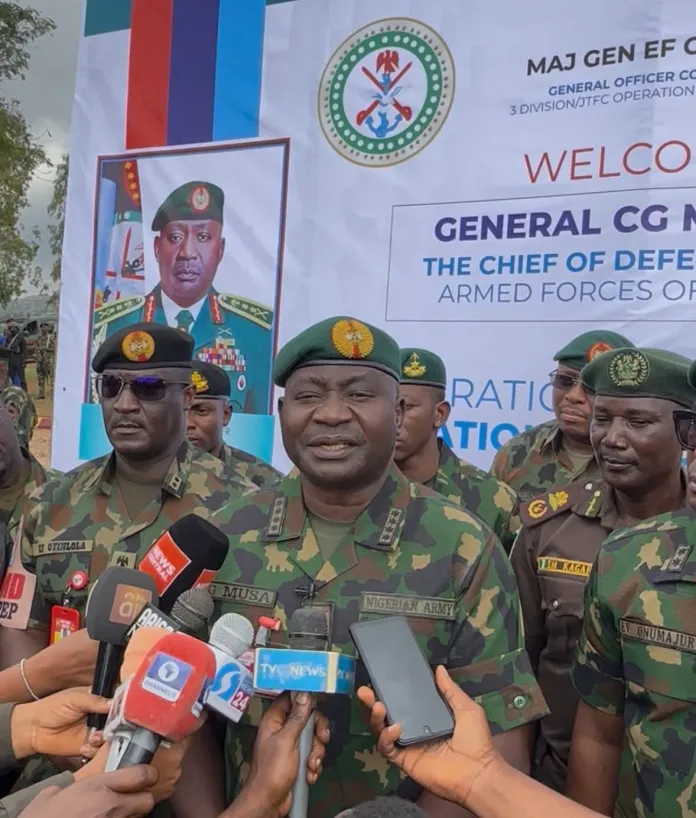
The Chief of Defence Staff (CDS), General Christopher Gwabin Musa, has explained why the Nigerian military deactivated Operation Safe Haven and inaugurated its successor, Operation Enduring Peace, in Plateau and neighbouring states.

Speaking at the rebranding ceremony in Jos on Friday, August 29, 2025, General Musa said the transition was necessary after careful assessments showed that Safe Haven, though impactful, was constrained by operational and structural challenges.

“Over the years, Operation Safe Haven has played a vital role in mitigating communal conflicts, curbing armed banditry, and enhancing civil-military relations,” he noted. “However, limited availability of critical enablers hampered its ability to decisively deter and respond to threats, making it appear more reactive than proactive.”

According to the CDS, the rebranding to Operation Enduring Peace reflects a renewed mandate and stronger resolve to achieve not just temporary security but lasting stability across Plateau, Kaduna, Nasarawa, and Benue States.

“This change is not cosmetic,” Musa stressed. “It underscores our determination to deliver sustainable solutions that integrate military, political, judicial, and community efforts. Enduring Peace will emphasize inter-agency collaboration, intelligence-driven operations, and stronger community engagement.”

He disclosed that the new operation would benefit from additional troop deployment, enhanced logistics, and critical operational assets, backed by welfare initiatives to support personnel in the field. The operation will also deepen coordination with neighbouring missions such as Operation Whirl Stroke for a more comprehensive regional security approach.

General Musa further appealed to political leaders, traditional rulers, religious figures, and community stakeholders to support the Armed Forces in building trust and fostering reconciliation.

“Our commitment is not just to suppress violence temporarily, but to build a secure environment where peace can take root and endure,” he said.

The CDS thanked President Bola Ahmed Tinubu for his support of the Armed Forces, as well as the Minister of Defence, Mohammed Badaru Abubakar, Minister of State for Defence, Dr. Bello Mohammed Matawalle, and the National Security Adviser, Mallam Nuhu Ribadu, for their backing.

He concluded by urging troops to embrace the new identity with “pride, discipline, and renewed vigour,” while calling on communities to partner with the military in transforming conflict-prone areas into “beacons of peace and prosperity.”

With the official deactivation of Operation Safe Haven, Operation Enduring Peace is now fully operational in the North-Central region.

Continue Reading
Click to comment

Leave a Reply

Your email address will not be published. Required fields are marked *

News

NIGERIA HAS LOST ITS WOMEN’S FOOTBALL ADVANTAGE — AND AFRICA IS CATCHING UP FAST

info

Published

on

By

IMG 20260814 WA0000.jpg

For more than three decades, Nigeria’s Super Falcons were the standard of African women’s football.

Ten Women’s Africa Cup of Nations titles. Every FIFA Women’s World Cup from the beginning of the competition. Generations of players who dominated the continent.

Read Also: 14th Women AFCON: Swart’s heroics foil Super Falcons’ search for World Cup ticket

But that era has now reached a disturbing turning point.

For the first time in the history of the FIFA Women’s World Cup, Nigeria will not be at the tournament.

South Africa’s 2–1 victory over the Super Falcons in Casablanca on Thursday ended Nigeria’s final route to the 2027 World Cup.

But perhaps this should not be viewed simply as a failure of the Super Falcons.

Perhaps it is the clearest evidence yet that the rest of Africa has finally caught up.

Look at Malawi.

The Scorchers were appearing at the WAFCON for the first time in 2026. They did not come merely to make up the numbers. They reached the semi-finals and secured Malawi’s historic first-ever Women’s World Cup qualification.

Look at Morocco.

The country has invested heavily in women’s football, and AS FAR has become a continental force, winning the CAF Women’s Champions League in 2025 and earning the right to represent Africa at FIFA’s inaugural Women’s Champions Cup.

Look at South Africa.

Banyana Banyana have transformed themselves from challengers into African champions and have now defeated Nigeria when a World Cup place was on the line.

And across the continent, CAF says women’s football is being strengthened through coaching education, better administration, grassroots development, refereeing and more structured domestic leagues.

This is the part Nigerians must understand.

Africa did not wait for Nigeria to remain dominant.

Other countries started building.

For years, Nigeria had an enormous advantage because many of our best players grew up playing together for long periods, particularly through the domestic system and national-team pathways.

The Super Falcons of previous generations were not simply eleven talented Nigerians assembled for a tournament.

They were products of a football culture that continuously produced players.

Today, that advantage is much smaller.

And there is another uncomfortable reality: Nigerian players are increasingly finding opportunities in women’s leagues outside Nigeria, while African leagues are becoming more organised and competitive.

CAF’s Women’s Champions League has also created a continental platform with meaningful financial rewards; participating clubs received at least $150,000 in the 2024 edition, while the winners received $600,000.

So perhaps the question is no longer:

“Why did the Super Falcons fail?”

The bigger question is:

“Why did Nigeria stop developing faster than the countries chasing us?”

We should support the Falcons.

We should respect the players.

We should recognise their achievements.

But we must also recognise what this moment represents.

Nigeria has won ten WAFCON titles. That history is extraordinary.

But history cannot qualify a team for the next World Cup.

Systems do.

Leagues do.

Academies do.

Coaching structures do.

Investment does.

Player development does.

And if Nigeria does not rebuild those foundations, the Super Falcons’ absence from Brazil may not remain a once-in-history event.

THE SUPER FALCONS HAVE NOT SUDDENLY BECOME A BAD TEAM. AFRICA HAS SIMPLY STOPPED WAITING FOR NIGERIA.

The real alarm is not that Nigeria lost to South Africa.

The real alarm is that the countries Nigeria used to look down on are now building football systems capable of defeating Nigeria when it matters most.

This should not be a blame game.

It should be a wake-up call.

NIGERIA DID NOT LOSE WOMEN’S FOOTBALL IN ONE MATCH. WE MAY HAVE BEEN LOSING THE ADVANTAGE FOR YEARS.

Continue Reading

Business

Sovereign Trust, Guinea Insurance, 5 Others Join Verified List in Final Recapitalization Clearance

info

Published

on

By

BY NKECHI NAECHE-ESEZOBOR—Sovereign Trust Insurance Plc and Guinea Insurance Plc are among seven additional underwriting firms officially cleared and verified by the National Insurance Commission (NAICOM) as compliant with the Minimum Capital Requirements stipulated under the Nigerian Insurance Industry Reform Act (NIIRA) 2025.

This final batch of approvals formally completes the nation’s insurance recapitalization exercise, bringing the total roster of fully capitalized operators in Nigeria to 48 insurance companies and two reinsurance companies.

See details below:

List of Additional Insurance Companies that Complied with the MCR Prescribed by NIIRA 2025

The post Sovereign Trust, Guinea Insurance, 5 Others Join Verified List in Final Recapitalization Clearance appeared first on Business Today NG.

Continue Reading

Trending